Washington, United States — August 20, 2026
Trump Iran Sanctions warnings have intensified as President Donald Trump said the United States has the ability to impose significantly tougher economic measures on Tehran, while also sharply criticizing South Korea for not providing the level of support Washington sought in securing the Strait of Hormuz.
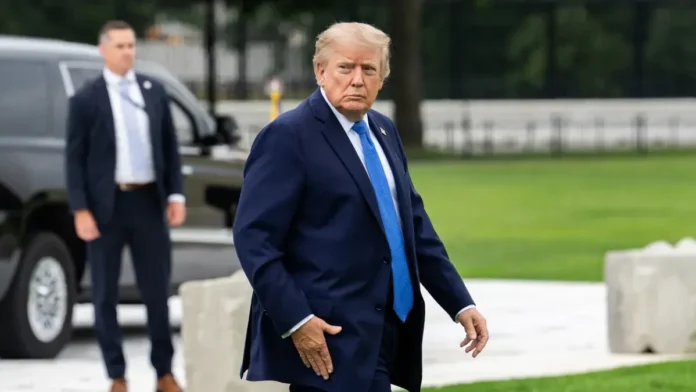
Speaking to reporters at the White House, Trump said his administration still had powerful sanctions tools available if tensions with Iran continued.
“We have measures where we can sanction. We have the ability to put very tough sanctions on,” Trump said, adding that Washington would watch developments before deciding its next move.
His remarks come as the confrontation between the United States and Iran continues to disrupt shipping and energy markets around the Strait of Hormuz. Oil prices have remained elevated amid uncertainty over tanker traffic through the strategically vital waterway. Brent crude recently settled near a four-week high above $91 a barrel as Middle East tensions persisted.
Trump Says US Can Impose Much Tougher Sanctions on Iran
Trump stopped short of announcing a new sanctions package immediately, but his comments indicated that economic pressure remains one of the options under active consideration.
The president has increasingly emphasized economic measures against Tehran as diplomatic efforts struggle to produce a lasting settlement.
The latest warnings follow the expiration of a 60-day framework agreed in June that was intended to give Washington and Tehran time to negotiate a more permanent arrangement. Since then, the two sides have continued to accuse each other of failing to meet commitments.
Trump said the United States would determine its next steps based on Iran’s actions.
That leaves open the possibility of further measures affecting Iranian energy exports, financial transactions or other sectors already subject to extensive U.S. restrictions.
Strait of Hormuz Remains at Center of US-Iran Tensions
The Strait of Hormuz links the Persian Gulf with the Gulf of Oman and the Arabian Sea and remains one of the world’s most important energy shipping chokepoints.
Trump said ships were continuing to transit the strait and argued that reports of a complete shutdown did not reflect the full picture.
However, recent shipping data and regional reports indicate traffic has been significantly disrupted, with tanker movements falling sharply amid attacks and uncertainty over navigation. Iran has also continued to dispute Washington’s characterization of the waterway as fully open.
That disagreement itself has become part of the wider confrontation.
Trump Says Hormuz May Become Less Important
Trump also argued that the Strait of Hormuz may become less strategically important in the future.
He pointed to higher U.S. energy production and the development of alternative supply routes as factors that could gradually reduce dependence on the waterway.
“I think Hormuz is not going to be as important as it used to be,” Trump said.
The argument reflects Trump’s broader emphasis on U.S. energy production and energy independence.
Still, the strait remains critically important today. Before the current conflict, roughly one-fifth of global oil flows passed through the waterway, making even temporary disruptions capable of moving global energy prices sharply.
Trump Turns Anger Toward South Korea
Trump also directed unusually sharp criticism at South Korea.
He said he was unhappy that Seoul had not agreed to provide the level of assistance Washington wanted in efforts related to the Strait of Hormuz.
“I was not happy when South Korea said no, they weren’t interested in helping us in the Strait of Hormuz,” Trump said.
The president argued that South Korea has a major economic stake in keeping the route secure because of its dependence on imported energy.
South Korean officials, however, have said Seoul has been participating in international discussions over freedom of navigation and has been considering practical contributions while taking into account domestic law and security requirements on the Korean Peninsula.
That distinction is important because Seoul has not described its position as opposition to freedom of navigation itself.
South Korea Says It Is Consulting Closely With Washington
South Korean officials have stressed that their government remains in close consultation with Washington.
National Security Adviser Wi Sung-lac said Seoul has participated in international discussions aimed at protecting navigation through the Strait of Hormuz and has been reviewing ways it could contribute without weakening its own defense posture.
South Korea’s caution reflects the country’s unique security environment.
Seoul must simultaneously manage energy risks in the Middle East and the continuing military threat posed by North Korea.
Hormuz Dispute Spills Into US-South Korea Military Alliance
Trump linked his frustration over Hormuz to another sensitive issue: joint U.S.-South Korean military exercises.
Earlier this week, he ordered the Pentagon to substantially reduce U.S. participation in the annual Ulchi Freedom Shield exercises.
The United States and South Korea subsequently agreed to shorten the drills from 11 days to five and reduce the scale of some field training.
Trump has long criticized the cost of large-scale military exercises on the Korean Peninsula and has argued that they can undermine efforts to engage North Korean leader Kim Jong Un.
This time, however, the decision also appears tied to his broader dissatisfaction with Seoul over Iran and other alliance issues.
South Korea’s foreign minister has publicly said Trump appears to be using the military exercise issue as part of a wider effort to pressure Seoul over Iran and other unresolved matters.
Trump Again Highlights Relationship With Kim Jong Un
Trump also returned to one of the defining themes of his first presidency: his personal relationship with North Korean leader Kim Jong Un.
Asked whether denuclearization remained his objective in any renewed negotiations, Trump declined to give a direct answer.
Instead, he emphasized that he continues to have a good relationship with Kim.
Trump has repeatedly argued that his personal rapport with the North Korean leader reduced the risk of war and made the United States and its Asian allies safer.
He has also signaled that he expects to meet Kim again later this year.
North Korea Talks Could Return to Center Stage
The reduction in U.S.-South Korea military exercises is widely seen as an attempt to create more favorable conditions for renewed diplomacy with Pyongyang.
North Korea has long described the drills as preparations for war.
South Korean President Lee Jae Myung has welcomed the reduction as a possible step toward restarting dialogue, while some security analysts and opposition politicians have warned that smaller exercises could weaken military readiness.
North Korea, meanwhile, has remained publicly skeptical of Washington’s approach even while acknowledging Trump’s personal relationship with Kim.
Why South Korea Matters to the Hormuz Crisis
South Korea is among Asia’s most energy-import-dependent economies.
Any prolonged disruption in the Strait of Hormuz can therefore create direct economic consequences for Seoul through higher oil and gas prices, shipping costs and supply-chain uncertainty.
Trump’s argument is that countries benefiting from U.S.-led security efforts should contribute more directly to protecting the route.
South Korea’s position is more cautious.
Its government has indicated that participation in Middle East security operations must be balanced against legal requirements and the continuing need to deter North Korea.
That difference is now emerging as a broader test of how Trump views U.S. alliances.
Is Trump Linking Alliance Protection to Burden Sharing?
The latest comments reinforce Trump’s long-standing transactional approach to alliances.
He has repeatedly argued that U.S. allies should contribute more financially and militarily to collective security.
In South Korea’s case, Trump has connected several issues that previous U.S. administrations often treated separately:
- defense spending;
- joint military exercises;
- cooperation over Iran;
- Strait of Hormuz security;
- trade and investment commitments; and
- diplomacy with North Korea.
That approach is creating new uncertainty in Seoul over how Washington will manage the alliance.
What Happens Next With Iran?
For Iran, the immediate question is whether Trump follows through with additional economic sanctions.
Washington already maintains extensive restrictions on Tehran, particularly targeting oil exports, banking and companies connected with the Iranian state.
Additional measures could intensify pressure on Iran’s economy but could also complicate efforts to restart diplomacy.
Tehran has warned that it could escalate its posture in and around the Strait of Hormuz if negotiations fail, adding further risk to global shipping.
What Happens Next With South Korea?
The U.S.-South Korea relationship now faces two simultaneous tests.
The first is whether the allies can manage disagreements over Middle East security without damaging their long-standing defense partnership.
The second is whether reduced military exercises help restart talks with North Korea or instead create new concerns about deterrence.
South Korean officials have publicly emphasized that the alliance remains strong, but the unusually direct criticism from Trump shows that tensions between Washington and Seoul are real.
The Bigger Picture
The Trump Iran Sanctions warning is part of a wider foreign-policy strategy in which the president is simultaneously increasing economic pressure on Tehran, demanding more support from U.S. allies and reopening the door to personal diplomacy with Kim Jong Un.
The Strait of Hormuz crisis is therefore no longer only a Middle East issue.
It is increasingly affecting U.S. relationships in Asia as well.
Trump’s frustration with South Korea shows how the Iran confrontation is beginning to spill into alliance management on the Korean Peninsula, while his renewed outreach to Kim creates another layer of uncertainty.
For now, Washington appears to be pursuing three tracks at once: threatening tougher economic pressure on Iran, pushing allies to contribute more to maritime security and creating space for renewed North Korea diplomacy.