New Delhi, India — August 20, 2026
Congress Strategy Meeting discussions have put education, examination paper leaks, caste enumeration and delimitation at the center of the opposition party’s next political campaign, with senior leaders laying out plans for wider student outreach and renewed pressure on the government over several national issues.
Congress general secretary in charge of communications Jairam Ramesh said discussions covered the recurring problem of examination paper leaks, differences between central and state-level legal frameworks and the need for greater coordination to prevent exam fraud.
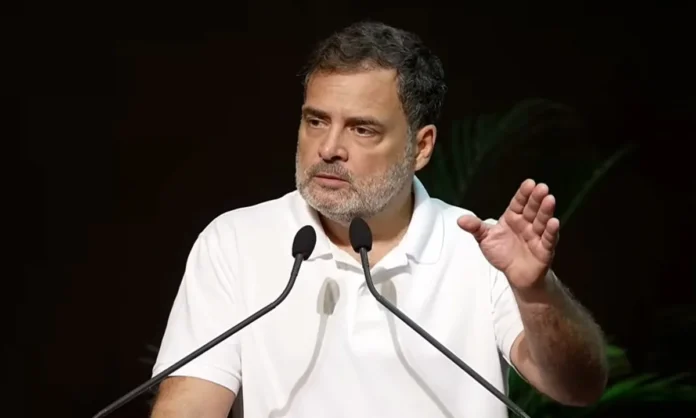
Leader of the Opposition in the Lok Sabha Rahul Gandhi also raised concerns over school closures, the rising role of private education and the affordability and accessibility of education, according to the party briefing.
The Congress is now preparing to expand its “Chhatron Ki Goonj” student outreach campaign across the country, while also sharpening its position on caste census, women’s reservation and the politically sensitive delimitation debate.
Paper Leaks Become a Major Congress Campaign Issue
Repeated paper leaks and examination irregularities have emerged as one of Congress’ primary youth-focused issues.
Ramesh said states have their own laws dealing with examination fraud while the Centre has a separate statutory framework, leading the party to discuss how enforcement could be better coordinated.
The issue has also reached the Supreme Court. On August 18, the court sought responses from the Centre and states on a petition seeking tougher financial consequences against people involved in paper leaks, including possible confiscation of assets under anti-corruption and money-laundering laws.
Congress has previously argued that tougher punishment alone will not solve the problem unless recruitment systems, examination administration and accountability mechanisms are strengthened.
Rahul Gandhi Raises School Closures and Privatization
Rahul Gandhi focused on a broader question: what is happening to India’s education system beyond examination leaks?
According to the briefing, Gandhi raised concerns over school closures and the increasing privatization of education.
The party discussed seeking input from education specialists, students and other stakeholders before developing a broader policy response.
Congress has increasingly connected examination irregularities with other youth concerns such as high educational costs, employment opportunities and the availability of public institutions.
Gandhi launched the Chhatron Ki Goonj initiative earlier this year around issues including paper leaks, expensive education and employment opportunities.
‘Chhatron Ki Goonj’ to Expand Nationwide
Congress plans to significantly expand the student campaign beyond major metropolitan centers.
The latest strategy discussions indicate that the program is intended to reach hundreds of cities and smaller towns, with current party planning reported around an expansion to as many as 800 cities.
Rahul Gandhi will not personally attend every event. Different Congress leaders and state-level figures are expected to participate across the country.
The campaign’s next major event is scheduled in Pune on August 22, where student and women-related issues are expected to receive particular attention.
This expansion shows that Congress is attempting to turn student grievances into a sustained national political campaign rather than a series of isolated rallies.
Ram Mandir Donation Allegations Discussed
The meeting also spent considerable time discussing allegations involving donations to the Ram temple in Ayodhya.
Congress has been campaigning on alleged financial irregularities connected with temple donations and has demanded an independent investigation under judicial supervision.
These remain allegations, and they should not be presented as established findings of wrongdoing.
The Supreme Court itself has already stressed the need for a speedy, qualitative and impartial investigation into allegations surrounding the management of temple donations.
Congress has separately demanded an independent probe supervised by a Supreme Court judge.
The party now plans to take its campaign on the issue beyond Uttar Pradesh and organize protests in other states.
Congress Discusses India-China Relations
India’s relationship with China also featured in the strategy discussions.
The subject remains politically sensitive because border management, military disengagement and the wider strategic competition between India and China continue to influence both foreign and domestic political debate.
Congress has repeatedly pressed the government for greater parliamentary discussion and transparency on developments along the border.
The party appears likely to continue raising the issue as part of its wider national-security campaign.
Caste Census: Congress Questions Centre’s Approach
Another major issue is the caste census.
Congress says the government’s current approach does not fulfill what the party believes should be the purpose of comprehensive caste enumeration.
The party has raised questions over the format in which caste data would be collected and has argued that accurate enumeration is necessary to formulate policies around representation and social justice.
The Centre, however, has said caste-related data would arise during the population-enumeration phase of the census rather than the initial house-listing exercise. Home Minister Amit Shah made that distinction while discussing the government’s delimitation proposals in Parliament earlier this year.
This means the political dispute is increasingly about how caste data will be collected and used, rather than simply whether caste will be counted.
Delimitation Emerges as One of the Biggest Political Battles
Delimitation was another major focus of the Congress discussion.
The party has consistently opposed linking women’s reservation to a large-scale expansion and redistribution of parliamentary seats.
Congress leaders have argued that states that successfully controlled population growth should not lose political influence because of a population-based seat redistribution.
One important numerical correction is necessary: the Lok Sabha currently has 543 elected seats, not 545.
Earlier this year, the government introduced a constitutional amendment and delimitation framework that would have allowed a major expansion in the House. The proposal contemplated an upper limit of 850 members, with government calculations indicating around 816 seats under the proposed formula.
The constitutional amendment failed to secure the required two-thirds majority in April.
Congress Discusses Freezing Lok Sabha Strength
The latest Congress deliberations included proposals to maintain the existing 543-seat Lok Sabha strength for another 25 years and preserve the current representation of individual states.
Such a position would address concerns, particularly in southern states, that a population-based delimitation could alter their relative influence in Parliament.
The political debate has intensified considerably this month, with other opposition-led states also advocating retention of the current 543-seat strength.
Karnataka Chief Minister D.K. Shivakumar, for example, has publicly backed keeping the Lok Sabha at 543 seats for 25 years.
Congress Wants Women’s Reservation in 2029
Congress has simultaneously reiterated that it supports implementing 33% reservation for women in the Lok Sabha and state assemblies from the 2029 elections.
The party’s position is that women’s reservation should not be used to justify a delimitation formula it opposes.
Congress has formally supported women’s reservation while rejecting the government’s proposed delimitation framework. Its own published position calls for implementation of women’s reservation in the 2029 Lok Sabha election.
The government, meanwhile, has argued that delimitation needs to be completed in time if women’s reservation is to be implemented in the 2029 general election.
That disagreement is likely to become one of the most consequential political disputes ahead of 2029.
Congress Builds a Broader Youth and Governance Campaign
Taken together, the discussions show Congress trying to connect several separate political issues into a broader national narrative.
For younger voters, the emphasis is on:
- paper leaks and examination credibility;
- education costs and privatization;
- employment opportunities; and
- access to quality public education.
For the broader electorate, Congress is focusing on:
- caste census;
- delimitation;
- women’s political representation;
- India-China relations; and
- transparency in institutions.
The strategy suggests the party wants to build campaigns around issues that can be sustained outside Parliament and taken directly to smaller cities and towns.
What Happens Next?
The immediate focus will be the expansion of Chhatron Ki Goonj, including the Pune program on August 22.
Congress-ruled states are also expected to work on education and examination-reform proposals after consultations with stakeholders.
Meanwhile, delimitation and women’s reservation will continue to generate political friction between the government and opposition.
The Congress Strategy Meeting therefore appears to have established several major campaign themes that could shape the party’s political activity over the coming months.
Paper leaks and education provide the youth-facing campaign, while caste census, women’s reservation and delimitation place the party directly into some of the largest constitutional and electoral debates currently unfolding in India.