ISLAMABAD, Pakistan | September 10, 2026 —
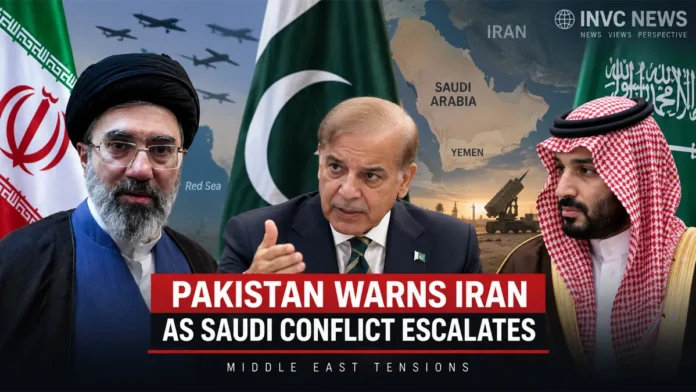
Pakistan warns Iran over Houthi attacks as Islamabad moves directly into an increasingly dangerous Gulf security crisis following missile and drone strikes that wounded 73 people in Saudi Arabia and hit civilian, military and energy-related targets.
Pakistan has communicated Saudi Arabia’s concerns to Tehran and urged Iran to use its influence to restrain Yemen’s Houthi movement as fears grow that renewed fighting could expand into a much larger regional confrontation.
The intervention puts Pakistan in a delicate position. Islamabad maintains close strategic and defense relations with Saudi Arabia while also sharing a long border and important diplomatic ties with Iran.
Pakistan therefore faces the difficult task of supporting Saudi security without becoming drawn directly into an expanding regional war.
Pakistan delivers Saudi message to Iran
Pakistani officials have indicated that Islamabad conveyed Riyadh’s warning to Tehran following a major wave of Houthi attacks on southern Saudi Arabia.
The strikes targeted locations including Abha, Jazan, Najran and Khamis Mushait.
Saudi authorities said 73 people were wounded.
The attacks also affected energy infrastructure and other economic facilities, temporarily disrupting operations at some locations.
Khamis Mushait is particularly significant because it hosts King Khalid Air Base, one of Saudi Arabia’s important military facilities.
The Houthis said they used missiles and drones against Saudi targets.
Saudi Arabia described the attacks as a dangerous escalation and said it would take necessary steps to defend its territory.
Pakistan wants Iran to restrain the Houthis
Pakistan’s diplomatic intervention adds a new dimension to the crisis.
Islamabad has urged Tehran to use its influence over the Houthis to prevent further attacks on Saudi territory.
Iran has long supported the Houthi movement politically and militarily, although Tehran has repeatedly rejected claims that it directly controls every Houthi decision or military operation.
The distinction remains important.
The Houthis have their own political leadership and military command structure in Yemen, even as they maintain close ties with Iran.
Consequently, Pakistan’s message is best understood as an attempt to use Tehran’s influence rather than an assertion that Iran directly ordered every attack.
Pakistan signals defensive role, not offensive war
Pakistan has also drawn an important line around its potential military involvement.
Pakistani officials have indicated that military assistance would focus on defending Saudi territory rather than carrying out offensive operations inside Yemen.
That distinction could prove critical.
Pakistan has historically maintained close defense cooperation with Saudi Arabia. However, direct participation in another Yemen conflict could create domestic political complications and damage Islamabad’s relationship with Iran.
By emphasizing a defensive role, Pakistan appears to be trying to reassure Riyadh while avoiding deeper involvement in the conflict.
That approach also leaves space for diplomacy.
Saudi Arabia faces renewed Houthi threat
The latest attacks have revived a security challenge that had eased significantly following the reduction in large-scale fighting between Saudi Arabia and the Houthis after 2022.
Saudi Arabia spent years trying to end its military involvement in Yemen and move toward a negotiated settlement.
The new missile and drone attacks threaten that strategy.
Saudi energy facilities are particularly sensitive because the kingdom remains one of the world’s most important oil producers and exporters.
Any sustained attacks on refineries, pipelines or export infrastructure could quickly affect international energy markets.
The threat becomes even more serious because instability around the Strait of Hormuz has already disrupted global concerns about oil supplies.
That means Saudi Arabia’s Red Sea energy infrastructure and alternative export routes are becoming increasingly important.
Yemen conflict risks returning to full-scale war
Renewed fighting is also raising fears that Yemen could return to the intensity of its earlier civil war.
The Houthis seized Yemen’s capital, Sanaa, in 2014.
A Saudi-led coalition intervened the following year in support of Yemen’s internationally recognized government.
Years of fighting created one of the world’s most severe humanitarian crises.
An informal truce later sharply reduced cross-border attacks, although it never produced a comprehensive political settlement.
Recent clashes now threaten that relative calm.
Saudi-backed forces and the Houthis have intensified military operations, while missile and drone attacks have again crossed the Saudi-Yemen border.
A prolonged confrontation could reopen multiple fronts inside Yemen.
India also watching Gulf security closely
The escalation carries significant consequences for India.
India has condemned the attacks on civilian and energy facilities in Saudi Arabia and emphasized the importance of regional peace and stability.
New Delhi has strong relationships with Saudi Arabia, Iran and other Gulf states.
Millions of Indian citizens also live and work across the Gulf region.
Energy security represents another major concern.
India imports a substantial share of its crude oil requirements, making any prolonged disruption involving Saudi Arabia, Iran, the Strait of Hormuz or Red Sea shipping routes economically important for New Delhi.
Higher crude prices can increase India’s import bill, put pressure on the rupee and eventually affect inflation.
Iran faces growing diplomatic pressure
The Pakistan warning comes as Tehran faces pressure on several fronts.
Iran’s confrontation with the United States has already increased military tensions around the Gulf.
Meanwhile, Iran’s nuclear program has returned to the center of international diplomacy after the International Atomic Energy Agency referred the issue to the UN Security Council.
The Saudi-Houthi confrontation now creates another pressure point.
If attacks on Saudi territory continue, Tehran could face increasing demands from regional governments to distance itself from Houthi military operations.
However, any Iranian attempt to restrain the Houthis would depend on how much operational influence Tehran actually possesses and whether Houthi leaders see de-escalation as serving their own interests.
Pakistan could become an important diplomatic bridge
Islamabad’s relationships with both Riyadh and Tehran could make Pakistan an important intermediary.
Pakistan wants strong ties with Saudi Arabia, which remains one of its most important economic and strategic partners.
At the same time, geography makes stable relations with Iran essential.
A wider Saudi-Iran confrontation would therefore create serious risks for Pakistan itself.
That gives Islamabad a strong incentive to push for de-escalation.
For now, Pakistan appears to be combining a clear commitment to Saudi territorial defense with diplomatic pressure aimed at preventing the crisis from expanding.
Whether that strategy succeeds will depend heavily on Iran, the Houthis and Saudi Arabia’s response to any further attacks.
The next major escalation could determine whether Pakistan remains a diplomatic intermediary or faces growing pressure to take a more direct security role.