DALLAS, United States | September 10, 2026 —
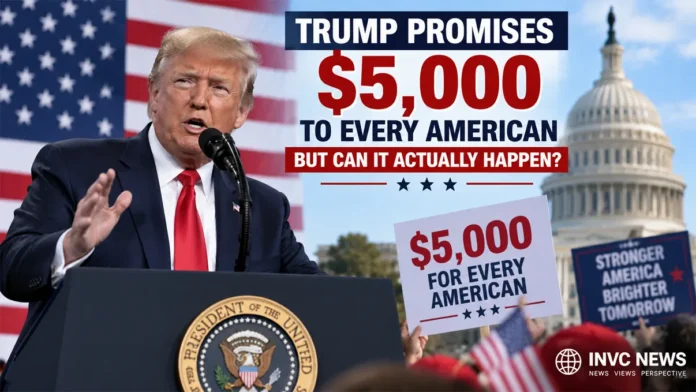
Trump $5000 Payment has suddenly become one of the biggest money-and-politics stories of the 2026 U.S. midterm elections after President Donald Trump promised a $5,000 “Trump dividend” to every adult American citizen if Republicans retain control of both chambers of Congress in November.
The promise immediately created an obvious question for millions of Americans: Is a $5,000 federal payment actually coming?
For now, the answer is no.
Trump has announced a political proposal tied directly to the election outcome. Congress has not approved a $5,000 payment programme, the federal government has not opened applications, and no payment date has been announced.
The potential price tag makes the proposal even more significant. With roughly 270 million adults in the United States, paying $5,000 to each would cost approximately $1.35 trillion.
That means turning the campaign promise into reality would require answers to enormous legal, fiscal and political questions.
What exactly did Trump promise?
Trump unveiled the proposal during the Republican Party’s midterm convention in Dallas.
His condition was straightforward: Republicans must retain both the House of Representatives and the Senate in the November 3 midterm elections.
If that happens, Trump said he would issue what he described as a $5,000 dividend to every adult citizen in the United States.
He added another unusual condition: the money would have to be spent inside the United States.
Trump branded the proposed payment the “Trump dividend.”
The announcement effectively turned a congressional election promise into a direct financial proposition for voters.
Who would get the proposed $5,000?
This is where readers need to be careful.
Trump referred to adult U.S. citizens.
However, his announcement did not provide a detailed eligibility framework.
There is currently no published federal programme explaining income limits, tax requirements, residency rules, treatment of dependents or whether high-income Americans would qualify.
Therefore, claims circulating online about detailed eligibility requirements should be treated cautiously unless the administration or Congress formally releases them.
The only clear conditions Trump publicly attached to the proposal were Republican control of both chambers and a requirement that the money be spent in the United States.
Is the Trump $5,000 payment approved?
No.
This distinction should not get lost in the excitement surrounding a possible $5,000 payment.
The proposal is not the same as an enacted federal benefit.
Congress has not passed legislation authorising the nationwide payments.
There is no approved distribution schedule.
No federal agency has announced a registration process.
No official application portal has opened.
Americans therefore should not expect a $5,000 deposit simply because Trump announced the proposal.
The November election comes first, and even a Republican victory would not by itself answer every legal and budgetary question surrounding the plan.
How much could the Trump dividend cost?
The mathematics illustrates the scale.
If approximately 270 million American adults received $5,000 each:
270 million × $5,000 = $1.35 trillion.
That is an extraordinary amount of federal spending.
The actual cost could differ if eligibility were ultimately restricted. For example, Congress could theoretically introduce income thresholds, citizenship or tax-filing requirements, or other limitations.
Trump did not announce those details.
As currently described, however, the proposal carries a potential cost well above $1 trillion.
Where would the money come from?
That remains one of the biggest unanswered questions.
Trump linked the dividend to what he described as America’s economic strength and success, but his Dallas announcement did not provide a detailed funding mechanism.
That matters.
A nationwide payment programme of this size would need a credible source of funding or additional federal borrowing.
Congress would also have to address how the programme fits into federal spending and budget rules.
Until a detailed legislative proposal appears, any specific claim about exactly how Washington would finance the $5,000 payments remains speculative.
Would Congress have to approve it?
A president generally cannot simply create more than $1 trillion in federal payments by announcement alone.
Federal spending normally requires congressional authority and appropriations.
That makes control of Congress particularly relevant to Trump’s proposal.
Even if Republicans win both chambers, however, political control does not automatically mean every Republican lawmaker would support a $1.35 trillion programme.
Fiscal conservatives could question the cost.
Other lawmakers could seek narrower eligibility requirements or a different payment amount.
Congress could also debate how such spending would affect the deficit and inflation.
The political promise therefore represents only the beginning of what could become a complicated legislative process.
Is this another stimulus check?
Not exactly.
The comparison is understandable because Americans received direct federal payments during the COVID-19 pandemic.
Those stimulus checks, formally known as Economic Impact Payments, were authorised through legislation passed by Congress.
Trump’s proposed $5,000 dividend has not reached that stage.
It is better described right now as an election-linked payment proposal, not a new stimulus check programme.
That difference is crucial.
Why is Trump making the promise now?
Timing explains much of the political significance.
Republicans are fighting to maintain control of Congress in the November 3 midterm elections.
Trump placed himself at the centre of that campaign during the Dallas convention, even urging voters to behave as though his own name were on the ballot.
The election comes amid intense voter concern over living costs and the broader economic environment.
Trump’s $5,000 proposal gives Republicans a simple and highly visible pocketbook message.
It also creates considerable political risk.
Opponents can attack the cost, question its feasibility or portray it as an election-driven promise without a financing plan.
The result is likely to be a major debate extending well beyond the Dallas convention.
Could a $5,000 payment increase inflation?
Potentially — but the final economic effect would depend heavily on how the programme was designed and funded.
Putting hundreds of billions or potentially more than $1 trillion into consumers’ hands could generate additional spending.
Higher consumer demand can support businesses and economic activity.
However, if demand rises faster than the economy’s ability to supply goods and services, inflationary pressure can increase.
Funding matters as well.
A programme financed through new federal borrowing could have different economic consequences from one funded through spending cuts, new revenues or a combination of measures.
Without a detailed proposal, definitive predictions about inflation would be premature.
Trump’s requirement to spend the money in America raises another question
Trump said the dividend would have to be spent within the United States.
That sounds straightforward politically but could become complicated technically.
How would the government determine where each dollar was spent?
Would cash withdrawals be restricted?
Could the payment go into an ordinary bank account?
Would overseas purchases be blocked?
Would recipients receive a conventional Treasury payment or some form of restricted payment mechanism?
Trump did not explain.
Those questions would have to be resolved if the proposal moved from campaign promise to actual legislation.
Beware of fake Trump $5,000 payment websites
This may become the most immediately useful warning for readers.
High-profile government-payment announcements routinely attract scammers.
Because no official $5,000 payment programme has been approved, Americans should be extremely cautious about websites, social-media posts, text messages or emails claiming that registration has already opened.
Do not provide a Social Security number, bank-account password, card details or one-time verification code to a website merely because it promises access to the “Trump dividend.”
There is currently no general federal application process for this proposed $5,000 payment.
That remains true unless the government formally announces otherwise.
Do Americans need to apply now?
No.
There is no approved application to complete.
People do not need to pay a processing fee.
They do not need to reserve their payment.
There is no legitimate requirement to provide banking credentials now to “secure” the proposed dividend.
If the proposal eventually becomes law, federal authorities would announce the official eligibility and distribution process.
Until then, any website demanding payment to obtain the $5,000 should raise immediate suspicion.
What happens next?
The first major milestone is the November 3, 2026 midterm election.
Trump explicitly conditioned the proposal on Republicans maintaining control of both the House and Senate.
If Republicans fail to achieve that outcome, the proposal as Trump presented it would not meet its stated political condition.
If Republicans win both chambers, attention would quickly move to Congress.
Lawmakers would then have to confront the questions Trump left unanswered: eligibility, financing, spending restrictions, implementation, taxation and the programme’s effect on the federal budget.
That would be the point at which Americans could begin judging whether the “Trump dividend” is moving toward actual policy.
The bottom line
The Trump $5000 Payment is a dramatic campaign promise, not money that Americans can currently claim.
Trump says every adult U.S. citizen would receive a $5,000 “Trump dividend” if Republicans retain both the House and Senate. He also says the money would have to be spent in the United States.
But major details remain unresolved.
There is no approved payment programme, no application portal, no payment date and no detailed funding plan.
At the broadest interpretation, the proposal could cost roughly $1.35 trillion.
That makes the November election only the first hurdle.
Even if Republicans win Congress, transforming Trump’s promise into $5,000 deposits would require the political slogan to become workable federal policy.
For Americans searching today for a simple answer — “Can I claim my $5,000 now?” — the answer is clear:
No. Not yet.