
NEW DELHI, India | September 10, 2026 —
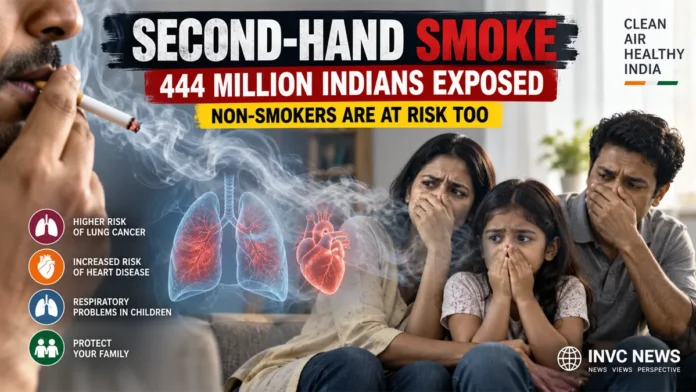
Second-Hand Smoke Health Risks are emerging as a major public-health concern in India after a new global analysis estimated that about 444 million people in the country were exposed to tobacco smoke from other people in 2023.
The findings are especially important for people who do not smoke themselves.
Second-hand smoke can still expose non-smokers to toxic substances linked to heart disease, lung cancer, respiratory illness and other serious health problems. Children can face particular risks because their lungs and immune systems are still developing.
The Global Burden of Disease 2023 analysis, published in The Lancet Public Health, estimated that India had the world’s second-highest number of people exposed to second-hand smoke in 2023, behind China.
It also estimated that about 325,600 deaths in India were attributable to second-hand smoke exposure during that year.
Those numbers do not mean that every exposed person will develop cancer or another serious illness. Instead, they show the enormous population-level health burden associated with repeated exposure to tobacco smoke.
What exactly is second-hand smoke?
Second-hand smoke is the smoke breathed in by people who are near someone using combustible tobacco.
It includes smoke released from the burning end of a cigarette and smoke exhaled by the smoker.
A person therefore does not need to smoke directly to inhale many of the harmful substances produced by tobacco.
Exposure can occur at home, in vehicles, workplaces, restaurants, public spaces and other areas where smoking takes place.
Indoor exposure is especially concerning because smoke can accumulate in enclosed environments.
444 million Indians were exposed in 2023
The latest analysis estimated that around 444 million people in India were exposed to second-hand smoke in 2023.
That makes India one of the largest contributors to the global burden.
China was estimated to have approximately 664 million people exposed, while Indonesia had about 142 million.
Together, China, India and Indonesia accounted for a very large share of global second-hand smoke exposure.
The India findings also reveal an important trend.
The proportion of the population exposed has declined over the past three decades, but the absolute number of people exposed has increased.
In other words, progress in reducing exposure rates has not yet translated into a sufficiently large reduction in the number of people affected.
Global exposure reached 2.71 billion
The scale of the problem extends far beyond India.
Researchers estimated that 2.71 billion people worldwide were exposed to second-hand smoke in 2023.
Among them were approximately 767 million children aged 0 to 14.
The study associated second-hand smoke exposure with around 1.66 million deaths globally and an estimated 44.8 million years of healthy life lost.
Heart disease accounted for a major share of the overall health burden, while lower respiratory infections were particularly important among children.
Why second-hand smoke affects the heart
Many people associate cigarette smoke mainly with lung cancer.
However, the cardiovascular effects can be equally important.
Tobacco smoke contains substances that can damage blood vessels, increase inflammation and interfere with normal cardiovascular function.
Repeated exposure can raise the risk of coronary heart disease.
The World Health Organization says there is no safe level of exposure to second-hand tobacco smoke.
Even people who have never smoked can therefore face higher cardiovascular risks when regularly exposed to tobacco smoke around them.
Lung cancer is not only a smoker’s disease
Smoking remains one of the strongest known risk factors for lung cancer.
Still, non-smokers can also develop the disease.
Second-hand smoke is one established risk factor.
Long-term exposure to tobacco smoke can allow carcinogenic substances to enter the lungs repeatedly.
That does not mean every non-smoker exposed to smoke will develop lung cancer.
Cancer risk depends on multiple factors, including duration and intensity of exposure, genetics, occupational exposures, air pollution and other environmental influences.
The important message is simpler: not smoking yourself does not completely eliminate the health risks associated with tobacco smoke around you.
Children can be especially vulnerable
Children deserve particular attention because their bodies and lungs are still developing.
Second-hand smoke exposure has been associated with respiratory infections, asthma symptoms, reduced lung function and middle-ear disease.
Infants exposed to tobacco smoke also face additional health risks.
For families, this means smoking in the same house as a child should not be treated as harmless simply because the cigarette is being used in another room.
Smoke can travel through indoor spaces.
Residue from tobacco smoke can also settle on surfaces, clothing and furniture.
Is smoking near a window enough?
No.
Opening a window may reduce visible smoke or odor, but it does not make indoor smoking safe.
Ventilation cannot reliably remove all harmful tobacco-smoke particles and gases.
Air conditioners, exhaust fans and air purifiers also should not be considered substitutes for a smoke-free indoor environment.
The most effective way to protect non-smokers is to keep homes and vehicles completely smoke-free.
What about smoking on a balcony?
A balcony is generally better than smoking inside a closed room, but it does not guarantee zero exposure.
Smoke can drift back through doors or windows.
People sitting nearby may also inhale it.
Anyone trying to protect children, family members or colleagues should smoke well away from entrances, windows and shared spaces.
The strongest protection remains avoiding tobacco use altogether.
Cars can become high-exposure spaces
Smoking inside a car can create particularly concentrated exposure because the cabin is small.
Opening a window does not remove all tobacco smoke.
Children travelling in the vehicle may therefore inhale significant amounts of smoke even during relatively short journeys.
Families should treat cars as completely smoke-free environments.
Can an air purifier remove second-hand smoke?
Air purifiers may reduce some airborne particles.
However, they cannot guarantee removal of all harmful chemicals found in tobacco smoke.
Their performance also depends on filter type, airflow, room size and maintenance.
Therefore, an air purifier should not be used as justification for smoking indoors.
A smoke-free environment is far more effective.
Second-hand smoke versus third-hand smoke
Second-hand smoke refers to tobacco smoke that people breathe from the surrounding air.
Third-hand smoke is different.
It describes tobacco-related chemicals that remain on surfaces after smoking has stopped.
These residues can settle on curtains, furniture, carpets, clothing and walls.
Young children may be particularly likely to contact contaminated surfaces because they frequently touch objects and then put their hands near their mouth.
Research into third-hand smoke continues, but avoiding indoor smoking remains the simplest precaution.
Why the India numbers matter
India has made progress through smoking restrictions and tobacco-control measures.
Yet the latest numbers suggest exposure remains widespread.
One reason is that laws governing public spaces cannot fully control what happens inside homes.
A person may work in a smoke-free office but return every evening to a household where another family member smokes indoors.
That household exposure can continue for years.
Protecting non-smokers therefore requires both enforcement of public smoke-free rules and changes in household behavior.
Women and children carry a major global burden
The GBD analysis found that women and children represented a substantial share of people exposed globally.
Women accounted for an estimated 1.49 billion exposed individuals worldwide.
In some regions, women had higher exposure than men despite lower rates of direct tobacco use.
That pattern often reflects exposure to other people’s smoking rather than smoking themselves.
Children similarly have little control over the environments in which they live.
This makes household smoking a public-health issue rather than simply an individual lifestyle choice.
How to reduce second-hand smoke exposure at home
Families can take several practical steps.
Make the entire house smoke-free rather than designating one room for smoking.
Keep cars completely smoke-free.
Ask visitors not to smoke inside.
Avoid smoking near doors, balconies or windows where smoke can return indoors.
Parents and caregivers should pay particular attention to environments used by children.
Most importantly, people who smoke can consider quitting rather than simply relocating where they smoke.
When should someone talk to a doctor?
Exposure to second-hand smoke does not automatically require medical testing.
However, people should seek medical advice if they develop persistent respiratory symptoms such as an unexplained cough, wheezing, breathlessness or chest discomfort.
Repeated asthma attacks or recurrent respiratory infections also deserve medical evaluation.
Urgent symptoms such as severe difficulty breathing or significant chest pain require prompt medical attention.
People with existing heart or lung conditions should also discuss regular smoke exposure with their healthcare professional.
Quitting smoking protects more than the smoker
Stopping tobacco use has obvious benefits for the person who quits.
The benefits also extend to everyone around them.
Children inhale less smoke.
Partners and family members experience less exposure.
Vehicles and indoor environments remain cleaner.
The effect is therefore both personal and collective.
That is one reason tobacco-cessation programs remain an important part of public-health policy.
A falling percentage does not mean the problem is solved
One of the most striking findings from India is that exposure prevalence has declined while the total number of exposed people has increased.
India’s age-standardized prevalence of second-hand smoke exposure was estimated to have fallen substantially since 1990.
Yet population growth means hundreds of millions of people are still being exposed.
This distinction matters when judging public-health progress.
A lower percentage is encouraging.
However, 444 million exposed people remains an enormous number.
The bottom line
Second-hand smoke is not merely an unpleasant smell or temporary irritation.
It is a documented health hazard.
The latest research estimates that hundreds of millions of Indians were exposed in 2023 and that a substantial burden of premature death and disease was attributable to that exposure.
For non-smokers, the key message is straightforward.
You do not need to hold a cigarette to be affected by tobacco smoke.
Creating smoke-free homes, cars, workplaces and public spaces remains one of the simplest ways to reduce avoidable exposure.
And for people who smoke, quitting can protect not only their own health but also the health of everyone sharing the air around them.