WASHINGTON, United States | September 10, 2026 —
Trump Iran Pickaxe Mountain warning has opened another dangerous front in the widening Middle East crisis after President Donald Trump said the United States had detected fresh activity at a heavily fortified site near Iran’s damaged Natanz nuclear complex.
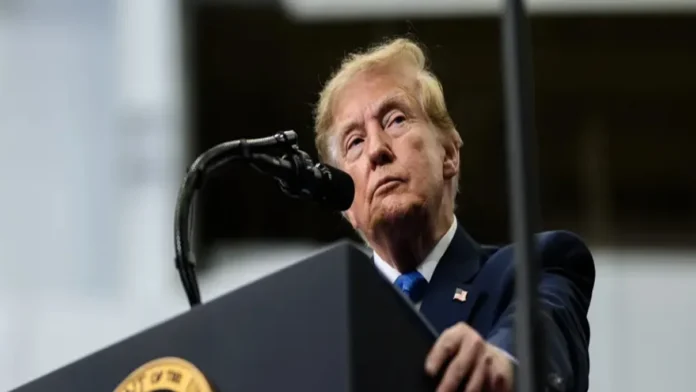
Speaking at a Republican midterm convention, Trump warned Tehran against further escalation and said Washington could strike the site if Iran pushed the confrontation further.
Pickaxe Mountain sits close to the Natanz uranium enrichment facility and contains deeply buried tunnel complexes designed to protect sensitive infrastructure from attack.
The latest warning matters because Trump had already raised the possibility of striking the site earlier this month. His new remarks suggest Washington continues to monitor activity around the underground complex as the broader U.S.-Iran confrontation intensifies.
What is Pickaxe Mountain?
Pickaxe Mountain has become one of the most closely watched locations in Iran’s nuclear infrastructure.
The fortified site lies near Natanz, long associated with Iran’s uranium enrichment program.
Its underground tunnel complexes have drawn international attention because deeply buried facilities are harder to monitor and significantly more difficult to destroy through conventional airstrikes.
That does not automatically mean Iran is conducting nuclear weapons work there.
However, any unexplained activity around a sensitive nuclear-linked site attracts immediate scrutiny, particularly during an active military confrontation.
Trump did not publicly provide details about what U.S. intelligence had observed.
That makes caution essential.
At this stage, the confirmed development is the president’s warning — not proof that Iran has restarted or expanded prohibited nuclear work at Pickaxe Mountain.
Trump raises threat of another U.S. strike
Trump’s comments represent a significant escalation in rhetoric.
He said the United States had noticed activity at Pickaxe Mountain and warned Iran against testing Washington’s resolve.
The president has repeatedly argued that the U.S. will prevent Tehran from rebuilding sensitive nuclear capabilities that were damaged during earlier attacks.
The latest warning comes only days after Trump said Washington could target Pickaxe Mountain.
This time, however, he linked the warning directly to activity the United States says it has observed.
That distinction could increase pressure on Tehran.
Natanz remains at center of Iran nuclear crisis
Natanz has played a central role in the dispute over Iran’s nuclear program for years.
The complex housed major uranium enrichment operations before suffering extensive damage during the current conflict.
Iran has consistently said its nuclear program serves peaceful purposes.
Western governments have questioned aspects of Tehran’s nuclear activities and have repeatedly sought greater transparency from Iranian authorities.
The latest Pickaxe Mountain warning arrives at an especially sensitive moment.
The International Atomic Energy Agency has also referred Iran to the United Nations Security Council amid continuing concerns over Tehran’s cooperation with nuclear inspectors.
Together, those developments are pushing Iran’s nuclear program back to the center of an already expanding military crisis.
Iran and U.S. conflict expands beyond nuclear sites
The confrontation now stretches far beyond nuclear infrastructure.
Iran and the United States have exchanged attacks involving oil tankers, military facilities and shipping routes around the Persian Gulf.
Iran said it attacked 10 ships near the Strait of Hormuz after U.S. forces sank five Iranian oil tankers.
The renewed maritime confrontation has disrupted energy flows through one of the world’s most important oil routes.
Brent crude has consequently moved above $100 a barrel, adding economic pressure to the geopolitical crisis.
For Washington, that creates a difficult calculation.
Further military escalation could weaken Iranian capabilities, but it could also drive energy prices higher and increase the economic costs of the conflict.
Strait of Hormuz makes every escalation global
The Strait of Hormuz carries enormous strategic importance because a significant share of global oil and gas trade normally passes through the waterway.
Traffic through the strait has already fallen sharply during the conflict.
Fresh U.S. strikes on Iranian territory could trigger additional retaliation against shipping, energy facilities or regional military bases.
That means Pickaxe Mountain is not simply a nuclear story.
It has direct implications for crude oil prices, inflation, global markets and energy security.
India has particular exposure because it imports most of the crude oil it consumes.
A prolonged Gulf disruption could therefore increase India’s import bill, pressure the rupee and complicate the inflation outlook.
Could the United States actually strike Pickaxe Mountain?
A presidential warning does not automatically mean an attack is imminent.
Military planners would need to assess the target, intelligence confidence, underground depth, air defenses and the risk of Iranian retaliation.
Deep underground facilities also pose a difficult technical challenge.
Conventional strikes can damage entrances, power systems and supporting infrastructure without necessarily destroying everything buried beneath the surface.
That makes any operation against Pickaxe Mountain potentially more complex than an attack on exposed facilities.
The political consequences would also be significant.
Another strike near Natanz could further narrow the possibility of diplomacy and make de-escalation more difficult.
Iran faces pressure on several fronts
Tehran is now dealing with simultaneous pressure from the nuclear watchdog, the United States, regional rivals and worsening economic conditions.
At the same time, Iran retains several ways to respond.
Those include missile and drone capabilities, regional allied groups and pressure on shipping routes.
Washington therefore faces the risk that every new strike produces another round of retaliation.
That escalation cycle has already affected global energy markets.
Why Pickaxe Mountain could become the next flashpoint
The importance of Trump’s warning lies less in the words themselves than in the target he identified.
Pickaxe Mountain connects three major elements of the current crisis:
Iran’s nuclear program.
The expanding U.S.-Iran military confrontation.
The risk of a wider energy and regional security shock.
If the United States concludes that activity at the site represents an attempt to restore sensitive nuclear capabilities, pressure for military action could increase.
If Iran views the warning as preparation for another strike, Tehran could also raise its own military readiness.
For now, the site has become another critical point to watch.
The next development may depend on what U.S. intelligence sees underground — and whether Washington believes Iran has crossed a line that President Donald Trump is prepared to enforce militarily.