New Delhi, India — August 20, 2026
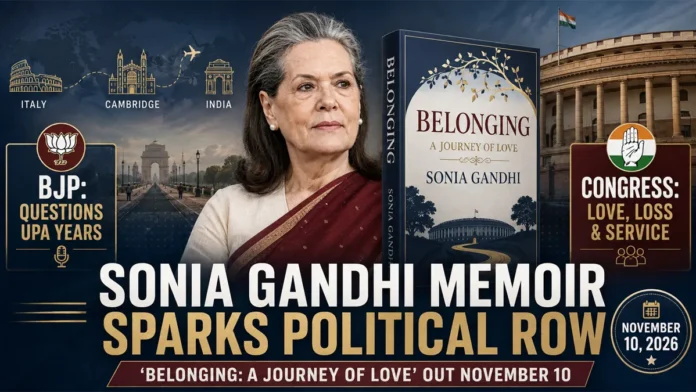
Sonia Gandhi Memoir Belonging has become the center of a fresh political battle months before it reaches bookstores, with the Bharatiya Janata Party welcoming the former Congress president’s decision to tell her story while challenging her to address controversial questions surrounding the Congress-led UPA years.
The upcoming memoir book , Belonging: A Journey of Love, is scheduled for publication on November 10, 2026, by Alfred A. Knopf. The book is expected to trace Sonia Gandhi’s journey from her childhood in Italy and meeting Rajiv Gandhi in Cambridge to family tragedy, her entry into Indian politics and her years at the center of the Congress party.
BJP leader Ram Kadam congratulated Gandhi on the upcoming publication but said he hoped the memoir would, in his words, tell the “truth” about how power operated during former Prime Minister Manmohan Singh’s two terms from 2004 to 2014.
Congress responded by portraying the memoir as a deeply personal account of a woman who endured the assassinations of two members of her immediate political family and nevertheless remained active in public life.
BJP Welcomes Book — With a Political Challenge
Kadam said there was nothing unusual about politicians writing positively about their own achievements but argued that a memoir should also address difficult questions.
He revived a longstanding BJP accusation that during the UPA governments, real political authority rested with Sonia Gandhi at 10 Janpath, while Manmohan Singh occupied the prime minister’s office.
Kadam characterized Singh as having functioned like a “puppet” and said the memoir should address allegations of corruption from the UPA period.
These are BJP political allegations, not established descriptions of how every government decision was made during Singh’s premiership.
Manmohan Singh and Congress leaders repeatedly rejected claims that he was merely a figurehead, while political accounts of the UPA years have long debated the distribution of authority between the prime minister, the Congress leadership and the coalition government.
‘If She Writes the Truth, It Will Be Welcomed’
Kadam’s central message was that the BJP would welcome Sonia Gandhi’s memoir if it contained what he considered a candid account of the UPA era.
The criticism reflects one of the BJP’s most persistent attacks on the Congress leadership: that Sonia Gandhi exercised substantial influence over government policy while not holding an executive government office.
Congress has consistently disputed the BJP’s characterization of the arrangement.
The renewed exchange suggests that Belonging may become more than a publishing event when it arrives in November.
Its treatment of the UPA years could trigger a fresh political debate over one of the most consequential periods in recent Indian political history.
Congress Says Book Is About a Life Marked by Love and Loss
Congress leader Pawan Khera offered a very different assessment.
He said readers in India and abroad were looking forward to the book because it represents not simply a political memoir but a personal journey shaped by extraordinary experiences.
Khera emphasized the losses Sonia Gandhi endured after the assassinations of her mother-in-law, former Prime Minister Indira Gandhi, in 1984, and her husband, former Prime Minister Rajiv Gandhi, in 1991.
He argued that despite those tragedies and the political challenges she subsequently faced, Sonia Gandhi continued in public life.
Congress is expected to frame the memoir around themes of resilience, family, sacrifice and service rather than around the BJP’s allegations about political control during the UPA years.
What Is ‘Belonging: A Journey of Love’ About?
The publisher describes the book as a memoir of Sonia Gandhi’s personal and political journey.
The narrative begins well before her emergence as one of India’s most influential political figures.
Born Sonia Maino in Italy, she grew up near Turin before traveling to England to study English in Cambridge.
It was there that she met Rajiv Gandhi.
Their relationship eventually brought her to India, where she became part of the Nehru-Gandhi family and entered a world dramatically different from her childhood in Italy.
The memoir is expected to explore that transition in deeply personal terms.
From Italy to the Center of Indian Politics
Sonia Gandhi initially stayed away from active politics even after Rajiv Gandhi became prime minister following Indira Gandhi’s assassination.
Rajiv was assassinated during an election campaign in 1991.
Sonia Gandhi resisted pressure to enter politics for several years afterward.
She eventually joined active politics in the late 1990s and became Congress president in 1998.
Her leadership would transform her into one of the most powerful political figures in the country.
She eventually became the longest-serving president of the Indian National Congress.
The 2004 Decision Likely to Be Closely Watched
One of the most anticipated portions of the memoir concerns 2004.
The Congress emerged as the leading party of the coalition that formed the United Progressive Alliance government after the general election.
Sonia Gandhi was widely expected to become prime minister but ultimately declined the position.
Manmohan Singh became prime minister and remained in office for two consecutive terms until 2014.
The reasons behind Sonia Gandhi’s decision—and her perspective on the political events surrounding it—are likely to be among the most closely examined portions of the book.
Will the Memoir Address the ‘Remote Control’ Charge?
That is now one of the central political questions surrounding the publication.
For years, BJP leaders have argued that Sonia Gandhi exercised influence over the UPA government from outside the formal executive structure.
References to “10 Janpath” being the power center became a recurring feature of opposition criticism during the period.
Congress, however, has maintained that Singh headed the government while Sonia Gandhi led the party and the UPA coalition.
The memoir could provide Sonia Gandhi’s own account of that relationship.
Whether she directly addresses the “remote control” allegation remains unknown until the full book is published.
Manmohan Singh-Sonia Gandhi Relationship Could Draw Attention
The relationship between Sonia Gandhi and Manmohan Singh is likely to interest political historians well beyond partisan arguments.
Their arrangement was unusual in Indian politics.
Singh held the country’s highest elected executive office while Gandhi remained Congress president and chaired the UPA.
The relationship survived two general-election victories, coalition pressures, major economic decisions and multiple political controversies.
A detailed first-person account from Gandhi could offer new insight into how decisions were made and how disagreements were handled.
UPA Corruption Controversies Could Return to Spotlight
The BJP’s reaction also shows that controversies from the UPA period will almost certainly return to political debate when the memoir is published.
The second UPA government was hit by major controversies involving telecommunications licensing, coal allocations and other government decisions.
Some cases resulted in criminal investigations and extensive litigation, while outcomes in individual cases varied considerably.
For that reason, broad political claims that everyone accused in those controversies was proven guilty would be inaccurate.
If Gandhi discusses those controversies, her account could reopen debates over governance and accountability between 2004 and 2014.
Sonia Gandhi Says Writing About Her Life Was Difficult
The memoir is expected to be notably personal rather than simply a chronological account of political events.
Gandhi has said that writing about her own life required revisiting memories and experiences she had long kept private.
The book’s title, Belonging: A Journey of Love, reflects one of its central themes: how a woman raised in Italy came to regard India as home.
The publisher says the book will also examine identity, duty, family and the meaning of belonging through roughly six decades of extraordinary political and social change.
Indira Gandhi and Rajiv Gandhi Central to the Story
Two relationships are likely to shape much of the narrative.
The first is Gandhi’s relationship with Indira Gandhi, her mother-in-law and one of India’s most consequential prime ministers.
The second is her marriage to Rajiv Gandhi.
Both relationships ended through political assassination.
That history provides the emotional backdrop to Sonia Gandhi’s eventual decision to enter politics despite having previously resisted public life.
Rahul Gandhi and Priyanka Gandhi Continue Political Legacy
The memoir arrives at a time when the next generation of the Gandhi family is deeply active in Indian politics.
Rahul Gandhi serves as Leader of the Opposition in the Lok Sabha.
Priyanka Gandhi Vadra is also a member of Parliament.
Sonia Gandhi currently serves in the Rajya Sabha after decades of representation in the Lok Sabha.
The publication therefore comes while the political family she writes about remains directly involved in the country’s opposition politics.
Why This Book Could Become a Major Political Event
Political memoirs become particularly significant when the author has spent years close to major decisions but has rarely offered a comprehensive first-person account.
Sonia Gandhi fits that description.
Her book could address:
- her relationship with Rajiv Gandhi;
- her relationship with Indira Gandhi;
- the assassinations that transformed her family;
- why she resisted entering politics;
- the crisis within Congress in the 1990s;
- her decision to lead the party;
- the 2004 general election;
- why she declined the prime minister’s post;
- her working relationship with Manmohan Singh;
- the UPA governments;
- Congress’ 2014 defeat; and
- her changing role as Rahul Gandhi emerged as the party’s principal national leader.
Any substantial new detail on these subjects could generate political headlines.
BJP and Congress Already Setting Competing Narratives
Even before publication, the two parties are framing the book differently.
For the BJP, the memoir is an opportunity to revisit questions about Congress governance, political authority and corruption allegations during the UPA era.
For Congress, it is the story of a woman whose personal life became inseparable from India’s political history after marriage into the Nehru-Gandhi family.
That clash makes the November release particularly significant.
Readers will ultimately be able to judge how much of the memoir focuses on intimate family history and how extensively it addresses the political controversies surrounding Gandhi’s career.
Sonia Gandhi Memoir Belonging: Release Date and Publisher
Book: Belonging: A Journey of Love
Author: Sonia Gandhi
Publication Date: November 10, 2026
Publisher: Alfred A. Knopf / Knopf Doubleday Publishing Group
Format: Memoir
Length: Listed at approximately 544 pages
Hardcover ISBN: 9780593803592
The book is expected to receive an international release.
Alfred A. Knopf / Penguin Random House
The Bottom Line
The Sonia Gandhi Memoir Belonging is already becoming a political story nearly three months before publication.
The BJP says it welcomes the book but wants Gandhi to confront questions about power, governance and corruption allegations during the Manmohan Singh years.
Congress says the memoir should instead be understood as the extraordinary personal journey of someone who endured deep family tragedy, entered politics reluctantly and spent decades at the center of India’s public life.
Both narratives will be tested when Belonging: A Journey of Love reaches readers on November 10.
The book’s biggest political impact may ultimately depend on one question: how candidly Sonia Gandhi chooses to describe the decisions, relationships and controversies of the UPA years.