New Delhi, India | July 16, 2026
Indian Seafarers Hormuz Strait Advisory has been issued by the Directorate General of Maritime Administration (DGMA) as the Indian government moves to strengthen the safety of its maritime workforce amid escalating security concerns in the Middle East.
Under the new advisory, ship owners, ship management companies, and recruitment agencies have been instructed not to deploy Indian seafarers on vessels transiting the Strait of Hormuz until further orders. The precautionary measure comes as regional tensions continue to rise following recent attacks on commercial vessels operating near the Persian Gulf.
The government described the safety of Indian seafarers as its highest priority and said the restrictions would remain in force until the security situation improves.
DGMA Issues Comprehensive Maritime Safety Advisory
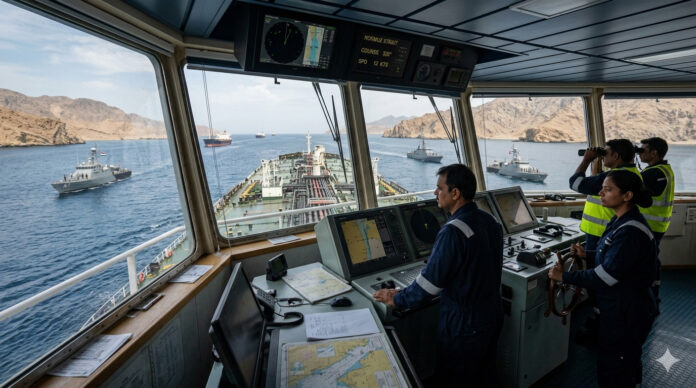
The Directorate General of Maritime Administration directed masters of all vessels operating in the Persian Gulf, Strait of Hormuz, and surrounding waters to maintain the highest level of vigilance.
According to the advisory, ship captains must:
- Continuously monitor official navigation warnings.
- Follow the latest maritime security advisories.
- Track updates issued by relevant authorities.
- Fully implement all security measures prescribed under the International Ship and Port Facility Security (ISPS) Code.
- Maintain enhanced watchkeeping while transiting high-risk waters.
The advisory reflects growing concerns over maritime safety in one of the world’s busiest shipping corridors.
Recent Vessel Attacks Triggered Government Action
The latest safety measures follow attacks on two commercial vessels—MT Al Bahiyah and MT Mombasa.
Together, the ships carried 46 crew members, including 30 Indian seafarers.
According to official information:
- One Indian sailor aboard MT Al Bahiyah was killed.
- Another Indian crew member on the same vessel was injured.
- Nine Indian nationals aboard MT Mombasa sustained injuries during the attack.
The incidents highlighted the increasing risks faced by merchant shipping crews operating in the Gulf region.
India to Launch Real-Time Seafarer Monitoring Dashboard
Following the attacks, the central government instructed the DGMA to establish a real-time digital monitoring system capable of tracking Indian seafarers serving aboard vessels operating in:
- The Persian Gulf
- The Strait of Hormuz
- The Gulf of Oman
The proposed centralized dashboard will provide authorities with immediate access to information regarding Indian crew members on ships operating in high-risk maritime zones.
Officials believe the system will significantly improve emergency response capabilities during security incidents.
Shipping Minister Orders Centralized Crew Database
Union Minister for Ports, Shipping and Waterways Sarbananda Sonowal directed maritime authorities to ensure that every vessel carrying Indian seafarers is included in the centralized monitoring platform, regardless of the ship’s nationality or flag.
According to the minister, maintaining an accurate, real-time database will enable faster coordination with shipping companies, foreign governments, naval authorities, and rescue agencies during emergencies.
He emphasized that protecting Indian seafarers remains the government’s foremost priority amid evolving regional security challenges.
Why the Strait of Hormuz Matters
The Strait of Hormuz is one of the world’s most strategically important maritime chokepoints.
Nearly one-fifth of global crude oil shipments pass through the narrow waterway connecting the Persian Gulf with international shipping lanes.
Any disruption in the area can have far-reaching consequences for:
- Global energy markets
- International shipping
- Supply chains
- Marine insurance costs
- Crew safety
Escalating geopolitical tensions have prompted several governments and shipping operators worldwide to reassess maritime security protocols for vessels operating in the region.
Indian Seafarers Among World’s Largest Maritime Workforce
India is one of the world’s leading suppliers of skilled merchant navy professionals.
Thousands of Indian officers, engineers, and ratings serve aboard international cargo vessels, oil tankers, LNG carriers, and container ships operating across global trade routes.
Given their significant presence in Gulf shipping operations, any security deterioration in the region directly affects Indian maritime personnel and their families.
Government to Continue Precautionary Measures
Officials indicated that the deployment restrictions are preventive rather than permanent.
The advisory will remain under regular review based on evolving security assessments and international maritime developments.
Until conditions stabilize, Indian shipping authorities are expected to continue coordinating closely with ship operators and international maritime organizations to safeguard Indian seafarers working in conflict-prone waters.
Key Highlights
- India has directed shipping firms not to deploy Indian seafarers on vessels transiting the Strait of Hormuz until further notice.
- The advisory was issued following recent attacks on MT Al Bahiyah and MT Mombasa.
- One Indian sailor was killed, while several others were injured.
- Ship captains have been instructed to implement enhanced ISPS Code security measures.
- India will establish a real-time dashboard to monitor Indian seafarers operating in Gulf waters.
- The government says protecting Indian maritime workers remains its highest priority.