By Team INVC | INVC NEWS
Published: August 29, 2026 | 08:05 PM IST
Updated: August 30, 2026 | 10:06 AM IST
NEW YORK CITY, United States | August 30, 2026 —
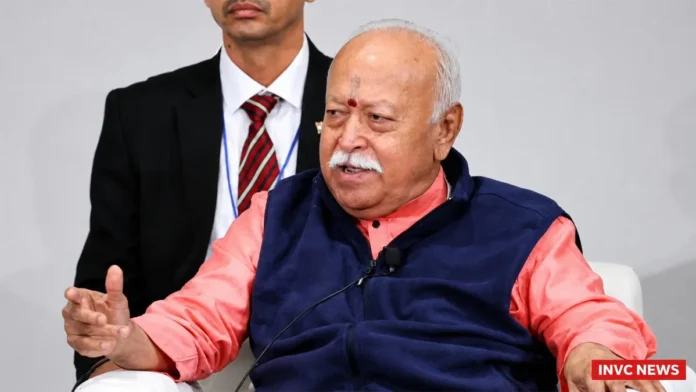
Mohan Bhagwat in New York delivered the line that instantly changed the political temperature surrounding his controversial Madison Square Garden appearance.
Addressing a multicultural gathering in Manhattan, the Rashtriya Swayamsevak Sangh chief said that any Hindu who believes Muslims should have no place in India ceases to be Hindu.
The remark came after days of protests, accusations and a sharp confrontation involving New York Mayor Zohran Mamdani, civil-rights groups and RSS supporters. Critics had accused the organisation of advancing an exclusionary vision of India. Bhagwat responded from one of America’s most prominent stages with an emphatically inclusive definition of Hindu thought.
In one sentence, the RSS chief moved the debate from whether he should be allowed to speak in New York to what his words mean for India’s continuing argument over Hindutva, Muslims, national identity and political power.
What Mohan Bhagwat Said About Muslims
Bhagwat recalled a question Muslim participants had asked him during a 2018 lecture series in Delhi.
They wanted to know what place Muslims would have in a Hindu Rashtra and whether the RSS wanted them driven out of India.
Bhagwat said he rejected that interpretation.
“If any Hindu thinks that there should be no Muslim in Bharat, he will not remain Hindu,” the RSS chief told the New York gathering.
His argument was that Hindu thought recognises multiple paths while treating human dignity as universal. Religions, rituals and identities may differ, he said, but humanity remains one.
A Direct Answer to Bhagwat’s New York Critics?
The timing ensured that Bhagwat’s remarks would be viewed through the controversy preceding his speech.
Mayor Zohran Mamdani had publicly opposed the RSS event, arguing that the organisation represented an exclusionary political ideology inconsistent with his vision of secular and pluralistic India.
Mamdani also acknowledged that opposing the event politically did not automatically give New York City the legal authority to cancel a lawful private gathering.
Civil-rights and interfaith organisations went further. Some called for Bhagwat’s appearance to be cancelled, while others demanded sanctions or action against RSS figures.
Supporters of the RSS accused the mayor and protesters of attacking a Hindu organisation while claiming to defend diversity.
Against that backdrop, Bhagwat’s declaration about Muslims sounded like more than a philosophical observation. It functioned as a direct defence of the RSS’s claim that its understanding of Hindu identity is civilisational and inclusive—not a demand for religious uniformity.
Also Read This – : Rahul Gandhi Demands SC/ST Act FIR Over Kharge ‘Purification’ Row
Bhagwat Says Politics Has Become a Game of Self-Interest
The RSS chief did not limit his address to religious identity.
He also argued that lasting political change cannot simply be imposed from the top. According to Bhagwat, meaningful transformation begins within society, develops through public opinion and only then influences political power.
He described modern politics as increasingly driven by self-interest and suggested that constitutional ideals cannot survive through government action alone if society does not practise them.
That message carries unmistakable political weight in India.
The RSS has enormous social reach and a longstanding ideological relationship with the Bharatiya Janata Party. However, the two remain separate organisations, and the Sangh frequently presents its role as shaping society rather than contesting elections directly.
Also Read This – : PM Modi Lands in Uzbekistan, Launches Trade and Terrorism Push
Bhagwat’s formulation was clear:
Change society first. Politics will eventually follow.
Diversity Must Be Protected, Not Merely Tolerated
Another significant portion of the address focused on diversity.
Bhagwat said differences should be accepted, respected and preserved. Protecting one’s own identity, he argued, cannot mean denying another person the same right.
He described diversity as the visible expression of an underlying human unity.
The message was packaged around the idea of “Vasudhaiva Kutumbakam”—the world as one family—and the broader theme of the Universal Oneness Celebration.
The event brought together religious and community representatives from multiple countries. A wider call to action rejected the use of religion to justify hatred, humiliation or violence and urged faith leaders to move beyond dialogue toward practical cooperation.
Also Read This – : PM Modi Lands in Uzbekistan, Launches Trade and Terrorism Push
The Big Question: Will Critics Accept the Message?
Bhagwat’s words are certain to be welcomed by RSS supporters as proof that the organisation rejects religious exclusion.
That is where the real debate begins.
Supporters will say Bhagwat could hardly have been clearer: a Hindu cannot seek an India without Muslims.
Opponents will ask whether the inclusive language delivered on an international stage consistently shapes political and social conduct on the ground.
Both reactions matter because the controversy is no longer confined to India. It is now part of a global diaspora argument over Hindutva, pluralism and who gets to define Indian identity abroad.
Zohran Mamdani Controversy Does Not End Here
Bhagwat’s speech may have complicated Mamdani’s criticism, but it has not erased the underlying confrontation.
The mayor’s objection concerned the broader ideology and historical influence of the RSS—not merely one statement by its chief. Meanwhile, RSS supporters are likely to use Bhagwat’s remarks to challenge claims that the organisation seeks a religiously exclusive India.
The result is a sharper and more interesting political contest.
Before the event, the question was whether Bhagwat should be given the Madison Square Garden platform.
Also Read This – : Trump Suffers Major Court Defeat Over Deportation of Pro-Palestinian Students
After the speech, the question is different:
Does Bhagwat’s inclusive definition of Hindutva settle the argument—or raise the standard against which the RSS will now be judged?
Why This Speech Matters Beyond New York
The venue made the address globally visible, but its political consequences will be felt most strongly in India.
Bhagwat placed three ideas at the centre of his message:
- India cannot be imagined by excluding Muslims.
- Diversity must be protected alongside one’s own identity.
- Durable political transformation begins with society rather than power.
Together, these statements represent an attempt to present Hindu identity as plural, socially rooted and compatible with religious diversity.
Whether the speech becomes a turning point or merely another fiercely debated intervention will depend on what follows.
For now, however, Mohan Bhagwat has ensured that one line from New York will travel far beyond Madison Square Garden: