
By Team INVC | INVC NEWS
Published: August 29, 2026 | 19 : 20 PM IST
TASHKENT, Uzbekistan | August 29, 2026 —
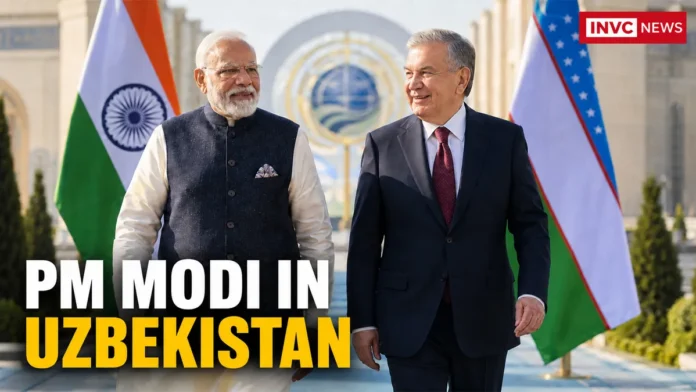
Prime Minister Narendra Modi arrived in Uzbekistan on Saturday and launched a high-stakes Central Asia diplomatic push aimed at expanding trade, securing new energy partnerships and building stronger regional action against terrorism.
Modi’s arrival in Tashkent opened the first leg of his four-day tour of Uzbekistan and the Kyrgyz Republic. The visit places India’s economic and security priorities at the centre of its engagement with a region increasingly important for energy, critical minerals and Eurasian connectivity.
The prime minister will hold delegation-level talks with Uzbekistan President Shavkat Mirziyoyev during the two-day state visit. From Tashkent, he will travel to Bishkek for the 26th Shanghai Cooperation Organisation Summit, where terrorism, separatism and regional security are expected to dominate India’s message.
Modi Pushes for Bigger India-Uzbekistan Partnership
Modi and Mirziyoyev will seek to convert their countries’ strategic partnership into stronger economic and security cooperation.
Trade and investment, digital connectivity, defence, energy, education and people-to-people exchanges form the core of the Tashkent agenda. The leaders will also examine how India’s Viksit Bharat programme can work alongside Uzbekistan’s Yangi Uzbekistan development vision.
Modi said before the visit that India-Uzbekistan relations had advanced significantly in recent years and that he wanted to deepen cooperation across the most important strategic sectors.
The visit is Modi’s fourth to Uzbekistan, signalling New Delhi’s sustained effort to expand its presence in Central Asia.
Trade and Energy Drive Gains Urgency
India wants to unlock greater trade with Uzbekistan, but the absence of direct land connectivity has limited the full potential of the relationship.
New Delhi is therefore pushing transport and logistics routes capable of linking Indian businesses with Central Asian markets. Better customs coordination, digital payment systems and alternative transit corridors could help reduce costs and accelerate trade.
Uzbekistan’s natural gas, uranium and mineral resources also make it an important energy and strategic partner. India, meanwhile, offers a large consumer market, pharmaceutical strength, digital technology and long-term investment capacity.
Pharmaceuticals, healthcare, agriculture, textiles, information technology, renewable energy and mining are among the sectors with room for immediate expansion.
Also Read – : Latest India and World News on INVC NEWS
Modi Takes Terrorism Message to SCO
The sharper political phase of Modi’s tour will begin in Bishkek, where leaders will gather for the 26th SCO Summit on August 31 and September 1.
Modi has already made India’s position clear: the region must act collectively against terrorism, separatism and extremism.
India is expected to press SCO members to reject double standards on terrorism and take concrete action against organisations, financing networks and safe havens that support extremist violence.
The message carries added significance because the SCO includes several of India’s most important regional partners and strategic competitors.
India has been a full SCO member since 2017. Modi said New Delhi’s approach to the organisation would remain based on three priorities—Security, Connectivity and Opportunity.
Central Asia Becomes a Strategic Battleground
Modi’s tour comes as major powers compete for economic, political and security influence across Central Asia.
The region connects China, Russia, South Asia, the Middle East and Europe. Its location, energy reserves and access to critical minerals make it increasingly valuable amid global supply-chain disruptions and geopolitical tensions.
India is seeking a larger role through trade, technology, development partnerships, cultural engagement and security cooperation.
The Tashkent visit allows Modi to strengthen a key bilateral relationship before taking India’s wider regional agenda to the SCO platform.
PM Modi’s arrival has now set two parallel diplomatic tracks in motion—an economic push with Uzbekistan and a forceful security message for the SCO. The outcome will show whether India can translate its historic Central Asian connections into stronger trade, connectivity and strategic influence.



Comments are closed.