
By Team INVC | INVC NEWS
Published: August 29, 2026 | 19 : 45 PM IST
NEW DELHI, India | August 29, 2026 —
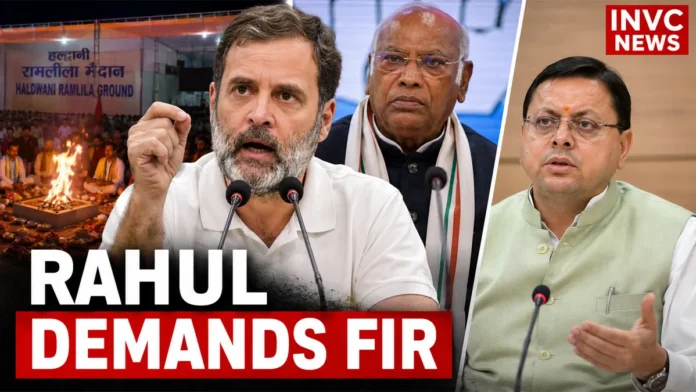
Rahul Gandhi demanded the immediate registration of an FIR under the SC/ST Act over an alleged “purification” ritual conducted at the venue of Mallikarjun Kharge’s Haldwani rally, calling the episode another form of untouchability and launching a fierce attack on the BJP, RSS and Prime Minister Narendra Modi.
The Leader of the Opposition in the Lok Sabha alleged that those responsible had insulted Kharge because of his Dalit identity. He argued that the incident was not merely a political controversy but a test of whether constitutional protections against caste discrimination would be enforced.
The BJP has denied any organisational connection with the ritual. Its leaders have also disputed the Congress’s interpretation of why the ceremony was performed.
What Happened After Kharge’s Haldwani Rally?
Mallikarjun Kharge addressed a Congress gathering at Ramlila Ground in Haldwani, Uttarakhand, on August 8.
Members of the Shri Ram Sena reportedly conducted a “shuddhikaran havan” at the same venue two days later. Congress leaders alleged that the ceremony amounted to caste-based discrimination against Kharge, who is one of India’s most prominent Dalit political leaders.
Rahul Gandhi said nearly three weeks had passed without an FIR being registered under the Scheduled Castes and Scheduled Tribes (Prevention of Atrocities) Act.
“Purification is actually just another name for untouchability,” Gandhi alleged during a press conference at the Congress headquarters in New Delhi.
He maintained that performing such a ritual after Kharge’s appearance conveyed the discriminatory message that a Dalit leader had made the venue “impure.”
No court or investigating authority has determined that the ceremony violated the SC/ST Act. That remains the Congress’s allegation and the basis of its demand for a police investigation.
Rahul Gandhi Targets BJP-RSS Mindset
Gandhi used the controversy to accuse the BJP and RSS of resisting the social progress and political empowerment of Dalits.
He described the dispute as part of a wider ideological struggle between the Constitution and what he called the BJP-RSS worldview.
According to Gandhi, if an experienced national leader such as Kharge could allegedly face such treatment, ordinary Dalit citizens and children could be even more vulnerable to discrimination.
He referred to reported instances in which Dalit children were allegedly made to clean toilets or perform menial tasks in schools. He also raised discrimination at village wells and tea stalls to argue that untouchability had not disappeared from everyday life.
The Congress leader insisted that both the Uttarakhand government and the Centre were responsible for ensuring that the allegations were investigated.
Rahul Questions Prime Minister Modi’s Silence
Rahul Gandhi directly questioned Prime Minister Narendra Modi for not publicly intervening in the controversy.
He urged Modi to direct the authorities to register an FIR against those responsible for the ritual. However, policing is constitutionally a state subject, and any decision to register a case would ordinarily rest with the appropriate police authorities after examining the allegations and applicable law.
Gandhi nevertheless argued that the prime minister’s silence reflected the ruling establishment’s approach towards the issue.
“If action is taken, we will welcome it. If action is not taken, there will be a reaction,” Gandhi said, indicating that the Congress would continue pursuing the matter politically and legally.
Also Read – : Latest India Politics News on INVC NEWS
Kharge Says the Ritual Carried the Sting of Untouchability
Kharge had previously raised the Haldwani controversy in the Rajya Sabha, saying the alleged ritual made him experience the pain and humiliation associated with untouchability.
His intervention transformed a local controversy into a national political confrontation over caste, constitutional rights and political accountability.
Kharge sought action against those responsible, while Congress leaders argued that the ceremony could not be dismissed as an ordinary religious event because of its timing and symbolism.
The BJP, however, rejected the suggestion that the party supported caste discrimination.
BJP Denies Involvement, Dhami Rejects Congress Charge
BJP president and Leader of the House in the Rajya Sabha J.P. Nadda called the incident painful and unacceptable. He said the BJP did not endorse such practices and denied that the party was connected with the organisers.
Uttarakhand BJP president Mahendra Bhatt offered a different explanation. He maintained that the ritual concerned the political atmosphere and slogans at the venue rather than Kharge’s caste.
Uttarakhand Chief Minister Pushkar Singh Dhami also rejected Rahul Gandhi’s interpretation. He said religious slogans had been raised and that the subsequent reaction reflected the sentiments of those involved.
These responses place the central facts of the controversy in dispute: Congress alleges that the ritual targeted Kharge’s Dalit identity, while BJP leaders deny a caste motive and reject any organisational responsibility.
Why the SC/ST Act Demand Matters
The SC/ST Act is intended to prevent specified offences, humiliation and discrimination against members of Scheduled Castes and Scheduled Tribes.
Whether the Haldwani ceremony attracts any provision of the law would depend on the evidence, the identities and intentions of those involved, the precise circumstances of the ritual and a formal assessment by police or a court.
Rahul Gandhi’s demand does not itself establish that an offence occurred. It raises political and legal pressure for the authorities to investigate the episode and record a formal case if the statutory requirements are met.
The controversy has now moved beyond the Haldwani venue. It has become a national confrontation over Dalit dignity, political symbolism and whether an alleged act described by Congress as untouchability should lead to criminal proceedings.









Comments are closed.