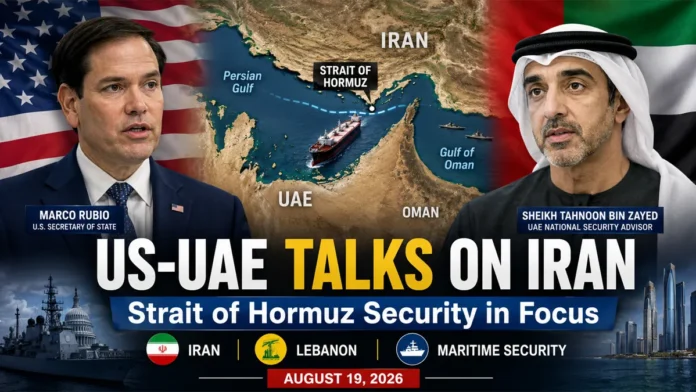
Washington, August 19, 2026
US UAE Iran Talks have brought renewed focus to security across the Gulf and wider Middle East after U.S. Secretary of State Marco Rubio held a phone conversation with UAE National Security Advisor Sheikh Tahnoon bin Zayed Al Nahyan covering Iran, Lebanon and the strategically vital Strait of Hormuz.
The two officials discussed a range of regional security issues as Washington and Abu Dhabi continued diplomatic coordination amid persistent tensions involving Iran and Iranian-backed armed groups, according to an official readout issued by the U.S. State Department.
The conversation also underscored the importance the United States places on maintaining freedom of navigation through the Strait of Hormuz, one of the world’s most consequential maritime passages for international energy trade.
No new military operation, sanctions package or specific joint security measure was announced following the call.
Rubio, Sheikh Tahnoon Discuss Regional Security
Secretary Rubio spoke with Sheikh Tahnoon as both countries continued consultations over security developments affecting the Gulf and other parts of the Middle East.
According to the State Department, their discussion included Iran, Iranian-supported groups, developments in Lebanon and the Strait of Hormuz, as well as continued coordination between Washington and Abu Dhabi.
The high-level conversation highlights the UAE’s importance as one of Washington’s principal security and diplomatic partners in the Gulf.
The United States and UAE cooperate across defense, counterterrorism, economic, technological and regional-security issues, although their positions on specific Middle Eastern conflicts do not always completely align.
Iran and Allied Armed Groups a Key Focus
Iran featured prominently in the conversation.
The State Department said Rubio and Sheikh Tahnoon discussed joint efforts to hold Iran and its terrorist proxies accountable for continuing attacks.
The official readout did not specify which attacks were being referenced or identify any new measures being considered by Washington and Abu Dhabi.
That distinction is significant.
The call demonstrates continued political and security coordination, but it should not be interpreted as confirmation that the United States and UAE have agreed on new military action against Iran or Iran-aligned groups.
Why Strait of Hormuz Security Matters
Rubio also emphasized the importance of freedom of navigation through the Strait of Hormuz, according to the U.S. statement.
The narrow waterway connects the Persian Gulf with the Gulf of Oman and, from there, the Arabian Sea and wider international shipping routes.
Its strategic importance comes from the enormous volume of oil, liquefied natural gas and other commercial cargo transported through the passage by Gulf producers.
Any prolonged disruption to shipping through Hormuz can potentially affect energy supplies, tanker movements, insurance costs and international oil markets.
For Gulf economies including the UAE, maintaining predictable maritime access is therefore both a national-security and economic priority.
Washington Sends Message on Freedom of Navigation
By highlighting freedom of navigation during the call, Rubio reinforced a longstanding U.S. position that international shipping must be able to move through strategically important waterways without unlawful interference.
The issue has become especially sensitive during periods of heightened confrontation involving Iran.
Washington has repeatedly worked with regional partners on maritime-security initiatives aimed at protecting commercial traffic and monitoring potential threats in Gulf waters.
Wednesday’s official readout, however, did not announce an expansion of those operations.
Lebanon Also Discussed
The two officials also discussed developments in Lebanon, according to the State Department.
The U.S. statement provided no further details about that portion of the conversation.
Lebanon remains an important element in the wider regional-security picture because of domestic political instability and the influence of armed groups with ties to Iran.
Given the lack of additional information in the official readout, it would be premature to conclude that Washington and Abu Dhabi agreed on any specific new policy toward Lebanon during the call.
No Specific Joint Action Announced
Although the call covered several major security issues, the State Department did not announce a concrete new diplomatic or military initiative.
There was no announcement of:
- new sanctions against Iran;
- a joint U.S.-UAE military operation;
- additional deployments around the Strait of Hormuz;
- a new policy toward Lebanon; or
- a formal security agreement arising from the conversation.
Instead, the public readout emphasized continuing coordination between the two governments.
That suggests the call was primarily part of ongoing high-level consultations rather than the announcement of a new policy framework.
Why the UAE Matters to US Gulf Strategy
The United Arab Emirates occupies an important position in Washington’s approach to Gulf security.
Its geographical location near key shipping routes, close economic links with global markets and significant regional diplomatic influence give Abu Dhabi an important role in discussions involving Iran and maritime security.
The UAE also maintains its own direct diplomatic channels with Tehran, giving it an unusual position as both a close U.S. partner and a neighboring Gulf state that regularly engages Iran.
This creates a complex diplomatic environment in which deterrence, economic interests and regional dialogue can operate simultaneously.
Maritime Security Remains a Major Concern
The security of international shipping has become one of the central strategic concerns across the Middle East.
Commercial vessels passing through the Persian Gulf, Gulf of Oman, Arabian Sea and nearby waters carry substantial volumes of energy and other goods.
Any security incident involving tankers or cargo vessels can quickly have consequences beyond the immediate region.
Those risks explain why freedom of navigation remains a recurring issue in discussions between Washington and Gulf governments.
US-UAE Relationship Extends Beyond Security
While defense and regional stability remain major elements of U.S.-UAE ties, the bilateral relationship also includes significant economic, investment and technology cooperation.
The UAE has developed into one of the most influential commercial and financial centers in the Middle East, while the United States remains an important defense and technology partner.
This wider relationship means high-level contacts between U.S. and Emirati officials frequently address multiple strategic priorities simultaneously.
Wednesday’s call nevertheless placed regional security firmly at the center.
Iran Tensions Continue to Shape Washington’s Gulf Policy
Iran and groups aligned with Tehran remain major factors in U.S. security planning across the Middle East.
Washington has repeatedly accused Iran-backed organizations of carrying out attacks against U.S. interests, regional partners and commercial shipping.
Iran, for its part, has long rejected U.S. pressure and accused Washington of destabilizing the region through its military presence and support for Tehran’s rivals.
The differing positions have made Gulf security one of the most sensitive areas of U.S.-Iran relations.
Hormuz Remains Critical to Global Energy Markets
The Strait of Hormuz is important not only to the United States, UAE or Iran.
Its strategic value extends to major energy-importing economies across Asia and Europe.
Oil and LNG exported from Gulf producers must often transit the waterway before reaching international markets.
That means even the prospect of prolonged disruption can influence market expectations.
For that reason, discussions about Hormuz frequently combine security policy with concerns over global energy stability.
Continued Coordination Between Washington and Abu Dhabi
The latest US UAE Iran Talks ultimately underline the continuing diplomatic coordination between Washington and Abu Dhabi as both governments assess changing security conditions across the region.
Rubio’s emphasis on freedom of navigation suggests that keeping the Strait of Hormuz open to international traffic remains a priority for the United States.
At the same time, the discussion of Iran, Iranian-backed groups and Lebanon demonstrates how interconnected the region’s security challenges remain.
The official readout provides no indication that a new military or diplomatic initiative was finalized during the call.
For now, the key takeaway is continued high-level coordination between two close partners at a time when Iran-related tensions and maritime security remain major concerns across the Middle East.