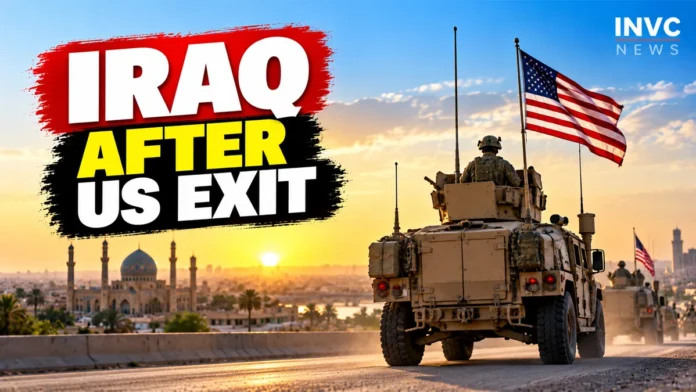
BAGHDAD, Iraq | September 30, 2026 — The US troop withdrawal from Iraq puts a security question at the center of a historic transition: can Baghdad contain armed factions and keep ISIS under pressure as American forces leave their remaining bases? The September 30 deadline closes another chapter in US military involvement that began with the 2003 invasion. However, the immediate stakes concern what replaces American intelligence, logistical support, and air defenses—and whether Iraq’s government can turn greater responsibility into effective control.
INVC NEWS | BEYOND THE HEADLINE
What happened. Why it matters. What comes next.
A Departure Planned Before Trump’s Current Term
Washington and Baghdad agreed on the transition in 2024 under President Joe Biden. President Donald Trump’s administration is carrying out the withdrawal.
The remaining deployment had concentrated in northern Iraq’s semi-autonomous Kurdistan region. Iraqi officials previously outlined plans to transfer coalition facilities near Erbil International Airport to the relevant authorities and other bases to Kurdish Peshmerga forces.
Baghdad presents the departure as a milestone for sovereignty. Yet taking control of facilities and maintaining the capabilities associated with them are different tasks.
The withdrawal also does not automatically end US-Iraqi relations. Both governments have discussed a future relationship involving bilateral defense and commercial cooperation.
What a “Security Vacuum” Would Actually Mean
A security vacuum does not require an empty country or the disappearance of its armed forces.
In this context, the concern involves gaps between existing threats and the capabilities available to respond. Iraqi and Kurdish forces remain responsible for security. The question is whether they can replace departing support quickly enough.
Kurdish commander Sirwan Barzani warned that losing US intelligence, logistics, and drone support could give ISIS opportunities to regroup.
That is a warning about potential consequences, rather than proof that an ISIS resurgence has already followed the withdrawal.
ISIS Lost Its Territory, but the Threat Remains
The defeat of ISIS’s territorial project did not eliminate its sleeper-cell networks.
Iraqi security officials have voiced concern that militants could exploit the transition. Barzani reported increased sleeper-cell movement ahead of the withdrawal deadline, while officials described a suspected plot timed around the departure.
These accounts underline why the next phase depends on operational performance: identifying networks, sharing intelligence, and disrupting attacks.
A successful handover requires those functions to continue even as the foreign military footprint changes.
Iran-Backed Militias See an Opportunity
Iran and allied armed factions portray the American departure as a victory.
Iraqi security analyst Jasim al-Bahadli argues that removing the US military presence weakens a counterweight to Tehran’s influence. He expects aligned factions to seek greater influence over political and security decisions.
However, increased influence is an assessment of what could follow. It should not become a claim that Iran now controls every Iraqi institution.
Baghdad faces a difficult challenge: strengthening state authority while managing powerful armed groups with their own leadership, weapons, and political connections.
The Unfinished Question of Disarmament
The troop departure and militia disarmament are not moving on identical timelines.
Iraqi Prime Minister Ali al-Zaidi has extended the disarmament timetable to June 30, 2027. Several powerful factions have resisted surrendering their weapons or attached conditions to doing so.
Chatham House researcher Renad Mansour describes Iraq’s political landscape as fragmented, with political movements connected to armed organizations. That structure makes rapid security-sector reform difficult.
For civilians, the practical test concerns who can enforce decisions when an armed faction challenges the government.
Why Erbil Faces Particular Concern
The withdrawal includes the removal of US air-defense systems from Erbil.
Kurdistan Regional Government Prime Minister Masrour Barzani has sought protection from Baghdad against missile and drone attacks. His concern highlights a capability that cannot be replaced simply by assigning more personnel to a base.
Federal and Kurdish authorities must also coordinate protection, command responsibilities, and responses to emerging threats.
The outcome will matter for residents, institutions, and communities that have already experienced repeated instability.
The History Needs a Careful Distinction
America’s involvement spans more than two decades, but its troop presence was not uninterrupted.
US forces invaded Iraq in 2003, withdrew in 2011, and returned in 2014 to help fight ISIS.
Consequently, today’s transition closes the latest deployment chapter. It does not mean the same military mission continued unchanged for 23 years.
That history also explains the concern surrounding another departure: the security arrangements that follow matter as much as the withdrawal itself.
What Readers Should Watch Next
Three developments will reveal whether the transition strengthens stability:
- Whether Iraqi and Kurdish forces maintain effective counter-ISIS coordination.
- Whether authorities provide replacement protection against missile and drone threats.
- Whether militia disarmament produces verifiable progress toward state control.
These are measures of performance, rather than predictions of inevitable collapse.
The Test Begins After the Bases Change Hands
Baghdad gains greater responsibility as American forces leave. It must now demonstrate that national institutions can provide security, prevent militant regrouping, and enforce decisions across competing centers of power.
The decisive question is whether Iraq can make sovereignty tangible for its people through protection and accountable authority.