WASHINGTON, D.C., United States | August 27, 2026 —
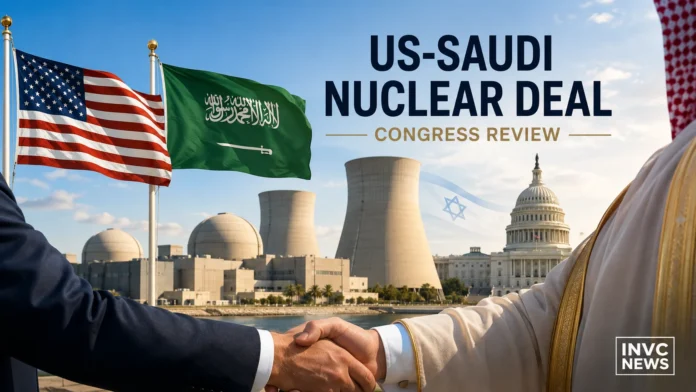
US-Saudi nuclear deal has entered a critical new phase after President Donald Trump’s administration submitted a proposed civilian nuclear cooperation agreement with Saudi Arabia to the U.S. Congress, opening a lengthy review process for a pact that could reshape energy, business and security ties across the Middle East.
The 30-year agreement would allow American companies to export civilian nuclear technology to Saudi Arabia and could pave the way for a reactor program worth tens of billions of dollars, with Westinghouse AP1000 reactors expected to play a central role.
But the biggest obstacle may have little to do with nuclear engineering.
The Trump administration says the agreement will only move forward if Saudi Arabia normalizes relations with Israel and joins the Abraham Accords. Riyadh, however, continues to insist that recognition of Israel requires an irreversible pathway toward a Palestinian state.
That leaves one of Washington’s most ambitious energy deals tied directly to one of the Middle East’s most difficult diplomatic questions.
What Is the US-Saudi Nuclear Deal?
The agreement is a civilian nuclear cooperation pact negotiated under Section 123 of the U.S. Atomic Energy Act.
Such an agreement provides the legal framework required before significant U.S. civilian nuclear technology, equipment and material can be transferred to another country.
The Saudi agreement was reached in July and has now been transmitted to Congress for review.
The proposed partnership could allow U.S. nuclear companies to participate in Saudi Arabia’s plans to build a large civilian nuclear-energy industry as the kingdom seeks to diversify its economy and reduce dependence on oil.
The agreement is expected to run for about 30 years and support projects potentially worth tens of billions of dollars.
Westinghouse AP1000 Reactors Could Be the Big Commercial Prize
For the U.S. nuclear industry, Saudi Arabia represents a potentially enormous export market.
The proposed framework calls for construction involving AP1000 nuclear reactors, technology developed by Westinghouse.
Westinghouse is jointly owned by Canada-based Cameco and Brookfield Asset Management.
If Saudi Arabia proceeds with a large reactor fleet using American technology, the project could create business opportunities extending beyond reactor construction into engineering, fuel services, maintenance, training and long-term nuclear infrastructure.
That gives the agreement an important commercial dimension alongside its geopolitical significance.
Why Is Israel Recognition Linked to the Nuclear Deal?
Trump has made Saudi participation in the Abraham Accords a central condition of his broader Middle East strategy.
The Abraham Accords established diplomatic relations between Israel and countries including the United Arab Emirates, Bahrain and Morocco.
Saudi recognition would be a far bigger diplomatic breakthrough because of the kingdom’s economic, political and religious influence across the Arab and Islamic world.
The Trump administration says its position has not changed: the nuclear agreement should only move forward if Riyadh normalizes relations with Israel.
However, this should be understood as the administration’s stated political condition.
It is not the same thing as saying that Israel recognition is automatically built into the congressional review law governing Section 123 agreements.
That distinction could become increasingly important as Congress examines the pact.
Saudi Arabia Still Wants a Palestinian State Path
The diplomatic gap remains substantial.
Saudi Arabia has maintained that normalization with Israel requires an irreversible pathway toward Palestinian statehood.
That condition became even more politically important after the Gaza war transformed public opinion and regional diplomacy.
For Washington, the challenge is therefore to connect three separate goals:
- Build a U.S.-Saudi civilian nuclear partnership
- Secure stronger non-proliferation safeguards
- Achieve Saudi-Israel normalization
Progress on one does not automatically guarantee progress on the others.
Congress Now Gets 90 Days of Review
The proposed agreement has entered the formal congressional review process.
Under Section 123 procedures, Congress receives a statutory review period of 90 days of continuous session, meaning the real-world process can stretch over several months depending on the congressional calendar.
If Congress does not enact legislation stopping the agreement during the review period, the pact can move toward entry into force.
If lawmakers reject it, Trump could veto that action, and Congress would require a two-thirds majority to override the veto.
That makes congressional opposition important—but not automatically decisive.
Uranium Enrichment Is the Most Sensitive Nuclear Question
The agreement is already facing scrutiny from some lawmakers and nuclear non-proliferation specialists.
A central concern is whether Saudi Arabia could eventually enrich uranium domestically or reprocess spent nuclear fuel.
Those activities can form part of a peaceful civilian nuclear-fuel cycle, but they are considered particularly sensitive because the same technologies can have proliferation implications.
Critics note that the United Arab Emirates accepted a stronger model in its 2009 U.S. nuclear agreement by renouncing domestic enrichment and reprocessing—the approach often described as the “gold standard.”
The Trump administration says the Saudi agreement contains the non-proliferation protections required under U.S. law.
However, debate over whether those safeguards go far enough is likely to become one of the central issues during the congressional review.
Why Saudi Arabia Wants Nuclear Power
Saudi Arabia’s interest in nuclear energy is closely connected to its broader economic transformation.
The kingdom wants to diversify its power system while preserving more oil and gas for export or industrial use.
Nuclear reactors can provide large amounts of low-carbon electricity around the clock, complementing Saudi Arabia’s rapidly expanding solar and renewable-energy investments.
The kingdom is also trying to develop industries that require enormous amounts of reliable power, including manufacturing, data centers and advanced technology.
That makes nuclear energy part of the larger Vision 2030 economic diversification strategy.
Why Washington Wants the Deal
For the United States, the agreement is about more than selling reactors.
Washington is competing with countries including China and Russia for influence in the global civilian nuclear market.
If Saudi Arabia builds its program around American technology and regulatory standards, the U.S. could maintain decades of strategic and commercial influence over one of the Middle East’s most important economies.
The nuclear agreement could also deepen an already significant U.S.-Saudi security relationship at a time when the region is facing continuing instability linked to Iran, Gaza and maritime trade routes.
Also Read – : Trump Says US Wants Iran Deal but Rules Out Any Iranian Nuclear Weapons Program
Iran Makes the Nuclear Question Even More Sensitive
Any Saudi nuclear program will inevitably be viewed through the lens of the regional rivalry with Iran.
Washington continues to insist that Iran must not develop nuclear weapons, while Tehran says its nuclear activities are intended for peaceful purposes.
Saudi Arabia has previously expressed concern about the possibility of Iran acquiring a nuclear weapon.
That makes safeguards surrounding the Saudi civilian program particularly important for preventing a broader regional nuclear competition.
Also Read – : Rubio Vows US Will Protect Gulf Allies’ Interests in Iran Talks
Hormuz Crisis Adds Another Layer
The nuclear agreement is also arriving during a period of severe energy-security disruption in the Gulf.
Tensions around the Strait of Hormuz have affected oil and shipping flows and reminded Gulf governments of the risks associated with heavy dependence on hydrocarbon infrastructure and regional shipping routes.
Also Read – : Trump Strait of Hormuz Tensions Rise as Iran Keeps Key Oil Route Restricted
For Saudi Arabia, diversifying its domestic electricity system does not eliminate geopolitical risk, but it could reduce the amount of oil and gas needed for domestic power generation over the long term.
Could the Deal Proceed Without Saudi-Israel Normalization?
This may become the most important legal and political question.
The administration insists normalization remains a condition.
However, once a Section 123 agreement enters the congressional process, lawmakers are examining the nuclear pact itself under U.S. law.
Non-proliferation specialists have therefore raised questions about whether the agreement could ultimately move forward through the statutory process even if Saudi-Israel normalization remains unresolved.
That uncertainty will keep attention focused on both Congress and the White House.
What Happens Next?
There are now four developments to watch.
Congressional review: Lawmakers will examine the agreement and its safeguards.
Saudi-Israel diplomacy: Riyadh’s Palestinian-state condition remains a major obstacle to normalization.
Nuclear safeguards: Enrichment and reprocessing provisions will face close scrutiny.
Commercial negotiations: Westinghouse and other U.S. nuclear companies could stand to gain substantially if the deal progresses.
The nuclear agreement therefore sits at the intersection of energy, business, diplomacy and nuclear security.
For Trump, success would mean more than selling American reactors.
It could deliver a major U.S. commercial victory, strengthen ties with Saudi Arabia and potentially produce the biggest expansion of the Abraham Accords.
But all three objectives depend on unresolved political questions.
And for now, the most important fact is this:
The US-Saudi nuclear deal has entered Congress, but its path to implementation remains closely tied to the far more difficult question of Saudi Arabia’s relationship with Israel.