WASHINGTON, August 12, 2026
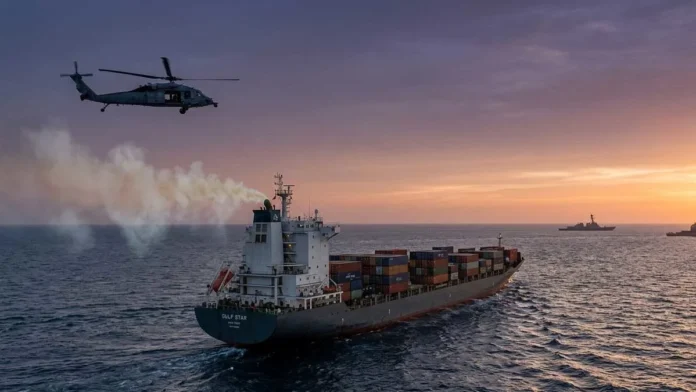
US Iran Naval Blockade enforcement has intensified after American forces fired on and disabled a Panama-flagged commercial vessel in the Gulf of Oman that the US military said was attempting to breach restrictions on maritime traffic to Iranian ports.
The vessel, identified as the Vela Nova, was struck after its crew failed to comply with repeated warnings from American forces enforcing the blockade, according to US Central Command.
A US military helicopter fired two Hellfire missiles at the vessel, striking its engine-room area and leaving the ship unable to continue its voyage. A fire that broke out aboard the vessel was later extinguished.
All 17 crew members aboard the Vela Nova were accounted for, with no casualties reported following the operation.
The incident represents a significant demonstration of Washington’s willingness to use military force to enforce its blockade as President Donald Trump’s administration continues applying economic and strategic pressure on Iran.
Why Did the US Military Strike the Vela Nova?
According to the US military, the Vela Nova was attempting to violate the naval blockade imposed on Iranian ports while traveling through the Gulf of Oman.
American forces issued warnings instructing the vessel to comply with the blockade. When the ship continued its movement despite those warnings, military action was taken to stop it.
A US Navy helicopter subsequently fired two Hellfire missiles, disabling the vessel.
The operation stopped the Vela Nova from continuing toward the blockaded area without sinking the commercial ship.
The incident occurred in the Gulf of Oman, a strategically important maritime area connecting the Arabian Sea with approaches to the Strait of Hormuz and Persian Gulf.
What Happened to the Crew?
The attack initially raised questions about the safety of those aboard the commercial vessel.
However, subsequent information indicated that all 17 crew members were accounted for and no casualties were reported.
The missile strike caused a fire in the vessel’s engine-room area, but the blaze was extinguished.
The ship was left disabled following the operation.
How Many Ships Has the US Turned Away?
The Vela Nova incident comes amid a broader American effort to enforce restrictions on commercial shipping entering or leaving Iranian ports.
US Central Command said shortly before the latest incident that American forces had redirected 55 commercial vessels attempting to operate in violation of the renewed blockade.
US forces had also disabled vessels that failed to follow instructions and boarded other ships to verify compliance.
The latest strike demonstrates that American forces are prepared to escalate from warnings and diversions to disabling vessels when crews do not comply with military instructions.
Why Is the US Blockading Iranian Ports?
The naval blockade is part of Washington’s broader campaign to place economic pressure on Tehran.
Restricting maritime access to Iranian ports can affect Iran’s ability to conduct international trade, particularly in sectors dependent on commercial shipping.
The Trump administration has sought to use economic pressure alongside military deterrence as it pushes Tehran toward an agreement.
The maritime operation means that pressure on Iran is no longer limited to financial sanctions and diplomatic measures. Enforcement is taking place directly along strategic shipping routes surrounding Iran.
US-Iran Tensions Extend Into the Gulf of Oman
The Gulf of Oman is one of the world’s most strategically sensitive maritime regions.
Ships traveling between the Arabian Sea and Persian Gulf typically pass through the Gulf of Oman before approaching the Strait of Hormuz, the narrow waterway through which a significant share of globally traded oil and liquefied natural gas moves.
That makes military incidents involving commercial vessels particularly sensitive because escalating tensions can affect shipping operations, insurance costs and global energy markets.
The Vela Nova incident therefore carries implications extending beyond the individual vessel.
US Military Presence Remains Strong Around Iran
The United States maintains substantial naval and air capabilities across waters surrounding the Middle East as Washington continues its pressure campaign against Iran.
Aircraft carriers, surface warships, military aircraft and Marine forces have been deployed across the broader region during the conflict.
The presence gives US forces the ability to monitor shipping routes and enforce maritime restrictions across strategically important waterways.
The latest operation also demonstrates the role of helicopters and precision-guided weapons in stopping vessels Washington says are violating the blockade.
What Does the Vela Nova Strike Mean for US-Iran Tensions?
The strike underscores the military dimension of Washington’s economic pressure campaign.
Rather than relying solely on sanctions to restrict Iranian trade, US forces are actively intercepting commercial shipping suspected of violating the blockade.
The action also sends a warning to shipping companies and vessel operators considering voyages involving Iranian ports.
At the same time, repeated military encounters involving civilian commercial vessels increase the risks surrounding navigation in the Gulf of Oman and waters near the Strait of Hormuz.
The latest incident comes as diplomatic efforts between Washington and Tehran remain stalled and both sides continue to maintain pressure over the terms of any future agreement.
For international shipping, developments in the Gulf of Oman and around the Strait of Hormuz will remain closely watched because further military encounters could have consequences for maritime traffic and global energy markets.