Kampala, Uganda | July 17, 2026
Uganda Ebola Outbreak response has entered a critical final stage after the country’s last confirmed Ebola patient was discharged from hospital with a negative test result, officially triggering the World Health Organization’s (WHO) 42-day surveillance period before the outbreak can be declared over.
Ugandan health authorities announced that if no new Ebola infections are detected during the next 42 consecutive days, the outbreak will officially be declared over in accordance with WHO guidelines.
The milestone marks significant progress in Uganda’s efforts to contain the deadly virus through rapid surveillance, treatment, and public health interventions.
Last Patient Declared Virus-Free
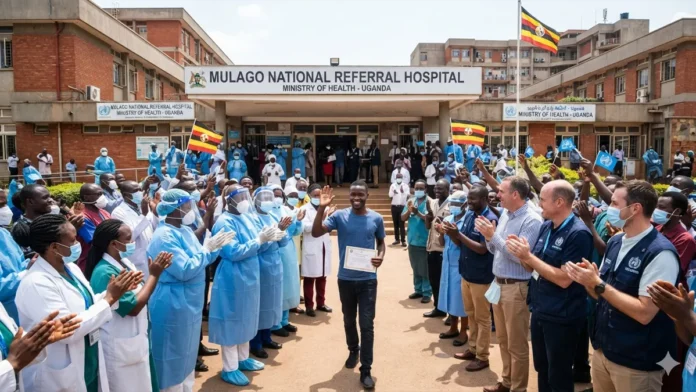
Uganda’s Minister of Health, Dr. Chris Baryomunsi, presided over a symbolic discharge ceremony at Mulago National Referral Hospital in Kampala, where the country’s final confirmed Ebola patient was formally released.
During the ceremony, the patient received an official Ebola discharge certificate confirming that laboratory tests had returned negative and that the individual was no longer capable of transmitting the virus.
Speaking at the event, Baryomunsi said the recovered patient no longer posed a public health risk and could safely return home, resume work, and reintegrate into normal daily life.
He also urged communities and local authorities to welcome survivors without discrimination, emphasizing the importance of helping them reintegrate into society.
WHO Praises Uganda’s Preparedness
The World Health Organization (WHO) credited Uganda’s strong preparedness and rapid response for helping contain the outbreak.
WHO Representative in Uganda, Dr. Kasonde Mwinga, said Ebola response teams remained fully operational throughout the outbreak, enabling authorities to quickly identify cases, isolate patients, and monitor contacts.
According to Mwinga, Uganda’s early preparedness contributed to a case fatality rate of less than 10%, one of the lowest recorded during an Ebola outbreak.
Health officials said coordinated surveillance, laboratory testing, and community engagement played a key role in limiting the virus’s spread.
Why the 42-Day Monitoring Period Matters
Under WHO guidelines, an Ebola outbreak can only be officially declared over after 42 consecutive days without a new confirmed case following the point at which the last patient is no longer infectious.
A patient is considered no longer infectious after:
- Recovering and testing negative before hospital discharge, or
- Dying from the disease.
If no additional cases are detected during the monitoring period, health authorities may formally announce the end of the outbreak.
Officials said surveillance activities will remain intensive throughout the six-week observation period to quickly detect and respond to any potential new infections.
Outbreak Linked to Bundibugyo Strain
Uganda confirmed the Ebola outbreak on May 15, after testing identified the Bundibugyo strain of the Ebola virus in a traveler who had arrived from the neighboring Democratic Republic of the Congo (DRC).
The Bundibugyo strain has also been responsible for ongoing Ebola activity in parts of the DRC.
Health authorities immediately launched emergency response measures, including contact tracing, laboratory testing, isolation of suspected cases, and public awareness campaigns aimed at preventing further transmission.
Twenty Confirmed Cases Reported
According to Ugandan health authorities, the outbreak resulted in:
- 20 confirmed Ebola cases
- 15 patients from the Democratic Republic of the Congo
- 5 Ugandan nationals
- 2 fatalities
The remaining patients recovered after receiving medical care and supportive treatment.
Officials continue to monitor individuals who may have had contact with confirmed cases while maintaining enhanced surveillance at health facilities and border crossings.
Regional Vigilance Remains Essential
Although Uganda is approaching the official end of the outbreak, health experts say continued regional cooperation remains vital because Ebola outbreaks can spread across borders through international travel.
Authorities are maintaining surveillance in collaboration with neighboring countries, particularly the Democratic Republic of the Congo, where the Bundibugyo strain continues to circulate.
Public health officials stressed that rapid detection, laboratory capacity, community awareness, and international cooperation remain critical components of Ebola preparedness.
WHO Monitoring Continues
The WHO and Uganda’s Ministry of Health will continue monitoring the situation throughout the 42-day surveillance period.
If no additional infections are confirmed, Uganda will officially declare the Ebola outbreak over, marking another significant public health achievement for the country and its international health partners.
Officials say the response demonstrates the importance of early detection, coordinated emergency action, and sustained public health preparedness in controlling highly infectious diseases.
Key Highlights
- Uganda Ebola Outbreak enters the WHO’s mandatory 42-day monitoring period.
- The country’s last confirmed Ebola patient has been discharged after testing negative.
- Uganda’s Health Ministry says the patient is no longer infectious.
- WHO praised Uganda’s rapid response and preparedness efforts.
- The outbreak recorded 20 confirmed cases and 2 deaths.
- The outbreak involved the Bundibugyo strain of the Ebola virus.
- If no new cases emerge within 42 days, Uganda will officially declare the outbreak over.