By Team INVC | INVC NEWS
Published: August 29, 2026 | 8 : 48 AM IST
WASHINGTON, UNITED STATES | August 29, 2026 —
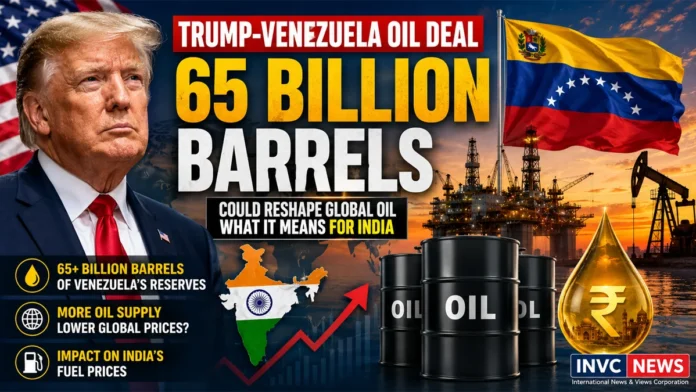
The Trump Venezuela oil deal has suddenly become one of the biggest developments in the global energy market after U.S. President Donald Trump announced an agreement giving the United States majority control over the development of more than 65 billion barrels of Venezuela’s proven oil reserves.
The unprecedented public-private arrangement could open major Venezuelan oil fields to expanded U.S.-led investment and production while potentially adding significant crude supplies to a global market already struggling with disruptions from the Iran conflict and the Strait of Hormuz.
For India, one of the world’s largest crude importers, the obvious question is immediate:
Could Venezuela’s enormous oil reserves eventually help bring down crude—and petrol and diesel prices?
The answer is potentially yes over time, but not immediately.
What Exactly Did Trump Announce?
Trump said the United States had entered an agreement involving more than 65 billion barrels of Venezuela’s proven reserves.
The arrangement is expected to provide new exploration and production rights, with U.S. companies playing a leading role in projects concentrated in areas including the Orinoco Belt and Lake Maracaibo.
The administration says the arrangement will not require U.S. taxpayer funding.
Venezuela’s interim President Delcy Rodríguez has backed the agreement and projected that it could attract around $100 billion in private investment.
The Venezuelan government also expects major tax revenues and employment benefits if investment succeeds in restoring production.
But the headline needs an important qualification:
The United States has not simply “bought Venezuela’s oil.”
The deal concerns majority control over development and production arrangements covering a portion of Venezuela’s reserves. Legal experts are already questioning how the structure fits with Venezuela’s constitutional rules governing state ownership of petroleum resources.
Why 65 Billion Barrels Is Such a Huge Number
Venezuela possesses the world’s largest proven crude-oil reserves.
Much of that oil is concentrated in the Orinoco Oil Belt, where deposits primarily consist of extra-heavy crude.
That means the resource is enormous—but it is not necessarily quick or cheap to produce.
Heavy Venezuelan crude requires specialized production, upgrading, transport and refining infrastructure.
Years of underinvestment, sanctions, political instability and deteriorating infrastructure have also reduced Venezuela’s ability to turn its huge reserves into equally huge daily production.
The new Trump-backed arrangement is essentially a bet that large-scale private investment can change that.
Chevron Could Be One of the Biggest Winners
Chevron is separately moving toward restructuring and expanding its Venezuelan operations under the country’s new energy framework.
The U.S. oil major could gain greater operational control over existing ventures and expand into additional areas in the Orinoco Belt.
That is significant because the difference between 65 billion barrels underground and millions of additional barrels reaching global markets ultimately depends on companies being willing to spend billions developing the fields.
If Chevron and other international producers commit serious capital, Venezuela could gradually become a much larger supplier again.
Could the Deal Push Global Oil Prices Lower?
Potentially—but markets should not expect 65 billion barrels to suddenly flood into refineries.
Brent crude settled Friday at around $89.31 a barrel, while WTI ended near $83.40.
Brent also fell more than 5% over the week amid changing expectations around the Strait of Hormuz, U.S.-Iran tensions and global monetary policy.
The Venezuela agreement creates an additional longer-term bearish factor for crude.
If Venezuelan production rises substantially, more barrels in the Atlantic market could:
- Increase global crude supply
- Give refiners more sourcing options
- Increase competition among producers
- Reduce reliance on some Middle Eastern supplies
- Put downward pressure on heavy-crude prices
But rebuilding oil production takes time.
Therefore, Saturday morning’s Trump announcement does not mean international crude prices—or Indian petrol prices—will suddenly fall next week.
Also Read – : Iran-America War Petrol Diesel Prices: Will Fuel Get Costlier as Brent Crude Jumps Above $91?
Why India Should Pay Close Attention
India imports more than 90% of the crude oil it consumes, making the economy highly sensitive to global oil prices.
Even a sustained reduction of a few dollars per barrel can affect:
- India’s import bill
- Inflation
- The rupee
- Refining costs
- Government finances
- Petrol and diesel pricing economics
Venezuelan crude is also not unfamiliar to Indian refiners.
Earlier in 2026, Trump said India would resume buying Venezuelan oil as New Delhi diversified away from some Russian supplies. U.S. restrictions on Venezuela’s oil sector had also been eased to facilitate international sales.
The latest agreement could eventually create a much larger pool of Venezuelan crude available to buyers.
For Indian refiners capable of processing heavier grades, that could improve sourcing flexibility—particularly when Middle Eastern supplies face geopolitical risks.
Hormuz Crisis Makes Venezuela More Valuable
The timing is especially important.
The Strait of Hormuz crisis has exposed how vulnerable the global energy market remains to disruption in the Middle East.
The White House said Friday that nearly 1,500 commercial vessels carrying 750 million barrels of crude had crossed the Strait under U.S. protection, while Gulf exports had recovered to about two-thirds of their pre-operation levels.
Nevertheless, the Iran conflict continues to complicate shipping, insurance and energy flows.
That makes large reserves outside the Gulf increasingly strategically important.
Venezuela therefore offers Washington something bigger than just commercial oil:
An enormous Western Hemisphere energy reserve outside the Strait of Hormuz.
Also Read – : Trump Strait of Hormuz Tensions Rise as Iran Keeps Key Oil Route Restricted
Could Petrol and Diesel Become Cheaper in India?
There is no automatic formula connecting this agreement to retail pump prices in India.
Indian petrol and diesel prices depend on international crude and refined-product prices, the rupee-dollar exchange rate, refining margins, freight, central and state taxes and pricing decisions by oil marketing companies.
However, if Venezuelan production increases materially and helps keep global crude prices lower over a sustained period, India would be among the major economies that could benefit.
The impact would first appear through lower crude-import costs and inflation pressure rather than an overnight reduction at petrol pumps.
The Biggest Question: Can Venezuela Actually Produce the Oil?
That is now the crucial test.
Venezuela may possess extraordinary reserves, but turning those reserves into dependable production requires:
Investment. Infrastructure. Political stability. Technology. Legal certainty.
Trump’s 65-billion-barrel announcement is therefore enormous on paper.
What happens next will determine whether it becomes an equally enormous development in the real oil market.
If billions of dollars of promised private investment actually arrive and production begins climbing sharply, the effects could stretch from U.S. gasoline stations to Indian refineries—and ultimately global crude prices themselves.