WASHINGTON — August 17, 2026
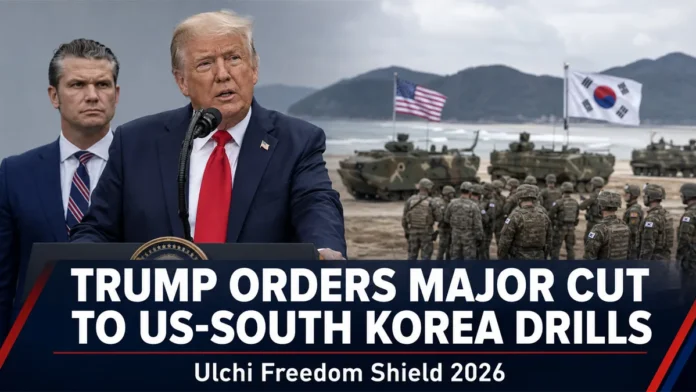
Trump South Korea military drills will be substantially reduced after President Donald Trump ordered the Pentagon to scale back the annual exercises, arguing that they are costly and send an unnecessarily hostile signal to North Korea.
Trump announced the directive Sunday, just before Washington and Seoul were scheduled to begin their annual Ulchi Freedom Shield exercise. The drills are set to run from August 17 through August 27 and involve approximately 18,000 South Korean military personnel.
The president said it was too late to cancel the exercise entirely. However, he instructed Defense Secretary Pete Hegseth to significantly reduce its scope.
“Based on my very good relationship with Kim Jong Un, of North Korea, I am not happy with the fact that the United States has, long ago, agreed to participate in Joint Military Exercises with South Korea,” Trump wrote in his social media statement.
Trump Calls Military Exercises Expensive and Hostile
Trump argued that the United States carries much of the financial burden associated with the exercises. He also said the drills send what he described as an inappropriate and hostile message to Pyongyang.
“These exercises are not only expensive, with the United States paying for most of them, as usual, but they send a signal that is totally inappropriate and hostile,” Trump wrote.
The president maintained that North Korea had not posed a threat and had behaved respectfully during his time in office. He then announced his decision to reduce the exercises.
“Since it is now too late to cancel them, I have instructed Secretary Pete Hegseth to substantially reduce the Joint Military Exercises,” Trump added.
The administration had not immediately provided detailed information about which parts of the exercise would be reduced, how many US personnel would participate or whether planned field-training operations would be affected.
What Is Ulchi Freedom Shield?
Ulchi Freedom Shield is a major annual exercise intended to strengthen coordination between American and South Korean forces. It combines military training with government-led emergency preparedness exercises.
The 2026 edition is expected to include training designed to address evolving security threats, including:
- Counter-drone operations
- Cyberattack response
- GPS signal disruption
- Missile defense scenarios
- Command-and-control coordination
- Civilian emergency preparedness
US military officials have historically described the exercise as defensive. Similar combined exercises are conducted to test readiness and improve the ability of both countries to respond to potential crises on the Korean Peninsula.
The US Army has described combined training with South Korea as an important part of maintaining military readiness and regional stability. Its official material says such exercises are designed to improve the alliance’s joint and all-domain response capabilities. US Army information emphasizes preparedness and combined defense.
South Korea Says Exercise Will Continue
South Korea’s Defense Ministry said the exercise would proceed according to the schedule previously announced. That position suggests Seoul has not treated Trump’s order as a cancellation of Ulchi Freedom Shield.
Instead, the immediate effect is expected to fall primarily on the scale or nature of US participation. Further coordination between the Pentagon, US Forces Korea and South Korean defense officials may determine how the presidential directive is implemented.
Any substantial reduction could affect field maneuvers, troop numbers, live-training components or the range of simulated operations. However, no official breakdown had been released when the directive was announced.
North Korea Has Long Opposed Joint Drills
Pyongyang has repeatedly condemned US-South Korea military exercises, calling them preparations for an invasion. Washington and Seoul reject that characterization and maintain that the drills are defensive.
North Korea has often responded to major exercises with military statements, weapons tests or threats of countermeasures. As a result, the Ulchi Freedom Shield period is regularly monitored for possible escalation on the Korean Peninsula.
Trump emphasized his relationship with North Korean leader Kim Jong Un while explaining his decision. The two leaders met three times during Trump’s first presidential term, including their 2018 summit in Singapore.
Following that meeting, Trump suspended some large-scale military activities and described them as expensive and provocative. His latest order indicates that his earlier objections to joint exercises continue to influence his approach to North Korea.
Iran Dispute Also Entered Trump’s Statement
Trump also connected his dissatisfaction with Seoul to an unrelated conversation about Iran. He said he recently asked South Korea’s president whether the country wanted to participate in US efforts to denuclearize Iran.
According to Trump, the South Korean president declined the invitation by responding, “No, thank you.”
Trump did not provide additional details about the conversation or explain whether Seoul’s response directly influenced his order to reduce the exercises.
What the Decision Could Mean for the Alliance
The directive places fresh attention on the US-South Korea security partnership and the balance between diplomatic outreach to North Korea and military preparedness.
Reducing the exercises could help lower immediate tensions with Pyongyang. However, smaller drills may also raise questions about combat readiness and the ability of American and South Korean forces to coordinate during a crisis.
The practical significance will depend on how the Pentagon applies Trump’s order. Until specific changes are announced, Ulchi Freedom Shield remains scheduled to continue through August 27, with South Korea maintaining that the exercise will proceed as planned.