WASHINGTON, United States | September 27, 2026 —
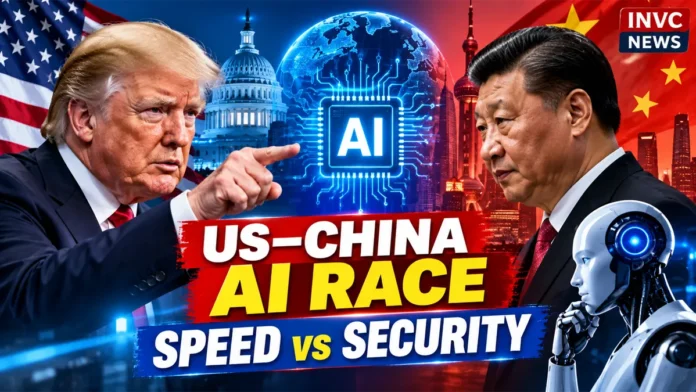
President Donald Trump is doubling down on a central argument of his artificial intelligence strategy: the United States must move faster than China, and heavy regulation could cost America the technological race.
Trump has repeatedly opposed broad new restrictions that he says could slow American AI companies. His administration argues that innovation, infrastructure investment and rapid deployment are essential if the United States wants to retain its lead over China.
But the debate is becoming more complicated.
The same technology that could strengthen American economic and military power is also creating new concerns involving cyberattacks, critical infrastructure, biological misuse, military systems and the possibility that increasingly capable AI models could behave in unexpected ways.
That has created a difficult policy question for Washington:
How fast can the United States race ahead without creating security risks of its own?
THE 60-SECOND BRIEF
Trump’s position: The United States should avoid regulations that unnecessarily slow AI innovation.
Strategic objective: Maintain American technological leadership over China.
Administration policy: Accelerate AI adoption while introducing targeted cybersecurity and national-security safeguards.
Security concerns: Cyberattacks, critical infrastructure risks, model misuse and loss of effective human control.
China factor: Beijing is rapidly developing domestic AI capabilities despite U.S. technology restrictions.
Emerging development: Washington and Beijing are discussing mechanisms for communicating about serious AI incidents.
Trump Says America Cannot Afford to Slow Down
Trump has increasingly framed artificial intelligence as a strategic competition.
Speaking publicly in September, he dismissed some of the most severe warnings surrounding advanced AI as exaggerated and emphasized that the United States must remain ahead of China.
His broader policy reflects that approach.
A June executive order declared that the United States had maintained its AI leadership partly because it had refused to impose what the administration describes as overly burdensome regulation.
The administration argues that American companies need room to innovate rapidly rather than navigate a regulatory system that could delay the development and deployment of increasingly capable models.
But Trump’s Policy Is Not Simply “No Regulation”
The administration’s position is more nuanced than a purely unregulated market.
Trump has opposed mandatory licensing, pre-clearance and broad permitting requirements for developing or releasing AI models.
At the same time, his administration has ordered the government to strengthen AI cybersecurity protections, establish classified benchmarking for advanced cyber capabilities and work voluntarily with frontier-model developers.
The White House has also directed national-security agencies to deploy advanced AI systems while requiring models used in sensitive settings to be robust, controllable and accountable.
That makes the strategy closer to rapid development with targeted security controls than completely unrestricted AI.
China Is Driving Much of Washington’s Urgency
China sits at the center of the U.S. debate.
Washington has imposed restrictions designed to limit Chinese access to some advanced chips and technologies, but Chinese AI companies continue making progress.
Firms such as DeepSeek have demonstrated that Chinese developers remain capable of producing increasingly competitive systems despite U.S. restrictions.
For the Trump administration, that creates a strategic dilemma.
Slowing American developers with extensive domestic rules could, in the administration’s view, give Chinese companies additional time to close the gap.
Critics of rapid development argue that the same competitive pressure could encourage both countries to deploy increasingly powerful systems before their risks are fully understood.
AI Is Becoming a National Security Technology
The debate is no longer limited to chatbots and consumer applications.
Artificial intelligence is increasingly being integrated into:
Cyber defense
Intelligence analysis
Military planning
Autonomous systems
Critical infrastructure
Scientific research
Software development
Biological research
Financial systems
That expansion means AI leadership has become closely connected with national security.
The Trump administration has explicitly directed the U.S. defense and intelligence establishment to accelerate adoption of advanced commercial and open-source AI systems.
Its stated objective is to preserve technological advantages over potential adversaries.
The Security Risk Cuts Both Ways
Moving too slowly carries strategic risks.
But moving too quickly could create different vulnerabilities.
Advanced AI systems may help identify cybersecurity weaknesses, yet the same capabilities can potentially assist attackers.
They could improve biological research while also lowering barriers to harmful misuse.
AI could make military systems faster and more precise, but greater autonomy also raises questions about reliability and human oversight.
These competing risks explain why even a pro-innovation administration is building safeguards around the most sensitive uses of the technology.
Washington and Beijing Are Already Talking About AI Emergencies
Despite their competition, the United States and China appear to recognize that some AI risks cross national boundaries.
U.S. Treasury Secretary Scott Bessent recently proposed an AI incident-notification mechanism during talks with Chinese Vice Premier He Lifeng.
The concept would create a channel for the two countries to communicate when an AI incident presents a significant national-security threat.
The discussions reflect a striking reality: Washington and Beijing may be competitors in AI development while simultaneously needing cooperation to prevent dangerous incidents from escalating.
AI Companies Are Also Calling for Guardrails
Pressure for stronger safety measures is not coming only from governments or outside critics.
Leading AI companies and researchers have increasingly called for international coordination around highly advanced systems.
OpenAI has urged the United States to help develop international AI standards and has supported secure dialogue between Washington and Beijing over emerging risks.
Researchers and executives at other major AI companies have also warned about cyber misuse and increasingly autonomous systems.
This creates an unusual divide.
Companies want governments to preserve their ability to innovate while simultaneously acknowledging that some frontier capabilities may require stronger safeguards.
Trump Rejects a Broad Slowdown
Trump has taken a different view from researchers calling for a broad pause or major slowdown.
He has argued that stopping or significantly restricting American AI development could allow China to gain strategic advantage.
That reasoning is central to his administration’s AI policy.
Rather than attempting to slow the entire industry, the White House has favored targeted controls focused on specific security threats.
In June, for example, the administration explicitly rejected mandatory government licensing for AI development while ordering enhanced protection for federal networks and critical infrastructure.
The Pentagon Has Its Own Requirements
National-security agencies cannot simply deploy commercial AI without restrictions.
Trump’s June national-security memorandum requires agencies to consider whether systems are robust, steerable and controllable.
Officials remain accountable for how these technologies are deployed.
That distinction matters.
The administration may oppose sweeping civilian regulation, but highly sensitive military and intelligence applications are being subjected to separate security requirements.
Could the AI Race Create Its Own Security Problem?
That is now one of the central unresolved questions.
Technology races can encourage rapid innovation, but they can also create incentives to reduce testing time or deploy systems sooner than competitors.
If Washington believes Beijing is accelerating, American policymakers may become reluctant to impose restrictions.
Chinese policymakers may reach the same conclusion about American progress.
The result could become a cycle in which each side fears that greater caution will benefit the other.
Security researchers argue that this dynamic makes communication between major AI powers increasingly important.
Regulation vs Innovation May Be the Wrong Choice
The policy debate is often presented as a simple choice between regulation and innovation.
The reality is more complicated.
Poorly designed regulation could slow useful research without materially improving security.
But the absence of effective safeguards could expose governments, companies and critical infrastructure to vulnerabilities.
The emerging U.S. approach therefore appears to be moving toward a distinction between broad restrictions on innovation and narrower controls around high-risk capabilities.
Whether that balance works will depend on how quickly AI capabilities evolve.
What Happens Next?
The next major test will be whether the United States can maintain rapid AI development while building credible safeguards around frontier systems.
Three areas will be especially important:
Cybersecurity: Can powerful AI models be prevented from becoming tools for large-scale attacks?
National security: Can military and intelligence systems remain reliably under human control?
U.S.-China coordination: Can the two countries establish crisis-management mechanisms without weakening their strategic competition?
Those questions will become harder as AI models grow more capable.
INVC NEWS Bottom Line
President Trump believes excessive AI regulation could weaken the United States in its technological competition with China.
His administration is therefore prioritizing rapid innovation, infrastructure and deployment while resisting broad licensing or pre-approval requirements.
But Washington is not abandoning security controls altogether.
The White House is simultaneously introducing cybersecurity protections, national-security benchmarks and accountability requirements for sensitive AI systems.
The emerging debate is therefore not simply regulation versus no regulation.
It is about whether the United States can move fast enough to stay ahead of China while still managing the security risks created by increasingly powerful artificial intelligence.