TEHRAN, August 11, 2026
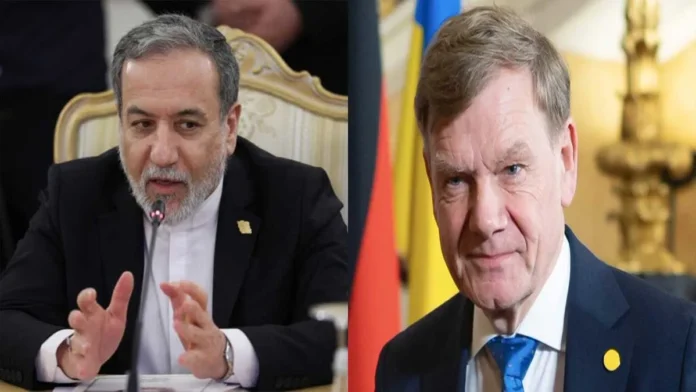
Strait of Hormuz security dominated a telephone conversation between Iranian Foreign Minister Abbas Araghchi and German Foreign Minister Johann Wadephul, as the two diplomats discussed regional tensions, international developments and Tehran’s consultations with Oman over a safe route for commercial shipping.
During the call, Araghchi blamed US and Israeli military action against Iran for instability surrounding the strategic waterway. He argued that diplomatic engagement must continue if the parties are to restore maritime security, ease regional tensions and address the economic consequences of disrupted shipping.
The two foreign ministers also reviewed Iran-Germany relations and emphasized the importance of maintaining diplomatic consultations at different levels, according to an official account of the conversation released by Iran’s Foreign Ministry.
Araghchi Briefs Germany on Iran-Oman Consultations
Araghchi informed Wadephul about Iran’s continuing consultations with Oman, which shares the Strait of Hormuz with Iran. He said the discussions were focused on establishing a secure navigation route for vessels moving through the waterway.
The consultations appear intended to address practical questions surrounding the movement of commercial ships, including how a protected transit route could operate amid continuing political and military tensions.
No detailed route, implementation schedule or enforcement mechanism was announced following the Iran-Germany call. It also remains unclear what security arrangements would be required before any proposed corridor could become fully operational.
Oman has traditionally maintained diplomatic channels with Iran and Western governments, giving Muscat an important role in regional mediation. Its geographic position is equally significant because the strait lies between Iran to the north and Oman to the south.
The Iran-Oman discussions are therefore central to efforts to develop a workable maritime arrangement. Any such mechanism would need to provide security for vessels, crews and cargo while addressing broader political disagreements involving Iran and the United States.
Iran Blames US and Israeli Military Action for Insecurity
Araghchi told his German counterpart that the insecurity affecting the Strait of Hormuz was, in Tehran’s assessment, a direct consequence of military action taken by the United States and Israel against Iran.
That position represents the Iranian government’s account of the crisis and its causes. Araghchi called on the international community to hold the US administration responsible for the security and economic consequences associated with the waterway’s closure and continued disruption.
He also maintained that restoring security would require an end to what Tehran describes as aggressive US actions and unlawful interference. Araghchi specifically referred to the US maritime blockade and alleged violations of Washington’s commitments under the Islamabad memorandum of understanding.
The Iranian readout did not provide additional information about the alleged violations discussed during the call. It also did not announce any immediate agreement between Tehran and Berlin on how the underlying disputes should be resolved.
The conversation nevertheless showed that Iran is continuing to present its position directly to European governments while pursuing a separate maritime track with Oman.
No Direct Iran-US Negotiations Underway
The diplomatic exchange came after Araghchi said that Iran was not currently engaged in negotiations with the United States.
According to the Iranian foreign minister, intermediaries are still attempting to identify a possible route toward renewed talks. Tehran, however, has tied any return to negotiations to its demand that Washington stop violating existing commitments and address what Iran describes as previous breaches.
Araghchi’s position suggests that Iran is separating ongoing communication through intermediaries from formal negotiations with the United States. This distinction is important because indirect diplomatic activity can continue even when the two governments are not participating in direct talks.
Iran’s demand for corrective steps from Washington remains a major obstacle. The United States and Iran would also need to resolve broader disagreements over maritime access, security arrangements and the implementation of previous commitments before negotiations could resume on a stable basis.
For now, the Iran-Oman consultations remain one of the most visible diplomatic efforts connected to maritime traffic through the strait. However, a technical agreement on shipping routes may not, by itself, settle the wider confrontation.
Why Strait of Hormuz Security Matters Worldwide
The Strait of Hormuz connects the Persian Gulf with the Gulf of Oman and the Arabian Sea, making it one of the world’s most strategically important maritime passages.
Its importance extends well beyond Iran and neighboring Gulf countries. Energy shipments passing through the waterway supply markets across Asia, Europe and other regions. Any prolonged disruption can affect vessel availability, insurance expenses, freight rates, delivery schedules and international energy prices.
Flows through the strait during 2024 and the first quarter of 2025 accounted for more than one-quarter of global seaborne oil trade and approximately one-fifth of worldwide oil and petroleum-product consumption. Around one-fifth of global liquefied natural gas trade also passed through the waterway in 2024, according to the US Energy Information Administration.
Although Saudi Arabia and the United Arab Emirates have pipelines capable of bypassing the strait, the available alternative capacity cannot fully replace the volume normally transported through the maritime route. This makes sustained disruption a serious concern for oil-importing economies and global shipping companies.
The consequences also extend beyond commodities and financial markets. Commercial ships operating in a conflict-affected waterway face direct risks, while crews can experience prolonged delays, limited access to essential supplies and uncertainty over when they can safely enter or leave the region.
The International Maritime Organization has said that approximately 20,000 seafarers, port employees and offshore workers have been affected by the regional disruption. The organization has repeatedly called for de-escalation, protection of civilian vessels and respect for freedom of navigation under international maritime law. The IMO’s current assessment also highlights the humanitarian consequences for crews working in and around the strait.
Iran and Germany Support Continued Diplomatic Contact
Araghchi and Wadephul agreed on the importance of continuing diplomatic consultations at multiple levels. Their conversation covered bilateral relations as well as regional and international developments, reflecting the wider implications of the maritime crisis.
For Germany, secure navigation through the Strait of Hormuz is connected to international trade, energy stability and the broader European interest in preventing further military escalation. Berlin’s diplomatic engagement with Tehran can provide another communication channel at a time when formal Iran-US talks remain suspended.
For Iran, the call offered an opportunity to explain its position on the Oman consultations and press its argument that US policies must change before lasting security can be restored.
The conversation did not produce a publicly announced breakthrough. Its immediate importance lies instead in the decision by both sides to keep diplomatic contacts open as discussions over maritime security continue.
Such engagement may help clarify positions, reduce the risk of miscalculation and support mediation by governments capable of communicating with the different parties. However, sustained diplomacy will still require concrete understandings on safe passage, the protection of commercial vessels and the responsibilities of the governments operating in the region.
Safe Shipping Route Remains the Immediate Priority
The most practical issue emerging from the call is the proposed safe shipping route through the Strait of Hormuz.
Any credible arrangement would need to reassure shipping companies that vessels could transit without being exposed to military action, detention or unpredictable restrictions. It would also require clear navigation rules, coordination between relevant maritime authorities and reliable communication with commercial operators.
Questions surrounding vessel inspections, advance notifications, security guarantees and emergency procedures could become central to the Iran-Oman consultations. Neither side has publicly detailed how these matters would be managed under a final arrangement.
Restoring dependable shipping may also depend on political decisions outside the technical negotiations between Tehran and Muscat. Iran continues to link maritime security to the conduct of the United States, while Washington’s position and its response to Tehran’s conditions will influence whether a broader settlement is possible.
The next significant development could therefore come from the Iran-Oman diplomatic track, communication through intermediaries or further engagement between Iran and European governments.
Until then, Strait of Hormuz security will remain a central diplomatic and economic concern. The Araghchi-Wadephul conversation demonstrated that Tehran and Berlin intend to maintain contact, but the restoration of stable commercial navigation will depend on whether diplomacy can produce enforceable security arrangements and reduce the wider confrontation.