By Team INVC | INVC NEWS
MUMBAI, India | September 2, 2026 —
Stock Market Today September 2 2026 opened with a sharp selloff as investors dumped equities across sectors after rising crude oil prices, surging global bond yields and renewed US-Iran fighting rattled financial markets.
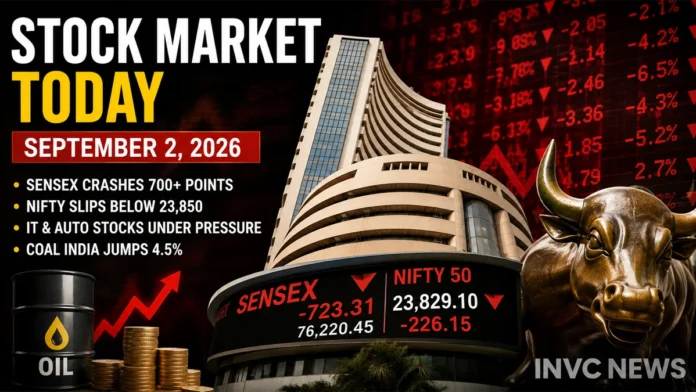
The BSE Sensex plunged more than 700 points in the opening minutes, while the Nifty 50 slipped below the crucial 23,850 level.
At around 9:18 AM, the Sensex traded approximately 723 points lower at 76,220, while the Nifty fell about 226 points to 23,829.
The market failed to find immediate support after the opening shock. Sellers targeted technology, automobile, financial and broader-market stocks, while only a handful of counters resisted the decline.
Sensex Crashes Over 700 Points at Opening Bell
Dalal Street reacted sharply as soon as regular trading began.
The Sensex dropped roughly 706 points to around 76,238 in early deals.
The Nifty opened with a gap down and lost approximately 231 points, pushing the index to around 23,824.
The fall marked a sharp deterioration from Tuesday, when the Sensex had closed almost flat at 76,944.28 and the Nifty had ended at 24,055.80.
Investors now face a fresh battle around the 23,800 zone.
If sellers push the Nifty decisively below this region, traders may watch lower support levels more closely. However, any recovery in crude oil prices, global markets or heavyweight stocks could trigger intraday volatility in both directions.
Why Is the Indian Stock Market Falling Today?
Three major global triggers hit Indian equities simultaneously.
1. US-Iran Conflict Pushes Oil Higher
Renewed military exchanges between the United States and Iran immediately increased fears of another disruption in global energy supplies.
Brent crude climbed above $95 per barrel during Asian trading after jumping more than 4% in the previous session.
Higher oil prices create a serious challenge for India because the country imports most of its crude requirements.
When crude becomes expensive, markets begin pricing in pressure on inflation, the current account, corporate margins and the rupee.
That explains why investors reacted quickly to the latest escalation.
2. Global Bond Yields Jump
Investors also faced rising government bond yields across major economies.
The US 10-year Treasury yield moved toward its highest level in nearly three years.
Higher bond yields can pull global money away from riskier assets such as emerging-market equities.
Technology and growth stocks usually face additional pressure because investors discount their future earnings at higher interest rates.
3. Asian Markets Tumble
Indian equities did not fall alone.
Major Asian markets also suffered heavy losses.
Japan’s Nikkei dropped close to 3%, while South Korea’s Kospi fell more than 3% during the morning session.
Other Asian indices also traded lower as investors reacted to higher oil prices, inflation concerns and expectations that the US Federal Reserve may keep monetary policy tighter.
Nifty IT Leads the Selloff
Technology stocks became one of the biggest drags on the market.
The Nifty IT index fell more than 2% in early trade.
Infosys ranked among the major Nifty losers as investors reduced exposure to technology stocks amid rising US yields.
The sector remains highly sensitive to changes in US economic conditions because Indian IT companies earn a large share of their revenue from overseas clients.
Higher interest rates can slow corporate technology spending and also change valuations for growth-oriented companies.
Auto Stocks Also Take a Hit
Automobile shares joined the decline.
The Nifty Auto index came under strong selling pressure as investors evaluated the impact of expensive crude oil and weaker market sentiment.
Higher fuel costs can influence consumer sentiment, transportation expenses and inflation expectations.
Auto stocks also entered Wednesday’s session after several manufacturers announced their August sales numbers, which created additional stock-specific movement.
Midcap and Smallcap Investors Feel the Pressure
The selloff spread beyond large-cap stocks.
The Nifty Midcap 100 fell more than 1%, while the Nifty Smallcap 100 dropped close to 1% during early trade.
That broader decline showed that investors were not simply rotating between sectors.
They actively reduced risk across the market.
Sharp declines in midcap and smallcap indices can also amplify volatility because these segments often react more aggressively when market sentiment changes suddenly.
Almost Every Major Sector Turns Red
Selling dominated almost the entire sectoral screen during the opening phase.
IT and auto suffered some of the sharpest losses.
FMCG and other cyclical segments also faced pressure.
Pharma and healthcare stocks showed comparatively better resilience at points during the morning, but the broader market remained decisively weak.
This widespread selling indicates that global macroeconomic concerns — rather than a single domestic corporate event — drove the opening decline.
Coal India Jumps More Than 4% Against Market Trend
Coal India delivered one of the morning’s most striking stock-specific moves.
The stock climbed approximately 4.5% and touched around ₹419.65 on the NSE, even as the broader market remained under heavy selling pressure.
The company attracted buyers after reporting stronger coal supply numbers for August.
Coal India’s move demonstrated that company-specific triggers can still produce sharp gains even during a weak market.
However, traders should remember that intraday prices can change rapidly.
Sun Pharma and Adani Ports Show Early Resistance
Most Sensex constituents opened in negative territory.
However, Sun Pharma and Adani Ports initially showed better resilience than the broader index.
Defensive sectors such as pharmaceuticals can sometimes attract investors during volatile sessions because demand for healthcare products usually remains less sensitive to economic cycles than demand in many other industries.
Still, the overall market mood remained cautious.
Rupee Faces Another Oil Test
The Indian rupee also entered Wednesday under pressure from the same global forces hitting equities.
The currency had closed Tuesday near ₹94.95 per US dollar after the Reserve Bank of India supported the market through dollar sales.
The rupee opened slightly stronger around ₹94.91, but rising crude oil prices and a stronger US dollar created a fresh challenge.
India needs dollars to pay for crude imports.
Therefore, a prolonged rise in international oil prices can increase dollar demand and place renewed pressure on the rupee.
Brent Crude Near $95 Becomes Biggest Market Risk
Crude oil has quickly become the most important variable for Dalal Street.
Brent settled Tuesday at approximately $94.65 per barrel after gaining more than $4.
It extended the rise on Wednesday and traded near $95.40-$95.90 during Asian hours.
Markets worry that further escalation around Iran or the Strait of Hormuz could disrupt oil shipments.
The Strait of Hormuz represents one of the world’s most important energy corridors.
Any material disruption there could send oil prices sharply higher.
For India, that scenario would increase concerns about imported inflation and the trade deficit.
Wall Street Weakness Adds to Nervousness
US markets also handed Asian investors a negative lead.
The Dow Jones Industrial Average fell approximately 0.8% in the previous session.
The S&P 500 lost about 0.7%, while the Nasdaq dropped roughly 1%.
Rising oil prices, higher Treasury yields and geopolitical tension pressured US stocks.
Indian investors carried those concerns directly into Wednesday’s opening bell.
Nifty 23,800 Becomes Key Level to Watch
The Nifty now sits close to an important near-term zone.
The index closed Tuesday at 24,055.80 but quickly fell toward 23,800 on Wednesday morning.
That rapid move puts the 23,800 level under close scrutiny.
A sustained break below the zone could strengthen the bears.
On the upside, the Nifty would first need to reclaim 24,000 and then move toward the 24,150-24,380 region to improve short-term sentiment.
These levels represent technical reference points rather than guaranteed market outcomes.
Investors Should Expect High Volatility
Wednesday could remain volatile because several powerful forces are moving simultaneously.
Traders are watching:
Brent crude oil prices
US-Iran military developments
Strait of Hormuz shipping risks
US Treasury yields
Rupee movement
Foreign institutional investor flows
Nifty’s 23,800 support zone
IT and banking heavyweight stocks
A sudden geopolitical headline could move oil prices and equities within minutes.
What Happens Next?
Dalal Street now needs stability in global markets to stage a convincing recovery.
Falling crude prices could offer immediate relief because India remains highly sensitive to energy costs.
A decline in US bond yields could also support technology and other rate-sensitive stocks.
However, continued military escalation between the United States and Iran could keep investors defensive.
For Stock Market Today September 2 2026, the message from the opening bell remains clear: global risk has returned aggressively, oil has become the market’s biggest headache and the Nifty must defend the 23,800 region to prevent sellers from gaining further control.
The market remains open, so index levels and individual share prices will continue to change throughout the trading session.
Market Disclaimer
This report provides market news and information only. It does not constitute investment advice or a recommendation to buy or sell any security. Investors should conduct independent research or consult a qualified financial adviser before making investment decisions.