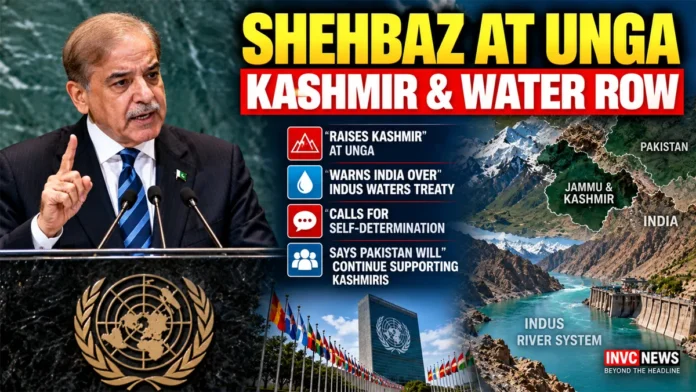
NEW YORK, United States | September 26, 2026 —
Pakistan Prime Minister Shehbaz Sharif used his address to the 81st United Nations General Assembly to again raise the Kashmir issue and sharply criticise India over the Indus Waters Treaty, bringing two of the most sensitive India-Pakistan disputes back onto the global diplomatic stage.
Sharif said Pakistan would continue its political, diplomatic and moral support for Kashmiris and called for what he described as a fair resolution of the Kashmir dispute.
He also warned that any attempt to stop, impede or divert Pakistan’s share of river waters would be treated by Islamabad as an “act of war”.
The remarks are likely to draw attention in India because they combine Kashmir, water security and the memory of last year’s India-Pakistan military confrontation in a single UN speech.
THE 60-SECOND BRIEF
Pakistan Prime Minister Shehbaz Sharif addressed the UN General Assembly in New York.
He again raised Kashmir and called for a resolution based on Pakistan’s long-standing position.
Sharif said Pakistan would continue supporting Kashmiris politically, diplomatically and morally.
He also attacked India’s decision to keep the Indus Waters Treaty in abeyance.
Sharif warned that any attempt to stop or divert Pakistan’s share of water would be treated as an “act of war”.
India maintains that Jammu and Kashmir is an integral and inalienable part of India.
The two countries continue to hold sharply opposing positions on Kashmir and the Indus Waters Treaty.
What Shehbaz Sharif Said About Kashmir
Sharif told the UN General Assembly that Kashmir remained central to peace and stability in South Asia.
He said Kashmiris had waited for decades for what Pakistan describes as implementation of United Nations commitments related to a plebiscite.
He also accused India of rights violations in the region and said Pakistan would continue supporting Kashmiris’ claimed right to self-determination.
These were Pakistan’s stated claims at the UN and reflect Islamabad’s established position on Kashmir.
India rejects Pakistan’s interpretation and maintains that Jammu and Kashmir is an integral and inalienable part of the country.
India and Pakistan Remain Far Apart on Kashmir
Kashmir remains one of the most persistent disputes between India and Pakistan.
Pakistan continues to internationalise the issue at forums including the United Nations.
India, however, has consistently rejected outside intervention and argues that matters between India and Pakistan should be handled bilaterally under existing agreements.
New Delhi also maintains that Pakistan must address cross-border terrorism before meaningful relations can improve.
The two sides therefore continue to approach the Kashmir question from fundamentally different positions.
Indus Waters Treaty Became the Sharper Part of the Speech
Sharif’s strongest language was directed at the Indus Waters Treaty.
He accused India of putting the treaty in abeyance without legal justification.
He said rivers should not be used as instruments of pressure and warned against any attempt to stop, impede or divert Pakistan’s share of water.
Sharif said Pakistan would regard such a move as an “act of war”.
The statement marked a significant escalation in rhetoric around the water-sharing dispute.
Why the Indus Waters Treaty Matters
The Indus Waters Treaty has governed the distribution of the Indus river system between India and Pakistan for decades.
Under the treaty framework, the two countries have specific rights and obligations over eastern and western rivers.
The arrangement has survived wars, military tensions and prolonged diplomatic breakdowns.
That history is why disputes over the treaty carry importance far beyond normal water-management disagreements.
For Pakistan, Indus river flows are closely tied to agriculture, food security and power generation.
For India, treaty-related disputes increasingly intersect with national security concerns and wider bilateral tensions.
Sharif Also Revisited the 2025 India-Pakistan Conflict
The Pakistan prime minister also referred to the brief military confrontation between India and Pakistan in 2025.
He presented Pakistan’s account of that conflict and praised Pakistan’s armed forces.
He also credited US President Donald Trump with helping bring about the ceasefire.
India has previously rejected suggestions that outside mediation determined its decisions during the confrontation and has maintained that bilateral military channels played the decisive role.
This remains another area where the public accounts offered by New Delhi, Islamabad and Washington have differed.
Kashmir and Water Linked in One Narrative
The notable feature of Sharif’s UNGA address was the way he connected different India-Pakistan disputes.
Kashmir was presented as a political and territorial issue.
The Indus Waters Treaty was framed as a question of legal obligations and national survival.
The 2025 military confrontation was cited as evidence of how quickly tensions can escalate.
By combining these issues, Pakistan attempted to present South Asian stability as a broader international concern.
India’s position remains that Pakistan should not use global platforms to internationalise bilateral disputes.
What Pakistan Says
Pakistan argues that Kashmir remains unresolved and says Kashmiris should be given what Islamabad describes as the right to self-determination.
It also says the Indus Waters Treaty remains legally binding and cannot be suspended unilaterally.
Islamabad has repeatedly called for international attention to both issues.
Sharif’s latest UN speech continued that diplomatic strategy.
What India Says
India rejects Pakistan’s claims over Jammu and Kashmir.
New Delhi states that Jammu and Kashmir and Ladakh are integral parts of India.
India has also accused Pakistan of supporting cross-border terrorism and argues that Islamabad must address terrorism before conditions for normal bilateral engagement can improve.
On the Indus Waters Treaty, India has linked its recent policy changes to wider security concerns following attacks that New Delhi attributes to Pakistan-based groups.
Pakistan denies supporting such attacks.
Why This Speech Matters Now
The timing of the address is important because India-Pakistan relations remain tense after the 2025 military confrontation.
Water has also become a more prominent strategic issue between the two nuclear-armed neighbours.
Sharif’s decision to raise both Kashmir and the Indus Waters Treaty at the UN ensures that these disputes remain part of the international diplomatic conversation.
However, a UN speech by itself does not alter either side’s legal or political position.
Could This Lead to New Talks?
There is no confirmed India-Pakistan dialogue process emerging from the speech.
Both governments would need to decide separately whether conditions exist for renewed engagement.
Kashmir, terrorism and water remain major obstacles.
The two countries also differ over whether outside actors should have any role in resolving bilateral disputes.
For now, the UNGA address should be viewed as a statement of Pakistan’s diplomatic position rather than evidence of a new negotiation process.
What Happens Next
Attention will now turn to any formal Indian response.
New Delhi has frequently used its right of reply at the United Nations to reject Pakistani statements on Kashmir and terrorism.
If India responds, the exchange could extend the India-Pakistan diplomatic confrontation at the UN for another round.
The Indus Waters Treaty will also remain closely watched because any practical change in water flows or treaty implementation would carry much greater significance than rhetoric alone.
INVC NEWS Bottom Line
Shehbaz Sharif has again used the UN General Assembly to raise Kashmir and challenge India over the Indus Waters Treaty. Pakistan presented Kashmir as an unresolved self-determination issue and warned against any diversion of its share of river waters. India rejects Pakistan’s Kashmir position and maintains that Jammu and Kashmir is an integral part of India. The speech raises diplomatic pressure, but it does not by itself signal a new India-Pakistan negotiation process.
What happened. Why it matters. What comes next.