BELGRADE, Serbia | September 7, 2026 —
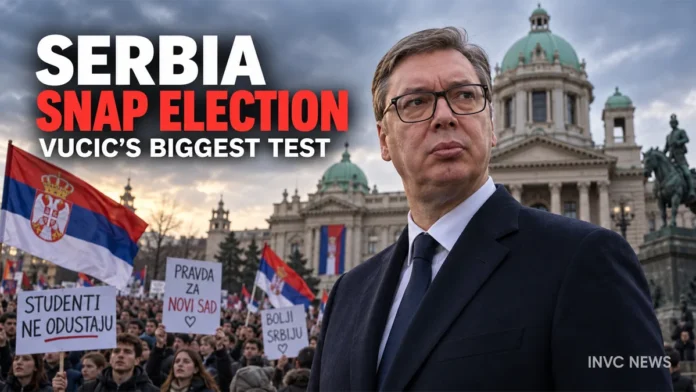
Serbia snap election 2026 moved dramatically closer on Monday after Prime Minister Djuro Macut’s government formally asked President Aleksandar Vucic to dissolve parliament and call an early election, setting up a high-stakes political showdown after nearly two years of student-led anti-government protests.
The decision could send Serbia to the polls more than a year ahead of schedule and give voters their first nationwide opportunity to pass judgment on a political crisis that began after the deadly Novi Sad railway station canopy collapse in November 2024.
Sixteen people died in that disaster.
What followed was far bigger than a local tragedy.
Students took to the streets, universities became centers of political mobilization and protests spread across the country. Demonstrators demanded accountability and argued that the collapse exposed deeper problems involving corruption, public works and government responsibility.
Vucic and his allies have rejected broader allegations of corruption, links to organized crime, political violence and suppression of media freedom.
Now Serbia appears headed toward the ballot box.
Serbian Government Formally Calls for Early Election
Prime Minister Djuro Macut announced that the government had asked President Vucic to dissolve parliament and call an early parliamentary election.
Macut framed an election as a democratic way to reduce the intense political tensions that have gripped Serbia.
The move marks a major escalation from months of speculation about an early vote.
Serbia’s next regular parliamentary election was not due until December 2027.
However, Vucic has already indicated that voters could instead go to the polls on October 18 or October 25, 2026.
Under Serbia’s constitutional rules, an election campaign must run for between 45 and 60 days after parliament is dissolved.
That means the political clock has started ticking.
Vucic Could Make Stunning Move From President to Prime Minister
The election carries an unusual twist.
Vucic’s Serbian Progressive Party, or SNS, formally nominated him over the weekend as its candidate for prime minister if the party wins the parliamentary election.
That could completely reshape Serbia’s political leadership.
Vucic has dominated Serbian politics for more than a decade, serving as both prime minister and president.
Although Serbia’s presidency formally carries more limited constitutional powers than the premiership, Vucic has remained the country’s most influential political figure throughout his time in office.
He has indicated that he intends to leave the presidency and enter the election campaign.
That creates a remarkable possibility: Vucic could leave one of Serbia’s highest offices only to return at the head of the government.
For his supporters, the move offers continuity.
For his opponents, the election represents a chance to challenge a political system that they say has concentrated too much power around one man and his party.
Novi Sad Tragedy Changed Serbian Politics
The roots of the current political crisis stretch back to November 1, 2024, when a concrete canopy collapsed at the railway station in Novi Sad.
Sixteen people died.
The disaster triggered grief and anger, but it soon developed into a national political movement.
Students and other protesters argued that the tragedy reflected broader failures in public-sector accountability and demanded transparency over the station renovation.
Demonstrations grew over the following months.
At some rallies, hundreds of thousands of people joined protests, making the movement one of the strongest challenges Vucic has faced during his long political dominance.
University students became particularly important to the movement.
Instead of relying entirely on established opposition parties, student groups built their own political identity and increasingly demanded early elections.
Now they may get them.
Students Could Become Vucic’s Most Unpredictable Opponent
The parliamentary election will not simply pit Vucic’s SNS against Serbia’s traditional opposition.
A student-backed electoral list is expected to compete as well.
University professors and other professionals could join that ticket, potentially giving voters who supported the protest movement an alternative outside Serbia’s established party structures.
That introduces a major uncertainty.
Large street protests do not automatically translate into election victories.
Vucic’s political machine remains formidable, and SNS has years of organizational experience, local networks and a highly recognizable leader.
However, the student movement has already demonstrated its ability to mobilize large crowds and keep political pressure alive for nearly two years.
The election will test whether that energy can move from the streets to polling stations.
Opposition Accuses Government of Corruption; Vucic Denies Claims
Opposition leaders and demonstrators have accused Vucic and his allies of widespread corruption, pressure on political opponents, ties to organized crime and restrictions on independent media.
The government and Vucic have denied those accusations.
Vucic, in turn, has repeatedly accused elements of the protest movement of trying to destabilize Serbia and has claimed that foreign forces have played a role in the unrest.
Critics dispute those claims.
This bitter exchange has transformed Serbia’s political climate.
The campaign is therefore unlikely to revolve solely around conventional issues such as taxes, pensions or public spending.
Accountability, corruption, democratic institutions and Vucic himself are likely to dominate.
EU, Russia and China Add Another Layer to Serbia Election
The result will also matter far beyond Serbia.
Belgrade remains a candidate for European Union membership, but its accession process has faced persistent concerns involving democratic standards, rule of law and electoral conditions.
At the same time, Serbia has maintained unusually close relations with both Russia and China.
Vucic has tried to balance those relationships while keeping Serbia’s EU ambitions alive.
Belgrade has not joined European Union sanctions against Russia over the war in Ukraine, creating periodic friction with Brussels.
Meanwhile, Chinese investment and diplomatic ties have grown substantially.
An election that weakens or strengthens Vucic could therefore influence Serbia’s geopolitical direction as well as its domestic politics.
October 18 or October 25 Could Become Serbia’s Defining Date
President Vucic still needs to complete the constitutional process and formally set the election date.
But the government’s request to dissolve parliament has removed much of the uncertainty over whether an early parliamentary election will happen.
Attention now turns to October 18 and October 25, the two dates Vucic has publicly identified as possibilities.
The stakes could hardly be higher.
Vucic will try to prove that months of demonstrations have not broken his political dominance.
Students will try to convert an extraordinary protest movement into electoral power.
Opposition parties will seek to capitalize on public anger over corruption and democratic governance.
And Serbian voters will decide whether a political system dominated by Aleksandar Vucic for more than a decade should continue in its current form.
After nearly two years of demonstrations, Serbia’s battle is moving from the streets to the ballot box.