By Team INVC | INVC NEWS
RIYADH, Saudi Arabia | September 9, 2026 —
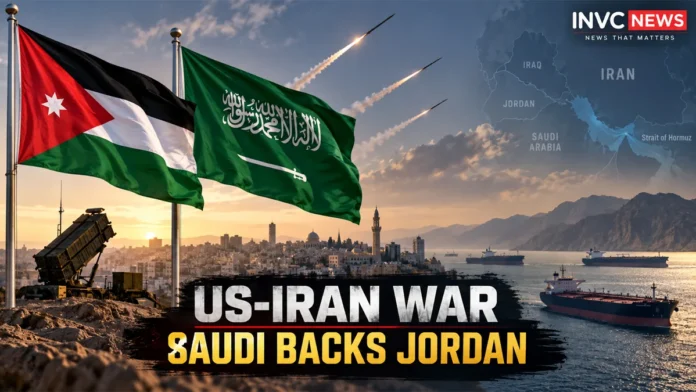
Saudi Arabia condemned Iran attacks on Jordan on Wednesday as the widening US-Iran confrontation spilled further across West Asia, putting military bases, Gulf shipping lanes and global energy supplies under growing pressure.
Riyadh strongly denounced what it described as continued Iranian attacks against Jordan and reaffirmed its solidarity with the kingdom and its people.
The Saudi Foreign Ministry said it supports measures taken by Jordan to protect its sovereignty and security. It also described the attacks as a violation of international law and the principles of good-neighborly relations.
Saudi Arabia called for an immediate halt to Iranian attacks targeting Jordan and other countries in the region, warning that continued escalation threatens regional security and stability.
The Saudi statement followed a major exchange of fire involving the United States and Iran that included attacks on oil tankers, ballistic missile launches toward Jordan and Iranian claims of strikes against shipping near the Strait of Hormuz.
Jordan Says Air Defenses Intercepted 18 Iranian Missiles
Jordan’s military said its air-defense systems intercepted 18 ballistic missiles launched toward the country.
Two additional missiles fell in uninhabited areas, according to the Jordanian military.
No casualties were initially reported.
The missile barrage came after Iran said it had targeted American military interests in Jordan following a fresh round of US strikes against Iranian oil tankers.
Iran identified the Al-Azraq area as one of its targets and claimed that military infrastructure associated with US forces had been attacked.
However, the extent of any damage claimed by Iran has not been independently established.
Jordan hosts US military personnel and has repeatedly found itself exposed to the consequences of the expanding confrontation between Washington and Tehran.
US Says It Destroyed Five Iranian Oil Tankers
The latest escalation began after the US military said it destroyed five Iranian crude-oil tankers on Tuesday.
US Central Command said the action followed attempts by Iran’s Islamic Revolutionary Guard Corps to target an American naval vessel with ballistic missiles.
According to the US military, the American warship was not hit and no US personnel were injured.
CENTCOM said the tankers were linked to a network that generates revenue for the IRGC and its regional partners.
Crews were reportedly instructed to abandon the vessels before the strikes.
The latest operation followed earlier US actions against Iranian shipping, intensifying an increasingly dangerous maritime confrontation.
Iran Claims Attacks on 10 Ships Near Strait of Hormuz
Iran responded by claiming attacks against 10 vessels operating near the Strait of Hormuz.
Iranian authorities said the targets included two American vessels and eight oil tankers that had entered what Tehran described as a restricted and unsafe maritime area.
However, these claims require important context.
The reported damage to the American vessels has not been independently confirmed, and US Central Command has denied that American ships suffered damage in the Iranian attacks.
The maritime confrontation nevertheless represents a significant escalation because the Strait of Hormuz remains one of the world’s most important energy transit corridors.
Any sustained disruption could affect crude oil, liquefied natural gas, shipping insurance and freight costs around the world.
Saudi Arabia Throws Its Weight Behind Jordan
Saudi Arabia’s response adds another layer to the regional crisis.
Riyadh said it stands with Jordan and supports measures taken by the country in response to attacks against its territory.
The Saudi government also urged immediate action to prevent further Iranian strikes across the region.
Its position is particularly significant because Saudi Arabia is already facing renewed security pressure from Yemen’s Iran-aligned Houthi movement.
Recent Houthi attacks have targeted Saudi cities and energy infrastructure, adding another front to an increasingly interconnected regional confrontation.
As a result, Saudi Arabia now faces instability both from attacks directed toward its own territory and from escalation affecting neighboring Jordan.
Bahrain and Other Arab States Also Condemn Attacks
Saudi Arabia has not been alone in criticizing the Iranian missile attacks.
Bahrain also condemned the strikes and reaffirmed its support for Jordan’s sovereignty and security.
Regional governments increasingly fear that repeated missile, drone and maritime attacks could pull additional countries into direct military confrontation.
The greatest concern is that attacks on US facilities hosted by Arab countries could turn those states into recurring targets despite their efforts to limit direct involvement in the conflict.
Brent Crude Moves Above $100
The military escalation has already reached global energy markets.
Brent crude climbed above $100 a barrel on Wednesday as traders reacted to US strikes on Iranian tankers, Iranian attacks around the Strait of Hormuz and renewed violence affecting Saudi energy infrastructure.
The Strait of Hormuz is particularly important because a major share of global oil and liquefied natural gas shipments traditionally passes through the narrow waterway.
Shipping activity has already been disrupted by military restrictions, security concerns and the risk of attacks.
A prolonged confrontation could raise costs not only for crude oil but also for tanker insurance, freight, natural gas and petroleum products.
For major energy-importing economies including India, Japan, South Korea and European countries, sustained disruption in the Gulf could eventually feed into inflation and fuel costs.
West Asia Conflict Enters Another Dangerous Phase
The latest developments show how quickly a direct US-Iran confrontation can spread beyond the two countries.
American attacks on Iranian tankers have triggered Iranian retaliation against military and maritime targets.
At the same time, Iran-aligned groups elsewhere in the region are increasing pressure on US allies.
Jordan is now dealing with missile attacks targeting areas where American forces operate, while Saudi Arabia faces threats to cities and energy facilities.
Commercial shipping is also being drawn increasingly into the conflict.
This combination makes the crisis more difficult to contain.
What Happens Next?
Attention will now focus on whether Washington and Tehran launch another round of retaliation.
Iran has warned that future attacks on its assets could produce a significantly larger response.
The United States, meanwhile, has made clear that it will defend its military forces and naval vessels.
Regional governments are calling for de-escalation, but the military cycle is moving in the opposite direction.
For Saudi Arabia and Jordan, the immediate priority is preventing the conflict from spreading further into their territory.
For global markets, the biggest risk remains the Strait of Hormuz.
If attacks on tankers and military vessels continue, the crisis could move from a regional security emergency into an even deeper global energy shock.