MUMBAI, India | September 3, 2026 —
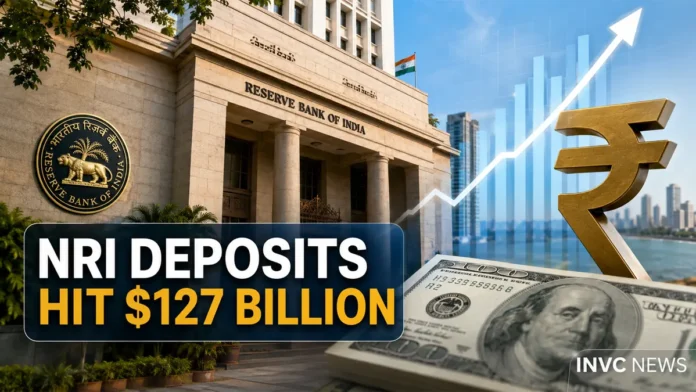
RBI NRI Deposits have delivered a massive foreign-currency boost to India, with banks mobilising nearly $127 billion through foreign currency non-resident deposits and giving the Reserve Bank of India significantly greater room to support the rupee.
India attracted a total of approximately $136.38 billion through special foreign-currency mobilisation measures, far exceeding earlier market expectations.
The extraordinary inflow comes at a crucial time for the Indian currency as high crude oil prices, geopolitical tensions and elevated US bond yields continue to challenge emerging-market currencies.
The rupee closed Wednesday at 94.97 against the US dollar. Currency traders entered Thursday expecting the Indian unit to strengthen further, with early estimates pointing towards the 94.30-94.35 region.
NRI Deposits Deliver the Biggest Share of Forex Inflows
Foreign Currency Non-Resident Bank deposits, commonly known as FCNR(B) deposits, drove the overwhelming majority of the mobilisation.
Banks raised approximately $127 billion through these deposits.
India also received around $3.89 billion through external commercial borrowings and another $5.26 billion through overseas foreign-currency borrowings.
Together, the different channels pushed overall mobilisation to approximately $136.38 billion.
The scale matters because foreign-currency inflows increase the resources available to the RBI at a time when global markets remain volatile.
It also gives policymakers a larger cushion when the rupee faces pressure from oil imports, dollar demand or foreign portfolio outflows.
Why $127 Billion in NRI Deposits Matters for the Rupee
India imports a large share of its crude oil requirements and therefore needs substantial quantities of US dollars to pay its energy bills.
When crude prices rise sharply, Indian importers typically need more dollars. That additional demand can weaken the rupee.
The latest wave of NRI deposits changes that equation to some extent.
By bringing large amounts of foreign currency into the banking system, the deposits improve India’s foreign-exchange buffer and strengthen the RBI’s ability to respond to sudden currency-market pressure.
The central bank can use its reserves and market operations to smooth extreme volatility rather than allowing abrupt currency movements to disrupt the wider economy.
That does not guarantee a continuously stronger rupee. Oil prices, US interest rates, foreign investment flows and global risk sentiment will continue to influence the currency.
However, the size of the latest inflows gives the RBI considerably more flexibility.
Rupee Eyes Another Rally Against Dollar
The rupee has already surprised parts of the currency market with its recent recovery.
After settling at 94.97 against the dollar on Wednesday, traders expected another stronger opening on Thursday.
Support also came from a softer US dollar and strength in several Asian currencies.
The dollar index moved below the 99.50 level as the Japanese yen strengthened, creating a more favourable environment for Asian currencies.
For Indian businesses, a stronger rupee can reduce the cost of imported goods and raw materials priced in dollars.
Import-heavy sectors can benefit, while exporters may see some pressure on rupee-denominated earnings if the domestic currency appreciates sharply.
Crude Oil Remains the Biggest Risk
Despite the foreign-currency cushion, crude oil remains a major risk for the rupee.
Brent crude has been trading in the mid-$90-per-barrel range amid renewed tensions involving the United States and Iran.
For India, expensive oil can widen the import bill and increase inflationary pressure.
Therefore, the strength provided by NRI deposits and RBI intervention will face a real test if crude prices move closer to or above $100 a barrel for a sustained period.
Investors will closely watch developments around the Strait of Hormuz because disruptions to one of the world’s most important energy routes can quickly push oil prices higher.
RBI Gets More Firepower to Manage Currency Volatility
The RBI has also increased its presence in the currency market.
The central bank can sell dollars when necessary to counter disorderly rupee weakness, while larger foreign-currency reserves improve its capacity to manage periods of stress.
The latest mobilisation provides an additional buffer.
This becomes especially important because global investors currently face uncertainty over US monetary policy.
Markets are waiting for fresh American economic data and comments from Federal Reserve officials before deciding whether the Fed could raise interest rates again in September.
Higher US rates often strengthen the dollar and can pull capital away from emerging markets.
A stronger reserve position gives India greater protection against such external shocks.
What FCNR(B) Deposits Mean for NRIs
FCNR(B) accounts allow non-resident Indians to maintain term deposits in permitted foreign currencies with Indian banks.
Because the deposits remain denominated in foreign currency, depositors avoid direct rupee exchange-rate risk on the principal and interest when the account remains within applicable rules.
These deposits have traditionally played an important role when India wants to attract stable foreign-currency inflows.
The latest mobilisation shows how strongly Indian banks tapped overseas deposits during a period of heightened currency and oil-market volatility.
For readers comparing NRI banking products, however, individual interest rates, tenure options, tax treatment and premature-withdrawal conditions can vary by bank and account structure.
India’s Forex Position Gains a Powerful Buffer
The broader significance extends beyond Thursday’s dollar-rupee movement.
Large foreign-currency inflows strengthen India’s ability to withstand periods of global financial stress.
They can help policymakers deal with sudden portfolio outflows, expensive oil imports or sharp moves in the US dollar.
At the same time, such inflows require careful liquidity management inside India because banks eventually convert part of the foreign currency into rupees.
The RBI therefore has to balance two objectives: maintaining adequate foreign-exchange protection while preventing excess domestic liquidity from creating fresh inflationary or financial-market pressures.
Dollar Rate, Fed Policy and Oil Prices Now in Focus
The next direction for the rupee will depend on several moving parts.
Investors will track US economic data, Federal Reserve signals, Brent crude prices, developments in the US-Iran conflict and RBI activity in the currency market.
For now, however, India’s $136.38 billion foreign-currency mobilisation has significantly strengthened the central bank’s hand.
The headline figure of nearly $127 billion in NRI deposits gives the rupee a powerful new line of defence at a time when global markets remain unusually volatile.
For Indian consumers, businesses, importers and investors, that makes the dollar-rupee exchange rate one of the most important economic indicators to watch in the coming sessions.