NEW DELHI, India | September 23, 2026 — India’s grocery basket is quietly changing.
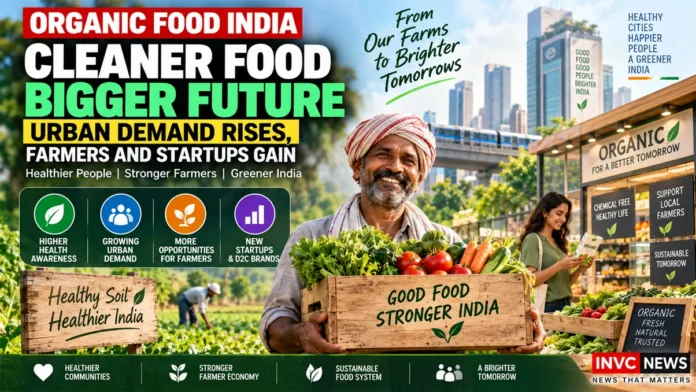
For years, organic food remained a premium category largely confined to specialist stores and affluent consumers in major cities. In 2026, that picture looks very different.
Organic grains, pulses, vegetables, spices, dairy alternatives and clean-label packaged foods are increasingly reaching mainstream urban shoppers through supermarkets, ecommerce platforms, subscription services and quick-commerce apps.
The result is creating a new commercial opportunity not only for large food companies but also for local farmers, farm-to-home businesses and direct-to-consumer startups.
Current market estimates place India’s organic food sector on a roughly 19–22% annual growth path, driven by greater health awareness, higher purchasing power, easier online access and growing concern about how food is produced.
The ‘40% Surge’ Claim Needs Context
Some reports and promotional material have suggested that urban organic-food demand has jumped around 40% this year.
However, there is currently no authoritative nationwide dataset establishing a 40% year-on-year increase across all urban India.
Different retailers, platforms, brands or individual cities may be experiencing much faster growth.
But those company-level or local numbers should not automatically be presented as a national market figure.
The broader evidence nevertheless points clearly in one direction:
Indian consumers are buying more organic and certified food, and the market is expanding rapidly.
India’s Organic Food Market Is No Longer Tiny
Recent industry research values India’s organic food and beverage market at roughly $2.3 billion in 2025.
Some 2026 projections expect it to expand at around 19% CAGR over the coming years.
Other market studies place the growth trajectory closer to 20–22%.
That would make organic food one of the faster-growing premium food categories in India.
The growth is especially visible in metropolitan and Tier-1 markets, where households have higher spending power and greater access to certified products.
Bengaluru, Delhi-NCR, Mumbai, Hyderabad, Chennai and Pune have become important consumption centres.
Why Are Urban Consumers Paying More?
Organic food frequently costs more than conventionally produced alternatives.
Yet a growing section of consumers appears willing to pay that premium.
Health remains the biggest driver.
A CRISIL survey used in APEDA’s organic-market strategy found that 91% of surveyed organic consumers identified perceived health benefits as their primary reason for buying organic products.
Other motivations include:
concern about pesticide use,
interest in traceable food,
environmental awareness,
greater focus on children’s nutrition,
and demand for minimally processed products.
For many urban households, food buying is increasingly becoming a question not only of price but also of origin and production method.
Online Shopping Has Changed the Organic Market
A major barrier to organic food used to be availability.
A consumer might want certified organic atta, pulses or vegetables but have no specialist retailer nearby.
Digital commerce has changed that.
Industry research indicates that online platforms already account for a meaningful share of organic-product sales.
Ecommerce allows small brands to reach consumers nationally without building expensive physical retail networks.
Quick-commerce is making the shift even more interesting.
Products once found only in premium supermarkets can now appear alongside ordinary groceries in app-based searches.
That dramatically increases visibility.
Local Farmers Are Finding a Direct Route to Consumers
For farmers, the most important change may be the growth of direct-to-consumer distribution.
Traditional agriculture often places several intermediaries between the producer and the final buyer.
Farm-to-home startups attempt to shorten that chain.
A farmer group can potentially sell certified vegetables, grains, dairy products or processed foods through:
subscription boxes,
mobile apps,
social-commerce channels,
specialist marketplaces,
farm stores,
and direct urban delivery networks.
That can create opportunities for better price realisation.
However, organic farming is not automatically more profitable.
Certification expenses, lower yields during transition periods, logistics and maintaining separate supply chains can all increase costs.
More Than 2 Million Farmers Are Connected to Certified Grower Groups
India already has a substantial certified organic-production ecosystem.
APEDA’s latest NPOP data for 2024-25 records more than 2.18 million farmers participating through certified grower groups.
The NPOP system recorded around:
2.25 million hectares of certified organic cultivated area
and another
1.71 million hectares under conversion.
Certified organic farm production available for commercial sale stood at approximately 4.39 million metric tonnes.
These figures show that India’s organic story is not simply a niche urban-retail trend.
There is already a sizeable production base behind it.
Organic Exports Are Growing Too
Indian organic products are also reaching international markets.
APEDA data show exports of approximately 368,155 metric tonnes during 2024-25.
Those exports generated around:
₹5,394 crore
or
$665.97 million.
Major export destinations included the United States, European Union, Great Britain, Canada, Australia and several other markets.
Cereals and millets formed the largest export category by volume, while processed foods, spices, medicinal plant products, tea and coffee also contributed.
That provides another potential revenue channel for certified growers and processors.
But ‘Organic’ Must Actually Mean Organic
The sector’s rapid growth creates another challenge: trust.
A green package, pictures of farms or words such as “natural,” “farm fresh” and “chemical-free” do not automatically prove that a product is certified organic.
India has a regulatory framework for organic foods.
Certified products can operate under systems including the National Programme for Organic Production — NPOP — and PGS-India.
Consumers buying packaged certified organic food should look for the appropriate certification and labelling information.
FSSAI’s Jaivik Bharat system exists specifically to help distinguish regulated organic products from unsupported marketing claims.
What Should Buyers Look for?
For NPOP-certified packaged organic foods, consumers should check for relevant certification information along with the FSSAI details and applicable organic identification.
For PGS-certified products, the relevant PGS-India certification information should be displayed.
This matters because one of the biggest long-term risks for India’s organic market is misleading labelling.
If consumers lose confidence in the word “organic,” genuine certified farmers and producers suffer as well.
Trust may therefore become as important as price.
The Biggest Opportunity May Be Everyday Food
The next stage of growth looks more ordinary.
The strongest opportunities may lie in items Indians consume every day:
atta and grains
rice
pulses
millets
spices
fruits and vegetables
tea and coffee
cooking ingredients
and processed pantry staples.
This is important because a category becomes truly mainstream when consumers stop treating it as an occasional wellness purchase.
Price Remains the Biggest Barrier
Despite the optimism, organic food still faces a difficult question:
How many households can afford to buy it regularly?
Premium pricing remains a major limitation.
A household may prefer organic food in principle but return to conventional alternatives when the price gap becomes too large.
That means long-term growth will depend on more than consumer awareness.
The sector will need:
higher farm productivity,
more efficient logistics,
larger certified supply,
better cold chains,
and stronger competition among brands.
If these reduce prices, organic food could expand far beyond affluent urban consumers.
A New Business Opportunity for Rural India
The most important part of India’s organic-food story may ultimately lie outside the cities buying the products.
Higher urban demand can create new markets for farmers willing to adopt certified farming systems.
It can also support businesses in:
food processing,
testing,
packaging,
cold storage,
traceability,
farm logistics,
certification,
and direct delivery.
That turns organic food into more than a lifestyle trend.
It becomes an agricultural and food-industry opportunity.
India’s Organic Shift Is Real — Even Without a 40% Headline
There is no need to exaggerate the numbers to make this story compelling.
India already has millions of farmers linked to organic certification systems, millions of tonnes of certified output and hundreds of millions of dollars in annual organic exports.
Meanwhile, the domestic market is projected to expand at roughly 20% a year as urban consumers search for food they perceive as cleaner, traceable and responsibly produced.
For local farmers and food startups, that shift creates an opportunity that barely existed at scale a decade ago.
The next challenge is clear:
make certified organic food easier to trust, easier to find and affordable enough to move from the premium shelf into the everyday Indian kitchen.