NEW DELHI, India | September 24, 2026 —
Prime Minister Narendra Modi on Thursday used his interaction with young Seva Yatris to deliver a message that went beyond their motorcycle journey: political influence may grow, but public service, he said, should remain rooted in action.
Speaking to participants through video conference, PM Modi stressed that service should become part of conduct rather than remain confined to speeches.
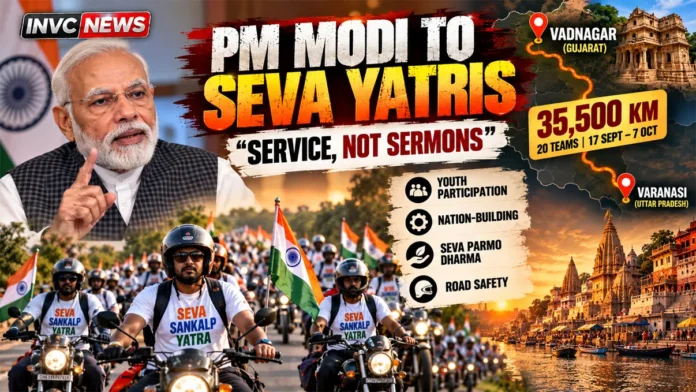
His message came as young riders continue a large motorcycle initiative linking Vadnagar in Gujarat with Varanasi in Uttar Pradesh, covering thousands of kilometres through towns, districts and villages.
The broader two-way initiative involves 20 teams covering around 35,500 kilometres between September 17 and October 7.
But behind the impressive distance lies a political question worth understanding:
Why is a 35,500-km journey connecting PM Modi’s hometown with his Lok Sabha constituency, and what message is the BJP trying to take to the ground?
PM Modi Tells Seva Yatris: Let Service Be Seen in Your Conduct
During the interaction, Prime Minister Modi placed service at the centre of his remarks.
He told participants that people should understand their commitment to service from their actions.
The Prime Minister invoked the principle of “Seva Parmo Dharma”, or service as the highest duty.
He also argued that reaching higher positions in politics should not change a person’s commitment to serving people.
That became the defining theme of Thursday’s interaction.
The emphasis was less on the motorcycles themselves and more on what participants were expected to do while travelling through different parts of India.
What Is the Seva Sankalp Yatra?
The motorcycle journeys are being conducted as part of the broader Seva Sankalp Abhiyan.
The campaign began on September 17.
The wider initiative connects Vadnagar, associated with Prime Minister Modi’s early life, with Varanasi, the Lok Sabha constituency he represents.
Teams are travelling in both directions.
Together, the 20 teams are expected to cover approximately 35,500 kilometres before the programme concludes on October 7.
The route takes participants through cities, districts, smaller towns and villages.
However, organisers describe it as more than a long-distance motorcycle rally.
The programme includes community engagement and service-oriented activities at different stops.
Important Distinction: This Is a BJP Campaign, Not a Union Government Scheme
The political context matters.
The Seva Sankalp Abhiyan is associated with the Bharatiya Janata Party and is being conducted to mark Prime Minister Modi’s birthday period and 25 years of his public life.
It should therefore be understood as a political and organisational outreach programme rather than a new Union government welfare scheme.
That distinction is important for readers.
The Prime Minister’s interaction gave the campaign national visibility, but its political organisation and government policy functions are not the same thing.
Why Vadnagar and Varanasi?
The choice of the two cities carries obvious symbolism.
Vadnagar is Prime Minister Modi’s hometown.
Varanasi is his parliamentary constituency.
Connecting the two creates a route that links his personal beginnings with his current national political career.
That symbolism gives the journey a significance beyond geography.
For the BJP, the route provides a way to frame the campaign around service, political journey and grassroots contact.
For participants, it also creates an opportunity to interact with communities across several states.
What Are Seva Yatris Doing Along the Route?
Participants have been stopping at different locations for community-oriented activities.
These include cleanliness programmes and interactions with local residents and beneficiaries.
Activities have also been organised around schools, hospitals, nursing homes and other community institutions.
The stated objective is to combine travel with service and public engagement.
That means the success of the campaign cannot be measured only by the kilometres covered.
The more relevant question is what participants actually do during those kilometres.
Youth Power Becomes the Centre of PM Modi’s Message
Prime Minister Modi repeatedly linked the journey with the role of young people in India’s development.
He told participants that youth participation would be important in the effort to build a developed India by 2047.
He also referred to areas he had highlighted in his Independence Day address, including manufacturing, technology and innovation, and connectivity.
His broader argument was that national development cannot depend on government institutions alone.
Citizen participation, particularly from younger people, would also be required.
That theme has become increasingly visible in the government’s wider Viksit Bharat messaging.
‘Politics Has Its Place’ — Why That Remark Matters
One of the most politically interesting parts of PM Modi’s interaction came when he distinguished electoral politics from the longer project of nation-building.
He said politics, elections and systems of governance have their respective roles, while those working toward a developed India should continue focusing on nation-building.
The statement is notable precisely because the programme itself is politically organised.
That creates two parallel layers to the event.
One is the BJP’s political outreach campaign.
The other is the Prime Minister’s message urging participants to present service as something larger than electoral activity.
Readers can therefore separate the campaign’s political context from the principle the Prime Minister chose to emphasise during his interaction.
The 35,500-Km Number Is Big — But the Ground Work Matters More
A distance of 35,500 kilometres naturally makes a strong headline.
But distance alone cannot determine the impact of a service campaign.
The more meaningful test will be what happens when the riders reach local communities.
How many people do they interact with?
What activities are actually carried out?
Do local communities participate?
Does the engagement continue after the motorcycles leave?
Those questions matter because public outreach campaigns often generate maximum attention during their launch.
Long-term credibility depends on what happens afterwards.
PM Modi Also Raises Road-Safety Point
The Prime Minister reminded participants to follow traffic and safety rules while travelling through different states.
That instruction has practical importance.
The campaign involves thousands of kilometres of motorcycle travel over several weeks.
Participants are travelling through different road conditions, weather patterns and traffic environments.
Safety therefore remains an important operational part of the programme.
Seva Sankalp Abhiyan Marks a Political Milestone
The broader campaign has been organised around the milestone of Prime Minister Modi completing 25 years in public life.
The Seva Sankalp Abhiyan was launched from Vadnagar on September 17 in the presence of senior BJP and NDA leaders.
Union Home Minister Amit Shah and Gujarat Chief Minister Bhupendra Patel were among those involved in the launch.
The motorcycle yatra became one of the campaign’s most visible components.
Thursday’s interaction with PM Modi gave the journey another national political moment.
Why This Story Matters Beyond a Motorcycle Rally
On the surface, this is a story about young people riding motorcycles between Vadnagar and Varanasi.
Politically, however, it carries several layers.
It marks a milestone in Prime Minister Modi’s public career.
It gives the BJP a grassroots outreach vehicle.
It connects two locations closely associated with PM Modi.
It places youth participation inside the Viksit Bharat 2047 narrative.
And it allows the Prime Minister to argue that political activity should ultimately be judged through service.
That combination makes the Seva Sankalp Yatra more than a ceremonial journey.
It is also a window into how the BJP is framing service, youth participation and PM Modi’s political journey for its grassroots audience.
What Happens Next?
The motorcycle initiative is scheduled to continue until October 7, 2026.
Teams will continue moving through multiple regions while taking part in local engagement programmes.
The next phase will therefore be important.
The launch has generated visibility.
The Prime Minister’s interaction has generated political attention.
Now the focus moves to implementation on the ground.
For the riders, the challenge is straightforward:
Can a journey built around the idea of service make its impact visible beyond speeches, ceremonies and kilometres?
That is the test that will define the campaign more clearly than any headline number.