NEW DELHI — August 15, 2026
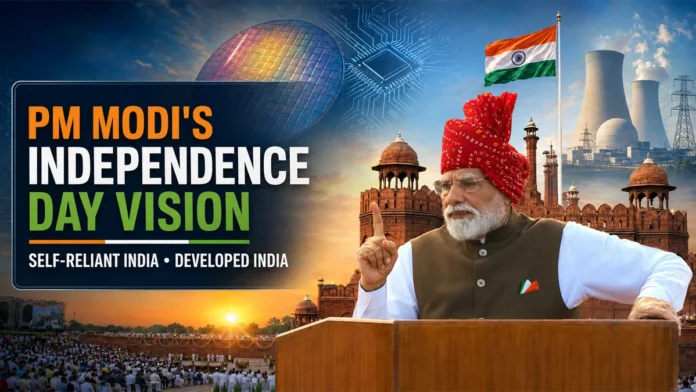
PM Modi Independence Day speech placed self-reliance at the center of India’s development strategy as the country celebrated its 80th Independence Day on Saturday.
After hoisting the national flag at Delhi’s Red Fort, Prime Minister Narendra Modi inspected the ceremonial guard and delivered his 13th consecutive Independence Day address from the historic monument’s ramparts.
The approximately 76-minute speech highlighted the government’s economic and technological priorities, including domestic semiconductor production, critical-mineral security and the expansion of nuclear power. Modi described Atmanirbhar Bharat, or a self-reliant India, as the principal route toward achieving the goal of a developed India by 2047.
“Make in India, Swadeshi and Vocal for Local are increasingly connecting with the minds of every Indian,” Modi said, arguing that greater domestic production would strengthen India’s economic security in an uncertain global environment.
Self-reliance is the highway to Viksit Bharat
Modi said Atmanirbhar Bharat should not be viewed merely as an economic slogan. Instead, he presented it as a strategic requirement for protecting India’s supply chains, technological capabilities and energy security.
The prime minister said domestic manufacturing would reduce the country’s dependence on external suppliers while creating jobs, expanding exports and supporting innovation.
He connected the self-reliance mission with the government’s broader Viksit Bharat objective, under which India aims to become a developed economy by the centenary of its independence in 2047.
Semiconductor production takes center stage
The prime minister used semiconductors to illustrate why domestic technological capacity has become essential.
He said discussions about establishing semiconductor manufacturing in India began decades ago, but the country was unable to develop a major fabrication and production ecosystem at the time.
In today’s technology-driven economy, Modi said, chips are indispensable to electronic products, medical equipment, transportation systems, communication networks, artificial intelligence and data centers.
“Without chips, the world can come to a standstill,” he said.
Modi said three semiconductor facilities had begun operations and were moving into production and exports. He added that several more semiconductor plants were expected to become operational over the next seven to eight years.
The government has been expanding India’s semiconductor ecosystem through fabrication, assembly, testing, packaging and chip-design projects. Three companies had entered commercial production by mid-2026, while additional projects were at different stages of construction or approval.
The prime minister said the growing domestic chip industry showed how self-reliance could provide a direct route toward India’s developed-nation ambitions.
Why critical minerals matter to India
Modi also focused on critical minerals, which are essential for semiconductors, electric vehicles, renewable-energy equipment, batteries, defense systems and advanced electronics.
As countries compete to secure minerals such as lithium, cobalt, nickel and rare-earth elements, disruptions in supplies can affect entire industrial sectors.
The prime minister said India was working to protect itself from such vulnerabilities through the National Critical Mineral Mission. The initiative seeks to strengthen domestic exploration, mining, processing, recycling and overseas acquisition of critical-mineral assets.
He also referred to the government’s announcement of critical-mineral corridors and India’s agreements with partner countries.
Modi said a growing number of countries were beginning to view India as a trusted participant in the global critical-minerals supply chain.
AI and data centers increase electricity demand
The prime minister linked India’s semiconductor and critical-mineral priorities with the need for reliable electricity.
Artificial intelligence systems, chip-manufacturing facilities and large data centers require considerable amounts of uninterrupted power. As these industries expand, electricity demand is expected to rise substantially.
Modi said energy security had consequently become one of India’s most urgent strategic requirements.
“Without energy, it will be difficult to run the new world,” he said, emphasizing that a modern technology economy needed dependable and diversified power sources.
Modi highlights nuclear power expansion
Nuclear energy formed a major part of the prime minister’s energy-security roadmap.
Modi said Parliament’s passage of the Sustainable Harnessing and Advancement of Nuclear Energy for Transforming India Act—commonly known as the SHANTI Act—had created a new framework for expanding the civil nuclear sector.
The law modernized India’s nuclear-energy regulations and opened selected areas of the sector to private participation under government and regulatory supervision.
India has set a target of expanding its nuclear-power capacity to 100 gigawatts by 2047. The country currently has less than one-tenth of that capacity, making the target a significant long-term expansion.
The SHANTI Act is intended to support investment and broaden participation while retaining licensing, safety and regulatory requirements. Official public-broadcast information says the legislation supports India’s clean-energy transition and the 100 GW objective.
Five small modular reactors planned by 2033
Modi also highlighted India’s plan to develop new nuclear reactors during the coming decade.
The government’s Nuclear Energy Mission includes an allocation of ₹20,000 crore for research and development involving small modular reactors. India aims to operationalize at least five domestically designed small modular reactors by 2033.
Small modular reactors are designed to be more compact than conventional nuclear plants. They could potentially supply electricity to industrial centers, remote areas and regions where large power projects may not be practical.
The five-reactor goal is separate from the broader target of reaching 100 GW of total nuclear capacity by 2047. Akashvani’s official report confirms the 2033 timeline for the five indigenous reactors.
A technology-led vision for 2047
Modi’s address presented semiconductors, critical minerals and nuclear power as interconnected components of a single national strategy.
Domestic chip production requires secure access to specialized minerals and large quantities of dependable electricity. Critical-mineral partnerships can protect manufacturing supply chains, while additional nuclear capacity could provide round-the-clock power without direct carbon emissions during generation.
The prime minister argued that self-reliance in these areas would strengthen India’s position in emerging global industries while reducing strategic dependence on overseas suppliers.
His central message from the Red Fort was that India’s path to becoming a developed country would depend on domestic manufacturing, technological capability, energy security and the collective support of citizens for locally produced goods.