VADODARA, India | September 8, 2026 —
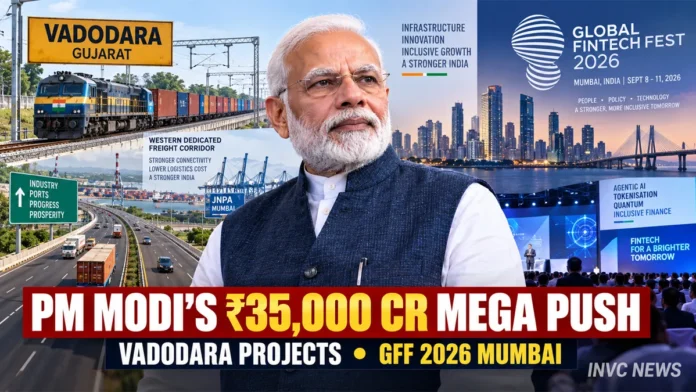
PM Modi Gujarat Maharashtra Visit takes center stage Tuesday as Prime Minister Narendra Modi travels to Vadodara and Mumbai for a packed development and technology agenda involving infrastructure projects worth more than ₹35,000 crore, the completion of key sections of the Western Dedicated Freight Corridor and the inauguration of Global Fintech Fest 2026.
Prime Minister Narendra Modi will begin the major public programme in Vadodara around noon, where he will lay foundation stones, inaugurate projects and dedicate new infrastructure to the nation.
Later, at around 5:45 PM, PM Modi will travel to Mumbai to inaugurate Global Fintech Fest 2026, placing India’s rapidly expanding digital finance ecosystem, artificial intelligence, tokenisation and quantum technologies in the global spotlight.
The day combines two of the government’s central development themes: large-scale physical infrastructure and next-generation digital financial technology.
PM Modi to Launch Projects Worth More Than ₹35,000 Crore in Vadodara
Vadodara will host the largest infrastructure component of Prime Minister Narendra Modi’s programme.
The Prime Minister will launch development projects collectively worth more than ₹35,000 crore across railways, highways, urban infrastructure, housing, renewable energy and water supply.
A major highlight will be the dedication of three important sections of the Western Dedicated Freight Corridor.
Together, the sections cover 326 route kilometres and have been developed at a cost of more than ₹20,700 crore.
The three sections are:
- New Sanand North–New Makarpura
- New Umbergaon–New Saphale
- New Saphale–New JNPT
Their commissioning marks a major milestone for India’s Dedicated Freight Corridor network.
Western Dedicated Freight Corridor Reaches Major Milestone
The newly commissioned sections will establish direct freight connectivity with the Jawaharlal Nehru Port Authority.
That connection carries major economic significance because JNPA handles a substantial volume of India’s containerised import and export cargo.
The government expects the corridor to accelerate cargo movement between industrial centers and ports, reduce transit times and lower logistics costs.
Dedicated freight movement could also ease congestion on conventional railway routes around Mumbai by shifting more goods traffic to specialized freight infrastructure.
With the new sections entering service, the Dedicated Freight Corridor network will become operational across its full planned length.
This gives Tuesday’s programme significance beyond Gujarat and Maharashtra.
The network forms part of India’s broader attempt to improve freight efficiency, strengthen manufacturing supply chains and make exports more competitive.
New Freight Trains to Begin Operations
Prime Minister Narendra Modi will also flag off freight train services from New Sanand North, New Makarpura, New Umbergaon and New JNPT.
These services will immediately connect several industrial and logistics hubs with the dedicated freight system.
The government expects the improved railway link to benefit manufacturers, logistics companies, ports and exporters by reducing transportation bottlenecks.
For businesses operating across western India, faster cargo movement between manufacturing centers and JNPA could translate into shorter delivery cycles and more predictable logistics.
New Passenger Train to Improve Regional Connectivity
PM Modi will also flag off a new passenger train service between Vadodara and Tanda Road.
The service will benefit passengers across Vadodara, Chhota Udepur and Alirajpur districts and improve rail access in areas where connectivity remains limited.
The Prime Minister will also dedicate the Jobat–Tanda Road new rail line to the nation.
Developed under the Chhota Udepur–Dhar railway project, the line will connect remote and tribal areas of Alirajpur with the national railway network.
The project has both transport and economic importance because improved railway access can support education, employment, trade and access to public services across underserved regions.
₹9,700 Crore Railway Expansion Plan
Prime Minister Narendra Modi will also lay the foundation stone for three railway projects covering approximately 329 kilometres and involving an investment of more than ₹9,700 crore.
The projects include:
- Vadodara–Ratlam third and fourth railway lines
- Miyagam Karjan–Choranda–Malsar gauge conversion
- Vishwamitri–Dabhoi doubling project
These railway projects aim to increase both passenger and freight capacity.
They will also reduce congestion and strengthen transport connectivity between Gujarat and Madhya Pradesh.
For Indian Railways, additional lines and upgraded capacity can become increasingly important as passenger demand and freight volumes grow.
₹1,780 Crore Highway Projects Target NH-48 and NH-53
Road infrastructure will form another major component of the Vadodara programme.
PM Modi will lay the foundation stone for three National Highway projects worth approximately ₹1,780 crore.
The projects include six-laning of the Kamrej–Chalthan section of NH-48.
The government will also construct additional structures, including major bridges over the Tapi and Narmada rivers, along the Vadodara–Surat section of NH-48.
Another project will create grade-separated structures at Abhava, Mindhola and Khajod junctions on NH-53.
These improvements aim to reduce congestion, improve road safety and make movement across one of western India’s busiest industrial corridors more efficient.
Gujarat Projects Include Ring Road and Floating Solar Plant
Prime Minister Narendra Modi will also launch Gujarat government projects worth approximately ₹2,600 crore.
Among the key projects is the next phase of the Vadodara Urban Development Authority Ring Road.
The programme also includes a 110 MW floating solar project at Kadana Dam, adding a significant renewable-energy element to the infrastructure package.
PM Modi will also launch construction of a new Vadodara Municipal Corporation office.
Other projects include housing under the Pradhan Mantri Awas Yojana and a water-supply project covering 11 villages in eastern Vadodara.
The combination of transport, housing, renewable energy and water infrastructure broadens the programme beyond large industrial projects and into daily urban and community services.
PM Modi Heads to Mumbai for Global Fintech Fest 2026
After completing his Gujarat programme, Prime Minister Narendra Modi will travel to Mumbai.
At around 5:45 PM, he will inaugurate Global Fintech Fest 2026 and address the gathering.
The seventh edition of GFF runs from September 8 to September 11, 2026, at Jio World Centre and Trident BKC in Mumbai.
The event brings together policymakers, regulators, central banks, financial institutions, fintech companies, technology firms, investors and academic experts.
Since its launch in 2020, Global Fintech Fest has evolved into one of the major annual forums focused on the future of digital finance.
Agentic AI, Tokenisation and Quantum Take Center Stage
The theme of Global Fintech Fest 2026 is:
“Potential to Impact: Agentic AI, Tokenisation, Quantum – Trusted, Connected, Global Systems for Inclusive Finance.”
That theme reflects how rapidly the financial technology industry is moving beyond basic digital payments.
Agentic AI could allow financial systems to automate complex tasks, monitor risk and deliver more personalized financial services.
Tokenisation could transform conventional assets into programmable digital units and potentially improve settlement, liquidity and access.
Quantum technology could eventually reshape financial computing and cybersecurity, particularly as institutions prepare for future encryption and data-security challenges.
The central question at GFF 2026 will therefore move beyond what these technologies can theoretically achieve.
Participants will focus increasingly on how they can deliver measurable, trusted and inclusive financial outcomes.
India Puts Digital Finance Leadership in Global Spotlight
India enters GFF 2026 with a strong international profile in digital payments and financial inclusion.
UPI and other digital public infrastructure systems have transformed the way millions of people and businesses make payments.
The next phase, however, will involve more complex questions around AI governance, programmable finance, cybersecurity, data protection and emerging technologies.
Global Fintech Fest provides India with an opportunity to position itself not only as a large fintech market but also as a major participant in shaping global rules and infrastructure for the next generation of finance.
Infrastructure by Day, Fintech by Evening
Prime Minister Narendra Modi’s Tuesday programme effectively connects two different pillars of India’s economic strategy.
In Vadodara, the focus will remain on railways, highways, freight movement, renewable energy, housing and urban infrastructure.
In Mumbai, attention will shift to artificial intelligence, tokenisation, quantum technology, digital payments and financial innovation.
The PM Modi Gujarat Maharashtra Visit therefore combines traditional infrastructure development with a fast-evolving digital economy agenda.
The commissioning of the Western Dedicated Freight Corridor sections could reshape cargo movement across western India, while Global Fintech Fest 2026 will focus on technologies that could reshape the future of finance itself.