New Delhi, India | August 21, 2026
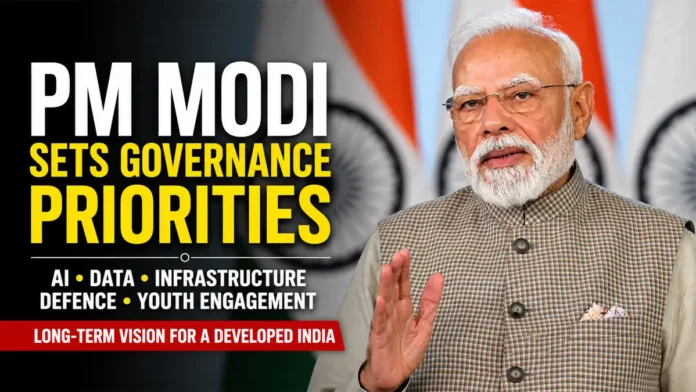
PM Modi’s governance agenda came into sharper focus after Prime Minister Narendra Modi chaired his third high-level meeting with Secretaries to the Government of India, calling on senior officials to look beyond immediate challenges and adopt a long-term approach to shaping India’s future.
The meeting, held Thursday at the Prime Minister’s residence at 7, Lok Kalyan Marg, reviewed the future action agenda of ministries and departments dealing with Infrastructure and Connectivity, Security and External Affairs, and Governance.
PM Modi emphasized stronger coordination across government, better use of data, effective deployment of artificial intelligence with human oversight, closer engagement with universities and young people, and a more globally competitive Indian defence industry.
PM Modi Calls for Long-Term Approach to Governance
During the meeting, PM Modi urged Secretaries not to limit their focus to immediate issues, targets and statistics.
Instead, he asked senior officials to think from a long-term perspective about how India’s future should be shaped.
The meeting was the third in a series of high-level interactions with different groups of Secretaries. Earlier discussions had covered other major areas of government, including finance, the economy, commerce, industry and technology.
The latest meeting therefore extended the government’s review to several strategically important sectors, including infrastructure, national security, external affairs and governance.
Breaking Government Silos a Key Priority
A major theme of the meeting was the need for better coordination between ministries and departments.
PM Modi said administrative silos should not be viewed only as an organizational problem, arguing that they can also reflect a mindset.
He highlighted both horizontal and vertical silos within government and called on officials to take greater ownership of their responsibilities while developing a stronger sense of collective purpose.
The Prime Minister cited coordination during the COVID-19 pandemic and the West Asia crisis as examples of situations in which different parts of government worked together effectively.
He said such coordination mechanisms should become a more natural part of the government’s working culture.
Data Should Be Treated as a National Asset
The Prime Minister also placed significant emphasis on government data.
PM Modi described data as a national asset and a resource for the future, highlighting the substantial resources used to collect, store and manage information.
However, fragmented systems can prevent the government from realizing the full value of that data.
He therefore called for greater interoperability and more effective use of information across government platforms and departments.
Better data integration could potentially improve policymaking, implementation and delivery of public services while reducing duplication across departments.
PM Modi Calls for Effective AI Use With Human Oversight
Artificial intelligence was another important part of the discussion.
PM Modi called for effective use of AI across government while emphasizing the continued importance of human intervention and judgment.
He encouraged officials to explore innovative ways of combining AI capabilities with human expertise.
The emphasis is significant as governments around the world increasingly examine how artificial intelligence can be used to improve administration, data analysis and delivery of public services.
At the same time, maintaining human oversight remains important when technology is used in areas involving public policy and decision-making.
Universities and Young People Could Play Bigger Policy Role
PM Modi also called for stronger engagement between government departments, universities and India’s young population.
He said greater interaction with universities and young people could introduce fresh and unconventional ideas into policymaking.
The proposal could broaden the government’s access to academic research, technological expertise and perspectives from younger generations.
It also fits into a wider push to connect government policymaking more closely with India’s innovation and research ecosystem.
Stronger and More Competitive Indian Defence Industry
National security and defence manufacturing also featured prominently in the meeting.
The Prime Minister stressed the need to further strengthen India’s defence industry and make it more competitive globally.
India has been seeking to increase domestic defence production while expanding exports and reducing dependence on imported military equipment.
Building globally competitive defence manufacturing capacity could therefore play a role not only in national security but also in India’s broader industrial and technology strategy.
Infrastructure and Ports Also in Focus
Infrastructure and connectivity were among the major areas reviewed during the meeting.
PM Modi highlighted the need to improve infrastructure planning and execution while emphasizing the strategic role of ports and connectivity in India’s economic development.
Efficient transport and logistics networks are critical for manufacturing, exports and investment.
Better coordination among ministries responsible for roads, railways, ports and other infrastructure could also help accelerate major projects and reduce implementation bottlenecks.
Third High-Level Meeting With Government Secretaries
The latest interaction follows two earlier rounds of discussions with groups of senior government officials.
The second high-level meeting focused on Finance and Economy, Commerce and Industry, and Technology, with the broader objective of accelerating progress toward India’s long-term development goals.
The third meeting expands that process into governance, infrastructure, security and foreign affairs.
Together, the meetings indicate an effort to establish longer-term priorities across multiple arms of the central government rather than focusing solely on short-term administrative targets.
The central message from the latest session was clear: greater coordination, smarter use of data and AI, stronger engagement with young people and universities, and long-term strategic planning should become integral to government decision-making.