By Team INVC | INVC NEWS
Published: August 29, 2026 | 10 : 00 AM IST
NEW DELHI, INDIA | August 29, 2026 —
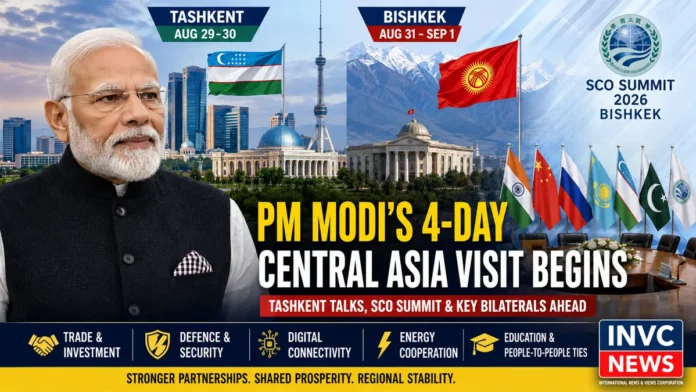
Prime Minister Narendra Modi begins a high-stakes four-day Central Asia diplomatic push today, with Tashkent preparing a substantial package of India-Uzbekistan agreements before PM Modi heads to Bishkek for the 26th Shanghai Cooperation Organisation Summit.
PM Modi will visit Uzbekistan on August 29–30, followed by the Kyrgyz Republic from August 31 to September 1.
The agenda puts trade, energy, defence, digital connectivity and regional security directly on the table at a time when India is trying to strengthen its strategic footprint across Eurasia.
The first big test comes in Tashkent.
Uzbek President Shavkat Mirziyoyev’s office has confirmed that PM Modi’s talks are expected to conclude with a substantial package of bilateral agreements.
That immediately turns the visit from diplomatic ceremony into a deals-focused mission.
PM Modi and Mirziyoyev Put Trade, Energy and Defence on the Table
PM Modi will hold delegation-level talks with President Shavkat Mirziyoyev as both sides push to expand the India-Uzbekistan strategic partnership.
The official agenda covers:
- Trade and investment
- Defence cooperation
- Energy
- Digital connectivity
- Education
- Pharmaceuticals
- Healthcare
- Agriculture
- Geology
- Engineering and manufacturing
The two leaders are also expected to discuss how India’s Viksit Bharat 2047 vision can connect with Uzbekistan’s Uzbekistan-2030 development strategy.
This will be PM Modi’s fourth visit to Uzbekistan.
The frequency of high-level engagement reflects Central Asia’s growing importance in India’s wider foreign-policy and economic strategy.
Also Read – : Jaishankar Russia Visit: $100 Billion Trade Goal, Energy Security and Lavrov Talks Take Center Stage
India Wants a Bigger Route Into Central Asia
Trade potential between India and Central Asia has long faced one major obstacle:
Geography.
Uzbekistan is landlocked, while Pakistan blocks India’s most direct overland route toward the region.
That makes alternative connectivity projects strategically important.
India has invested heavily in Iran’s Chabahar Port as part of a broader effort to reach Afghanistan and Central Asia without depending on Pakistani territory.
Regional transport corridors could eventually make it easier for Indian pharmaceuticals, engineering goods, machinery, technology and agricultural products to reach Central Asian markets.
At the same time, India wants better access to the region’s energy and mineral resources.
Also Read – : Chabahar Port Setback: US Sanctions Threaten India’s Strategic Connectivity Investment
Energy Security Gives PM Modi’s Visit Extra Weight
Energy is no longer just another item on the diplomatic agenda.
Recent disruption around Iran and the Strait of Hormuz has once again demonstrated how quickly geopolitical conflict can affect crude oil, natural gas, shipping and India’s import bill.
Central Asia offers India another route toward diversification.
The region holds significant reserves of:
- Natural gas
- Uranium
- Oil
- Critical minerals
India is not looking to replace existing suppliers overnight.
The objective is to create more options.
And for an economy heavily dependent on imported energy, more suppliers mean greater strategic flexibility.
Defence and Security Move Into Focus
PM Modi’s Central Asia push also carries a strong security dimension.
Uzbekistan lies close to Afghanistan and sits at the crossroads of competing Russian, Chinese and Western interests.
India has expanded defence exchanges and counter-terrorism cooperation with several Central Asian countries.
For New Delhi, deeper engagement helps maintain a strategic presence in a region where China has dramatically expanded investment and infrastructure ties.
That competition will become even more visible during the next phase of PM Modi’s trip.
After Tashkent, PM Modi Heads Straight Into SCO Diplomacy
From Uzbekistan, PM Modi will travel to Bishkek for the 26th SCO Summit on August 31 and September 1.
The summit marks the 25th anniversary of the Shanghai Cooperation Organisation.
India has been a full member since 2017.
PM Modi is scheduled to address the summit around three priorities:
Security. Connectivity. Opportunity.
Those three themes capture much of India’s current Eurasia strategy.
Security includes terrorism and regional instability.
Connectivity focuses on transport and digital links.
Opportunity covers trade, investment, energy and technology.
Bilateral Meetings Could Produce the Biggest Headlines
The formal SCO session will be important.
But the biggest political headlines could emerge outside the main conference hall.
Official Indian information confirms that PM Modi will hold bilateral meetings with SCO leaders on the sidelines.
The complete list has not yet been announced.
That means any meeting with a specific leader should not be treated as confirmed until an official announcement is made.
With major Eurasian powers represented at the summit, every bilateral will be closely watched for signals on India’s relationships with China, Russia and Central Asian states.
PM Modi Will Also Attend World Nomad Games Opening
PM Modi is also scheduled to attend the opening ceremony of the 6th World Nomad Games in Bishkek.
The event showcases the traditional sporting and cultural heritage of Central Asia.
Its inclusion in PM Modi’s itinerary adds a softer diplomatic layer to a visit otherwise dominated by trade, security and geopolitics.
Tashkent Agreements Will Be the First Scorecard
The quickest way to judge the first phase of the visit will be to look at what India and Uzbekistan actually sign.
Uzbekistan has already said a substantial package of bilateral documents is planned.
The real questions are:
How much investment is announced?
Which sectors receive concrete projects?
Does India gain new energy or mineral access?
Do connectivity plans move beyond discussions?
Are defence and digital partnerships expanded?
Those outcomes will determine whether the Tashkent leg delivers measurable economic value.
From Deals to Geopolitics in 48 Hours
PM Modi’s four-day itinerary effectively operates on two tracks.
Tashkent: Deliver the deals.
Trade, investment, energy, defence, technology and connectivity will dominate the bilateral phase.
Bishkek: Play the geopolitical board.
The SCO brings India into the same room as major powers competing for influence across Eurasia.
That makes the trip much larger than a conventional foreign visit.
For India, Central Asia represents energy, markets, security, minerals and strategic geography.
For the region, India offers a major consumer market, technology capabilities, pharmaceuticals, investment and an alternative strategic partner.
PM Modi’s Central Asia mission now begins with a simple test:
Can India turn diplomatic goodwill in Tashkent into real deals—and then convert its SCO presence in Bishkek into greater influence across Eurasia?
The first answers should begin emerging today.