
MOSCOW, Russia | August 23, 2026
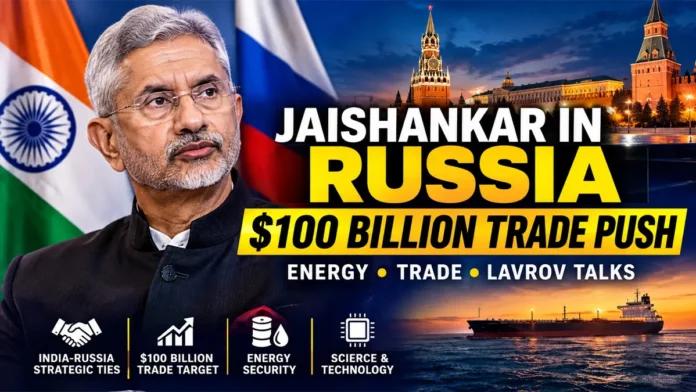
Jaishankar Russia visit has put India-Russia trade, energy security and strategic cooperation firmly in focus as External Affairs Minister S. Jaishankar begins a two-day official engagement with Moscow at a critical moment for global energy markets and geopolitical relations.
Jaishankar is visiting Russia on August 23 and 24 at the invitation of Russian First Deputy Prime Minister Denis Manturov. During the visit, the Indian foreign minister is scheduled to co-chair the 27th Session of the India-Russia Inter-Governmental Commission on Trade, Economic, Scientific, Technological and Cultural Cooperation, or IRIGC-TEC.
He will also meet Russian Foreign Minister Sergey Lavrov for discussions covering regional and global developments.
While the official agenda spans trade, economics, science, technology and cultural cooperation, energy is likely to remain one of the most consequential elements of the broader India-Russia relationship as New Delhi navigates volatile crude and gas markets.
Jaishankar and Denis Manturov to Lead Key India-Russia Meeting
The IRIGC-TEC is one of the principal institutional mechanisms through which New Delhi and Moscow review their economic relationship and identify areas for future cooperation.
Jaishankar will co-chair the 27th session with Denis Manturov, Russia’s First Deputy Prime Minister.
The mechanism covers a wide range of sectors, including:
- Trade and economic cooperation
- Industrial cooperation
- Energy
- Chemicals and fertilizers
- Pharmaceuticals
- Information and communication technology
- Mining
- Science and technology
- Cultural cooperation
The meeting therefore goes well beyond conventional diplomatic engagement and could influence commercial ties between Indian and Russian companies over the coming years.
$100 Billion India-Russia Trade Target in Focus
Trade is expected to be one of the biggest themes surrounding the Jaishankar Russia visit.
India and Russia have set a target of taking bilateral trade to $100 billion by 2030.
Official Indian data show bilateral merchandise trade reached a record $68.7 billion in FY 2024-25 before standing at approximately $59.86 billion in FY 2025-26.
However, a major imbalance remains.
During FY 2025-26, India’s exports to Russia were worth approximately $4.88 billion, while imports from Russia stood at around $55.37 billion.
That gap means expanding Indian exports is likely to remain a central long-term objective.
India exports products including pharmaceuticals, chemicals, iron and steel and marine products to Russia, while major Russian exports to India include oil and petroleum products, fertilizers, vegetable oils, coking coal and precious metals.
India Wants More Balanced Trade With Russia
New Delhi and Moscow have already been working on measures designed to make bilateral commerce broader and more balanced.
Among the issues under discussion in the wider economic partnership are tariff and non-tariff barriers, logistics bottlenecks, payment mechanisms and stronger business-to-business engagement.
Greater market access for Indian pharmaceuticals, agricultural goods, textiles, engineering products and other manufactured goods could help India reduce the enormous trade deficit with Russia.
Connectivity is another major part of that effort.
India and Russia have been working to expand logistics through projects such as the International North-South Transport Corridor, the Chennai-Vladivostok maritime route and other transportation networks.
Faster and cheaper logistics could make it easier for Indian exporters to compete in the Russian market.
Energy Security Gives Russia Added Importance for India
Energy is where the economic relationship has changed most dramatically in recent years.
Russia has become one of India’s most important sources of crude oil, fundamentally reshaping the country’s energy supply mix.
The relationship has become even more significant during periods of disruption in West Asia, when shipping risks and higher crude prices have forced Indian refiners to closely examine alternative sources of supply.
INVC has previously reported how Russian oil pricing for India changed as Middle East disruptions tightened global supplies.
The issue is especially relevant now because instability around the Strait of Hormuz has pushed energy security back to the top of India’s economic agenda.
Hormuz Crisis Adds New Dimension to India-Russia Energy Ties
India is already feeling the impact of disruption in global energy markets.
Indian energy companies recently paid some of their highest spot LNG prices since 2022 as the Iran conflict affected supply routes and shipping conditions.
Read INVC’s detailed report on India’s rising LNG costs amid Strait of Hormuz disruptions.
Against that backdrop, stable access to Russian energy carries strategic as well as commercial significance.
India has consistently emphasized that its energy procurement decisions are guided by national requirements, affordability and energy security.
Russia, meanwhile, has sought to deepen its role as a long-term energy partner for India.
The relationship already extends beyond crude oil into areas including natural gas, petroleum products, coal and nuclear energy.
Oil Payments and Financial Channels Remain Important
Expanding trade is not simply a question of buying and selling more goods.
Payment systems have emerged as one of the more complicated aspects of India-Russia commerce because Western sanctions have affected access to conventional financial channels.
Indian and Russian policymakers have explored alternative settlement arrangements while trying to ensure that legitimate trade can continue without exposing financial institutions to unacceptable compliance risks.
INVC earlier examined the payment challenges affecting India-Russia oil trade.
A smoother settlement mechanism could become increasingly important if bilateral trade is to approach the $100 billion target.
Jaishankar to Meet Sergey Lavrov
The diplomatic side of the visit will be equally important.
Jaishankar is scheduled to meet Russian Foreign Minister Sergey Lavrov and exchange views on regional and global developments.
The two foreign ministers have maintained regular contact as India and Russia coordinate on bilateral issues and multilateral platforms.
Their discussions come at a particularly sensitive time internationally, with conflicts and tensions affecting Ukraine, West Asia, global energy markets and international trade.
India has maintained longstanding relations with Moscow while simultaneously deepening partnerships with the United States, Europe, Japan and other major economies.
That balancing strategy remains one of the defining features of Indian foreign policy.
Ukraine and West Asia Could Enter the Conversation
The Ministry of External Affairs has not publicly detailed every geopolitical subject expected to be raised during the Lavrov meeting.
However, the commitment to exchange perspectives on regional and global issues leaves room for discussions on major international developments.
The Russia-Ukraine conflict remains an obvious strategic issue.
India has repeatedly advocated dialogue and diplomacy while maintaining its economic and political relationship with Moscow.
Developments in West Asia are also increasingly relevant because they directly affect India’s energy security, shipping routes and expatriate community.
The broader significance of the Jaishankar-Lavrov meeting will therefore extend beyond bilateral trade.
Science and Technology Remain Long-Term Pillars
Science and technology are another important component of the 27th IRIGC-TEC agenda.
India and Russia have a long history of scientific cooperation, including work in space, nuclear energy, materials science and other advanced fields.
Current cooperation includes areas linked to India’s human spaceflight program, research partnerships and commercialization of technology.
The two countries have also developed academic links through universities and scientific institutions.
Expanding cooperation into emerging technologies could help broaden the relationship beyond its traditional strengths in defense and energy.
Nuclear Energy Remains a Major Strategic Link
Civil nuclear cooperation continues to be another important pillar.
Russia has played a central role in the development of the Kudankulam Nuclear Power Plant in Tamil Nadu, one of the flagship projects of bilateral cooperation.
India and Russia have also discussed opportunities for wider energy collaboration involving nuclear technology, hydrocarbons and other energy infrastructure.
As India attempts to simultaneously expand electricity generation and reduce its dependence on imported fossil fuels over the longer term, nuclear cooperation could become even more strategically important.
Visit Comes Ahead of More High-Level Engagement
Jaishankar’s Russia visit also comes ahead of further high-level India-Russia engagement.
The two countries maintain a Special and Privileged Strategic Partnership, with regular exchanges between their political leadership and senior officials.
Russian President Vladimir Putin is expected to travel to New Delhi for the BRICS Summit in September 2026, giving both governments another opportunity to review bilateral and global priorities.
The Moscow talks can therefore help prepare the economic and diplomatic ground for the next phase of high-level engagement.
Why Jaishankar’s Russia Visit Matters Now
The timing gives this visit particular importance.
India is simultaneously dealing with volatile oil and gas prices, global trade tensions, uncertainty around major shipping corridors and the need to secure reliable supplies of energy and critical commodities.
Russia, meanwhile, remains a major supplier of oil, fertilizers, coal and other products to India.
At the same time, New Delhi wants the relationship to become more balanced by sharply expanding Indian exports and investment opportunities.
That makes the 27th IRIGC-TEC more than a routine bilateral meeting.
Its real test will be whether India and Russia can move from a relationship heavily driven by energy imports toward a broader economic partnership involving manufacturing, technology, pharmaceuticals, connectivity, investment and services.
With a $100 billion bilateral trade target for 2030 approaching, Jaishankar’s Moscow engagement could provide an important indication of how the two longtime strategic partners intend to get there.






Comments are closed.