SEOUL, South Korea | September 7, 2026 —
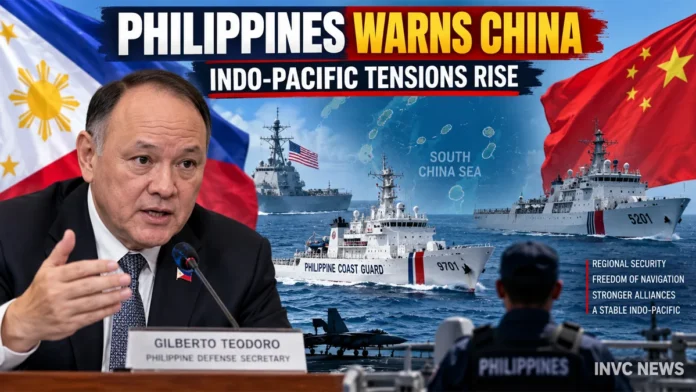
Philippines China tensions returned to the center of the Indo-Pacific security debate on Monday after Philippine Defense Secretary Gilberto Teodoro warned that Beijing could exploit reductions in US-South Korea military exercises to expand its strategic influence across the region.
Teodoro said China could interpret Washington’s decision to scale back exercises with South Korea as an opportunity to reassert itself in the Indo-Pacific.
His warning comes as Manila strengthens military ties with the United States and other partners while confronting China over increasingly tense disputes in the South China Sea.
However, Teodoro also stressed that Washington has given the Philippines firm assurances that its commitments under the US-Philippines Mutual Defense Treaty remain unchanged.
The message from Manila is clear: the Philippines does not believe America is stepping away from its alliance, but it does not want China to misread changes elsewhere in Asia as a weakening of US resolve.
Trump’s Korea Drill Cuts Trigger Wider Security Debate
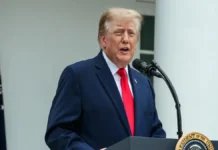
US President Donald Trump decided last month to scale back military exercises with South Korea.
That decision immediately raised questions among defence analysts about deterrence in Asia and whether China or North Korea might view fewer exercises as evidence of a less aggressive American military posture.
Teodoro said China could quickly exploit what it sees as strategic gaps.
For the Philippines, that possibility matters because the country sits at the center of one of Asia’s most sensitive security flashpoints.
China claims sovereignty over most of the South China Sea, while the Philippines, Vietnam, Malaysia, Brunei and Taiwan maintain overlapping claims in different areas.
Manila and Beijing have repeatedly clashed over access, patrols and maritime operations in disputed waters.
US Assures Philippines Its Defence Commitment Has Not Changed
Despite his concerns, Teodoro said the Philippines has received clear assurances from Washington.
He said there has been no reduction in US-Philippines military activities.
Instead, bilateral and multilateral security cooperation involving Manila continues to expand.
The United States and the Philippines are bound by a Mutual Defense Treaty that dates back to 1951.
Washington has repeatedly said that the treaty applies to attacks on Philippine armed forces, public vessels and aircraft, including coast guard assets, in the Pacific.
That commitment has become increasingly important as confrontations involving Philippine and Chinese vessels continue in disputed waters.
Marcos Jr Deepens Military Partnership With Washington
President Ferdinand Marcos Jr has significantly expanded defence cooperation with the United States since taking office.
The Philippines has allowed American forces greater access to selected military facilities and increased the scale of joint military exercises.
Manila has also expanded cooperation with countries beyond Washington.
The Philippines recently concluded agreements with Canada and New Zealand, signed a visiting forces agreement with France and continues negotiations for a similar arrangement with Britain.
That expanding network reflects Manila’s strategy of building multiple security partnerships instead of relying on only one ally.
China remains the central factor driving that shift.
Manila Accuses China of Combining Military Pressure With Influence Operations
Teodoro also raised a second concern: political and information influence.
The Philippine defence chief accused China of increasingly combining military and maritime pressure with attempts to shape public narratives.
He argued that open democratic systems can become targets for influence campaigns because political debate and free media provide space for competing narratives.
The Philippine government is therefore considering stronger legislation covering espionage and foreign influence.
Manila sees the issue as part of a broader security challenge rather than simply a maritime dispute.
Modern strategic competition increasingly includes military movements, economic pressure, cyber activity, information campaigns and political influence.
For smaller countries caught between major powers, those different forms of pressure can become difficult to separate.
China Rejects Confrontational Narrative
China rejected suggestions that it seeks instability in the region.
Beijing said it remains committed to peace and stability in the Asia-Pacific and opposes great-power confrontation.
China has repeatedly argued that outside military involvement increases tension in the South China Sea.
Beijing also insists that its territorial and maritime claims are legitimate.
The Philippines rejects many of those claims and relies heavily on the 2016 international arbitration ruling that invalidated the legal basis for several of China’s expansive claims in the South China Sea.
China has refused to accept that ruling.
The legal and strategic dispute therefore remains unresolved.
Joint China-Philippines Oil Exploration Still Faces Major Obstacles
Another potential area of cooperation also remains uncertain.
President Marcos recently indicated that Manila and Beijing were making progress toward possible talks on joint oil and gas exploration.
However, Teodoro expressed skepticism over whether economic cooperation could remain separate from sovereignty disputes.
The South China Sea contains potentially valuable energy resources.
For years, both countries have discussed ways to explore those resources without resolving their competing territorial claims.
Yet every proposed agreement raises difficult questions.
Who controls the area?
Which country’s laws apply?
Does cooperation imply recognition of another side’s sovereignty claims?
Those questions have repeatedly stalled progress.
Philippines Turns to South Korea for Military Modernization
Teodoro made his remarks while attending the Seoul Defense Dialogue, where the Philippines is also seeking deeper defence cooperation with South Korea.
South Korea has become an important supplier of military equipment to Manila.
It has already supplied FA-50 light combat aircraft, frigates and other systems as the Philippines modernizes its armed forces.
Manila is now interested in expanding industrial cooperation and gaining access to emerging defence technologies.
However, one major project remains uncertain.
The Philippines has discussed acquiring submarines for years, but Teodoro said the programme remains under review.
He pointed to unresolved questions involving operational requirements and the extensive infrastructure needed to support a submarine fleet.
That means Manila’s first submarine acquisition may still be some distance away.
South China Sea Pressure Is Creating a New Security Network
China’s growing power is producing an important regional consequence.
Countries that once relied mainly on bilateral defence relationships are increasingly building connections with one another.
The Philippines is strengthening cooperation with the United States, Japan, South Korea, Australia, Canada, New Zealand and European partners.
Japan and the Philippines have also moved toward deeper defence cooperation as both countries confront security pressure in nearby waters.
This could gradually create a more interconnected Indo-Pacific security structure.
Such a network would not necessarily resemble NATO.
However, it could allow countries to coordinate exercises, intelligence, logistics, weapons procurement and maritime security more closely.
Why This Warning Matters for Asia
Teodoro’s comments reveal a larger concern among American allies.
The issue is not simply whether the United States conducts one fewer military exercise.
The bigger question is how China interprets changes in American military activity.
Deterrence depends heavily on perception.
If Beijing believes Washington is reducing its commitment to Asia, China could become more assertive.
If regional allies believe the same thing, they could accelerate their own military buildup.
That is why even relatively small changes in military exercises can produce political consequences far beyond the Korean Peninsula.
For Manila, the priority is to prevent any strategic vacuum from emerging.
The Philippines wants Washington to remain firmly engaged while simultaneously building relationships with other partners.
And as tensions continue in the South China Sea, the competition between China and the United States is increasingly shaping defence decisions across the entire Indo-Pacific.