WASHINGTON, United States | September 8, 2026 —
Omar al-Bayoumi 9/11 Evidence has returned to the center of one of America’s most enduring national-security controversies after previously unseen videos revealed the Saudi national’s close contact with Anwar al-Awlaki and Saudi government-linked religious officials years before the September 11 attacks.
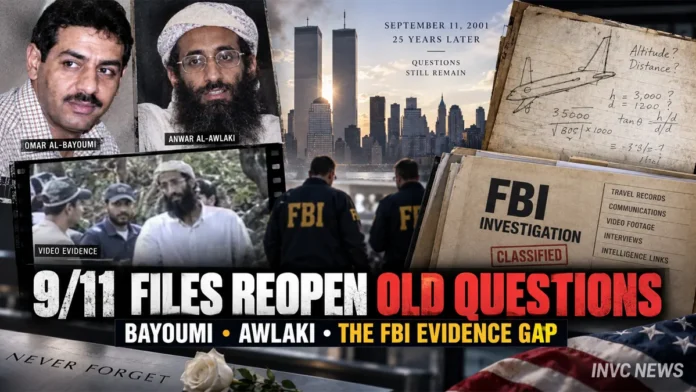
The footage, examined as part of a major new investigation into evidence gathered after 9/11, has reopened a deeper question: why was Omar al-Bayoumi never prosecuted even though British police seized videos, extensive documents and a notebook page containing calculations involving an aircraft?
The answer is not simple.
Records and accounts from former investigators suggest that US authorities initially concluded they lacked sufficient evidence to seek Bayoumi’s extradition from Britain. At the same time, evidence-sharing failures inside the FBI appear to have prevented some investigators and later the 9/11 Commission from seeing material that could have changed how they assessed him.
There is no established finding that the FBI deliberately concealed evidence to protect Bayoumi. The bureau has declined to comment on the latest investigation.
Bayoumi has denied involvement in the 9/11 plot, denied knowingly assisting terrorists and denied serving as a Saudi intelligence agent. Saudi Arabia has also repeatedly rejected allegations that the kingdom or its officials were complicit in the attacks.
Who Is Omar al-Bayoumi?
Omar al-Bayoumi was a Saudi national living in San Diego before the September 11, 2001 attacks.
His name entered the 9/11 investigation because of his contact with Nawaf al-Hazmi and Khalid al-Mihdhar, two al-Qaeda operatives who later joined the team that hijacked American Airlines Flight 77 and crashed it into the Pentagon.
Bayoumi helped the two men after their arrival in Southern California, including assisting them with finding an apartment and becoming established in San Diego.
The central dispute has always been whether he helped them simply as fellow Saudi nationals or whether he knew more about their identities and intentions.
Bayoumi has consistently maintained that he did not know they were terrorists.
Newly Public Videos Show Bayoumi With Anwar al-Awlaki
The latest scrutiny centers on videos recorded several years before 9/11.
One clip shows Bayoumi with Anwar al-Awlaki, who would later become a leading figure in al-Qaeda in the Arabian Peninsula.
Another shows men, including Awlaki, participating in paintball sessions near San Diego.
Some participants wore military-style clothing and engaged in combat-style exercises.
The footage also shows Bayoumi in contact with people associated with Saudi Arabia’s Ministry of Islamic Affairs.
That matters because Bayoumi later said in legal proceedings that he had not met Awlaki.
The video evidence now places the two men together.
Awlaki’s extremist role became far more prominent after 9/11. The United States killed him in a drone strike in Yemen in 2011.
Why the Paintball Video Matters
Paintball itself is not evidence of terrorism.
However, investigators after 9/11 examined several cases in which extremists used paintball or similar activities as informal combat training.
Former investigators cited in the new reporting say the presence of Awlaki in the footage would therefore have been significant in assessing Bayoumi’s network.
Yet the video apparently did not feature prominently in FBI summaries examining Bayoumi’s suspected extremist connections.
That gap has become one of the central questions in the renewed examination of the case.
British Police Arrested Bayoumi 10 Days After 9/11
British authorities arrested Bayoumi on September 21, 2001, after the FBI traced him to Birmingham, England.
Counterterrorism officers searched his properties and seized a huge volume of material.
Investigators found thousands of pages of documents, photographs, travel records, telephone material and at least dozens of videotapes.
They also recovered something that would attract far greater attention years later: a notebook page containing a crude drawing of an aircraft and mathematical calculations involving altitude and distance.
British officers marked the document as containing calculations related to the height of planes.
The Plane Sketch That Raises the Biggest Question
The handwritten diagram has become one of the most controversial pieces of evidence in the case.
The calculations appear to concern the relationship between an aircraft’s height and its distance from a point on the ground.
Bayoumi later said he enjoyed collecting mathematical equations and could not recall exactly when he wrote the page.
Lawyers representing 9/11 families interpret the document far more seriously.
A federal judge examining the civil case has said the notebook page, on its face, could connect Bayoumi with knowledge related to the attacks.
However, the page does not by itself establish that Bayoumi participated in planning 9/11.
FBI Agents Had the Diagram — So Why Was Bayoumi Not Questioned About It?
This is where the investigative history becomes particularly troubling.
Copies of the plane diagram reached US and British counterterrorism personnel while Bayoumi remained in custody in London.
Yet the British detectives directly interrogating him were apparently never instructed to question him about the document.
Other videos were shown to Bayoumi during interrogation, but investigators were also not directed to confront him about the paintball footage or his relationship with Awlaki.
That means some of the evidence now viewed as highly significant was physically available while investigators still had Bayoumi in custody — but did not become part of the questioning that could have tested his explanation.
Why Did Britain Release Him?
British law limited how long authorities could detain Bayoumi without charge.
As the deadline approached, British investigators discussed the case with senior US officials.
According to accounts from people involved in those discussions, British officers believed the available evidence could justify sending Bayoumi to the United States.
US officials, however, concluded at that stage that there was not enough evidence to seek extradition.
British police released Bayoumi on September 28, 2001.
The complication is that investigators had not yet completed their examination of everything seized from his properties.
Some videos, computer material and documents remained unreviewed.
Evidence Did Not Reach FBI Investigators in San Diego
The new investigation also exposes a significant internal FBI problem.
San Diego agents were conducting their own intensive investigation into Bayoumi because he had lived in their jurisdiction and had direct connections to Hazmi and Mihdhar.
Those investigators repeatedly sought material seized in Britain.
But they reportedly received only a fraction of it.
Former San Diego FBI investigator Rick Lambert has said that his team might have connected important pieces of evidence much earlier if it had received the full material.
The plane diagram apparently never reached the San Diego team during the crucial phase of the investigation.
Some videos eventually arrived through FBI personnel in London rather than through the New York office leading the overall 9/11 investigation.
Agents Were Also Unable to Question Some Saudi Contacts
Investigators encountered another obstacle when they sought interviews with Saudi officials connected to Bayoumi.
Because some of the officials held diplomatic or protected status, FBI agents needed higher-level authorization.
Investigators in both San Diego and Los Angeles later said they were unable to obtain permission for some interviews.
That left potentially important questions about Bayoumi’s Saudi government contacts unanswered.
The existence of such investigative obstacles does not prove Saudi government involvement in 9/11.
It does, however, help explain why investigators were unable to fully test some of their suspicions.
9/11 Commission Never Saw Key Material
Perhaps the most consequential revelation concerns the independent 9/11 Commission.
Its landmark 2004 report examined Bayoumi extensively.
The Commission said it had found no credible evidence that he believed in violent extremism or knowingly helped extremist organizations.
It also described him, based on investigators’ assessment, as an unlikely candidate for clandestine extremist activity.
But the new reporting says the Commission did not see the aircraft diagram, the paintball footage, some written material concerning alleged extremist views or much of the evidence British police seized.
That creates an extraordinary historical question.
Would the Commission have reached the same assessment if its investigators had seen all of that material?
There is currently no definitive answer.
Even 9/11 Commission Staff Reportedly Had Doubts
The Commission itself was not entirely united over Bayoumi.
Some staff members reportedly objected to language suggesting he was unlikely to have been involved with extremists.
The final report therefore attributed that conclusion specifically to investigators who had dealt directly with him and studied his background.
The Commission’s findings nevertheless became one of the most influential official assessments of Bayoumi for the next two decades.
Saudi Arabia Denies Any Role in 9/11
Saudi Arabia has consistently rejected accusations that it or its officials participated in the September 11 attacks.
The kingdom did not provide a new response to the latest requests for comment cited in the investigation.
Bayoumi also did not provide a new response.
Both have previously denied the central allegations.
Those denials remain important because the newly surfaced material raises questions and strengthens the 9/11 families’ arguments, but it does not amount to a criminal conviction or a final judicial finding that Saudi Arabia helped carry out the attacks.
Why the Evidence Is Emerging 25 Years Later
Much of the material has surfaced because of the long-running civil case brought by 9/11 victims and their families against Saudi Arabia.
Court discovery, subpoenas and the declassification of government records have gradually brought thousands of pages of files, photographs and videos into public view.
Former President Joe Biden also ordered additional 9/11 investigative records reviewed for declassification in 2021.
The accumulating evidence has allowed lawyers and journalists to reconstruct parts of the investigation that were unavailable to the public — and, in some cases, apparently unavailable even to investigators working on different parts of the case.
So Why Did the FBI Never Act?
The evidence available today points to several possible explanations rather than one proven answer.
US officials believed in September 2001 that they lacked enough evidence to extradite and prosecute Bayoumi.
Investigators were operating amid the extraordinary chaos immediately following the attacks.
Evidence was divided among agencies and FBI field offices.
Important material did not reach investigators in San Diego.
Some agents were prevented from interviewing Saudi officials.
And the 9/11 Commission later conducted its assessment without seeing several pieces of evidence that have now become central to the controversy.
What remains unproven is whether these failures resulted from bureaucratic breakdown, legal caution, inter-agency confusion, diplomatic considerations or something more deliberate.
No authoritative finding has established that the FBI intentionally buried the evidence.
That distinction matters.
25 Years Later, the Questions Have Not Gone Away
Nearly a quarter-century after almost 3,000 people were killed on September 11, 2001, Omar al-Bayoumi has never faced criminal charges related to the attacks.
Yet the newly revealed footage and documents have transformed the historical record surrounding him.
The videos establish contact with Awlaki that Bayoumi had denied. The seized records show extensive connections with Saudi officials. And the aircraft calculations raise a question investigators never fully put to him while he was in custody.
The Omar al-Bayoumi 9/11 Evidence therefore does not rewrite the history of September 11 by itself.
But it does raise a powerful new question about that history: how different might the investigation have looked if every investigator — and the 9/11 Commission — had received all the evidence available at the time?