Japan says the missile landed outside its exclusive economic zone, while South Korea strengthens surveillance after Pyongyang rejects demands over a border explosion.
By Team INVC | INVC NEWS
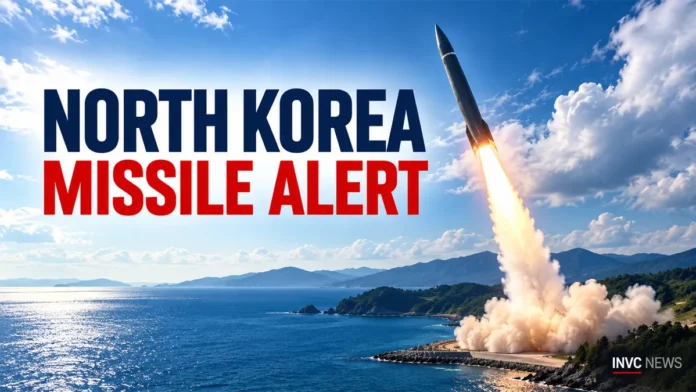
SEOUL, South Korea | October 3, 2026 — A North Korea missile launch early Saturday added fresh military pressure to a widening border dispute, prompting South Korea to strengthen surveillance and Japan to check the safety of nearby aircraft and vessels. The launch followed Kim Yo Jong’s rejection of Seoul’s demands over a mine explosion that injured South Korean soldiers. With Pyongyang dismissing responsibility and overtures for dialogue, regional authorities now face two simultaneous challenges: monitoring further missile activity and preventing the border confrontation from escalating.
THE 60-SECOND BRIEF
- South Korea detected a ballistic missile launch from the Wonsan area at approximately 6:30 a.m. local time.
- Seoul said the missile traveled more than 700 kilometers, approximately 435 miles.
- Japan estimated a flight distance of approximately 680 kilometers and said the missile landed outside its exclusive economic zone.
- The launch followed Friday’s statements by Kim Yo Jong rejecting Seoul’s accusations and diplomatic proposals.
- The underlying dispute concerns September 21 mine explosions that injured three South Korean soldiers, including two seriously.
Saturday’s Launch Triggers Coordinated Monitoring
South Korea’s Joint Chiefs of Staff said North Korea fired at least one ballistic missile toward the East Sea, also known as the Sea of Japan.
The military increased surveillance for possible additional launches and shared information with the United States and Japan. South Korean and U.S. authorities continued analyzing the missile’s characteristics.
Japan’s Defense Ministry separately recorded the launch at approximately 6:36 a.m. It estimated a maximum altitude of about 90 kilometers.
Tokyo said it had received no reports of damage to nearby aircraft or ships at the time of its announcement. Nevertheless, authorities convened an emergency response team, continued monitoring and lodged a strong protest with Pyongyang.
The slightly different flight-distance estimates reflect separate preliminary assessments. Neither establishes the missile’s maximum capability or confirms its precise model.
The Dispute Behind the Launch
The confrontation centers on explosions inside the Demilitarized Zone on September 21.
South Korea blamed North Korean mines and demanded an apology, along with an end to border fortification work.
The U.S.-led United Nations Command said a joint investigation discovered a North Korean antipersonnel mine south of the Military Demarcation Line. It determined that an armistice violation had occurred and said it would address the matter through established mechanisms.
Pyongyang rejects responsibility.
That disagreement matters because the dispute involves both the origin of the mines and activity around the line separating the two militaries. Seoul’s demands concern accountability and border construction, rather than the lifting of a military siege around South Korea.
Kim Yo Jong Rejects Seoul’s Approach
On Friday, Kim Yo Jong, the influential sister of North Korean leader Kim Jong Un, again dismissed South Korea’s findings in statements carried by North Korean state media.
She said the North’s fortifications aimed to permanently sever contact with the South.
Moreover, she ridiculed President Lee Jae Myung’s commitment to reducing military tensions and rejected Unification Minister Chung Dong-young’s proposal for talks about clarifying the Military Demarcation Line.
Seoul’s unification ministry responded that South Korea had no intention of acting with hostility toward the North. It urged direct discussions to prevent another incident.
Saturday’s launch followed those exchanges. However, the timing alone does not establish that North Korea ordered the test specifically in response to the mine dispute.
Why Japan and South Korea Are Watching Closely
Japan’s assessment placed the missile outside its exclusive economic zone. The immediate response focused on surveillance, information sharing and transportation safety.
Nevertheless, Tokyo condemned the launch as a violation of relevant U.N. Security Council resolutions and a threat to regional security.
Seoul’s presidential national security office also called on Pyongyang to halt repeated ballistic missile launches.
Meanwhile, the border dispute complicates efforts to reduce tensions. Military readiness can rise quickly, while the competing accounts of the mine explosions leave little common ground for negotiations.
The Next Test Is Military—and Diplomatic
Authorities will watch for further launches and more detailed findings about Saturday’s missile.
The diplomatic question is whether either side can establish a practical channel to address the border incident. Seoul has proposed communication; Pyongyang has rejected the approach.
For Japan and South Korea, the immediate task remains clear: maintain monitoring and safety measures while preventing a missile test and a contested border explosion from becoming a larger confrontation.