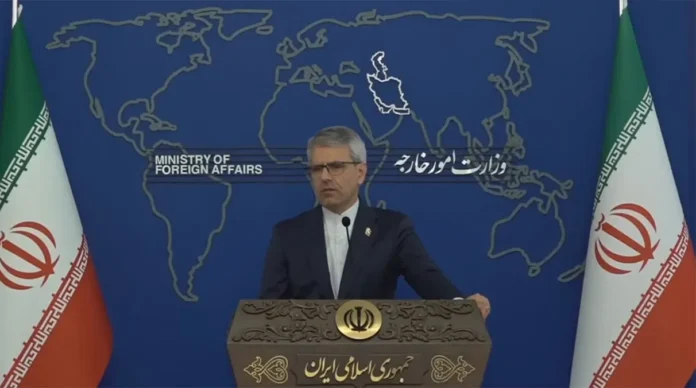
Doha/Tehran, October 23, 2026: Iran has objected to the phrase “Iran conflict” used in a joint statement following talks between Qatar and France, arguing that the wording obscures responsibility for the hostilities. Iranian Foreign Ministry spokesperson Esmail Baghaei said the situation should not be described in terms that, in Tehran’s view, blur the distinction between an aggressor and the country under attack.
In a post on X, Baghaei criticized the language used to describe the regional crisis. He argued that there was no such thing as an “Iran conflict” and accused the United States and Israel of launching what he called an unlawful war of aggression against Iran.
His remarks came after Qatar and France reaffirmed their strategic partnership and discussed a range of regional and international security issues, including Gulf security, navigation through the Strait of Hormuz, peace efforts in the Middle East and Africa, and developments in Syria and Lebanon.
What Did Iran Object To?
Baghaei’s objection centered on the terminology used in the Qatar-France joint statement. He argued that describing the situation as an “Iran conflict” fails to identify who Tehran holds responsible for the fighting.
In his post, the Iranian spokesperson said that hiding the truth behind misleading or evasive language was unacceptable. He maintained that refusing to identify an alleged aggressor was not neutrality, but an attempt to avoid moral responsibility.
Baghaei also argued that lasting peace could not be achieved by accommodating those accused of aggression, legitimizing attacks or blaming the side that had been attacked. In his view, a durable settlement would require recognition of the facts, respect for justice and a clear distinction between right and wrong.
These are the Iranian government’s stated position and accusations. The Qatar-France statement itself uses the phrase “ongoing Iran conflict” while discussing regional security and diplomatic efforts; it does not, in the cited passage, adopt Baghaei’s characterization of the war.
What Did Qatar and France Discuss?
The objection followed the fourth annual Qatar-France Strategic Dialogue, co-chaired in Doha on October 21 by Qatar’s Prime Minister and Foreign Minister, Sheikh Mohammed bin Abdulrahman bin Jassim Al-Thani, and France’s Minister for Europe and Foreign Affairs, Jean-Noël Barrot.
According to the joint statement, the two countries reviewed cooperation in regional security, defense, counterterrorism, trade, investment, education, technology, culture and humanitarian assistance. They also reaffirmed their commitment to strengthening their strategic partnership.
The political and diplomatic discussions covered several sensitive issues:
- Gulf security: Regional stability and coordination between Qatar and France.
- The Iran conflict: The regional hostilities and their diplomatic implications.
- Strait of Hormuz: Measures to restore freedom of navigation through a key maritime route.
- Middle East and Africa: Ongoing peace efforts and humanitarian challenges.
- Syria and Lebanon: Developments affecting security and stability in both countries.
The discussions reflect the wider diplomatic challenge facing countries in the region: protecting maritime trade, addressing security concerns and pursuing political solutions amid continuing tensions.
Why the Strait of Hormuz Matters
The Strait of Hormuz is a major international shipping corridor connecting the Persian Gulf with the Gulf of Oman and the wider Indian Ocean. Disruption to navigation through the strait can affect energy shipments, shipping costs and confidence in global trade.
That makes freedom of navigation a central concern for Gulf states and international partners. Any prolonged disruption could have consequences extending beyond the region, particularly for countries that depend on imported oil and other goods transported by sea.
Qatar and France included the restoration of freedom of navigation in their discussions, highlighting the connection between regional security and the wider global economy. The joint statement described the issue as part of their diplomatic agenda rather than announcing a specific new agreement to resolve it.
The Political Significance of the Dispute Over Language
Diplomatic statements often use carefully chosen terms to describe conflicts. Expressions such as “crisis,” “hostilities,” “war” and “conflict” can frame how responsibility, legal questions and possible solutions are discussed.
Iran’s objection shows how language itself has become part of the diplomatic dispute. Tehran wants international statements to identify the United States and Israel as responsible for the war, while the Qatar-France wording refers more broadly to the “ongoing Iran conflict.”
The difference matters because the choice of words can influence how governments, media organizations and international audiences understand a crisis. However, the use of a broad term does not by itself establish a country’s legal position on the conflict, just as an accusation by one party does not independently settle questions of responsibility under international law.
A careful assessment requires examining the events, the claims made by each party and the applicable international legal framework.
Can Diplomacy Bridge the Divide?
Qatar and France have said they intend to continue working together on regional and global challenges. Their agenda includes security cooperation, maritime navigation, humanitarian support and diplomatic engagement across the Middle East and Africa.
Iran’s public criticism highlights a challenge for such efforts: diplomatic language intended to keep discussions open can be viewed by a party to a conflict as avoiding responsibility or failing to acknowledge its position.
Whether diplomatic initiatives can make progress will depend on developments on the ground, the positions of the parties involved and their willingness to engage in negotiations. The statement from Qatar and France outlines areas of cooperation, but it does not by itself indicate that the dispute over terminology—or the wider conflict—has been resolved.
The Bottom Line
Iran has strongly criticized Qatar and France for using the phrase “Iran conflict” in their joint diplomatic statement. Esmail Baghaei says the wording obscures responsibility and insists that the United States and Israel should be identified as the parties responsible for what Tehran describes as a war of aggression.
Qatar and France, meanwhile, have focused on regional security, the Strait of Hormuz, peace efforts and their wider strategic partnership. The disagreement illustrates how the language used in diplomacy can become a point of contention in its own right, even as governments continue to discuss security and possible paths toward regional stability.