
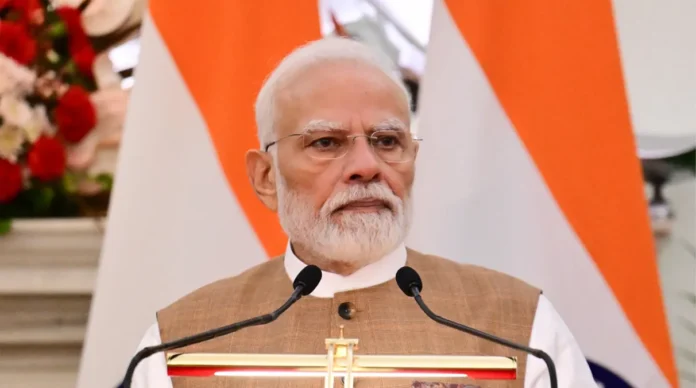
New Delhi, October 23, 2026 – Prime Minister Narendra Modi shared a Sanskrit verse on social media on Friday, drawing attention to the relationship between dependence, fear and sorrow in Hindu spiritual thought. The verse, from the Shrimad Bhagavata Mahapurana, explores how a person who remains bound by material influences can experience anxiety, confusion and grief.
The verse reads:
“यावदस्यास्वतन्त्रत्वं तावदीश्वरतो भयम्।
य एतत्समुपासीरंस्ते मुह्यन्ति शुचार्पिताः॥”
The verse appears in the 11th Skandha, Chapter 10, Verse 33 of the Shrimad Bhagavata Mahapurana and forms part of the teachings associated with the Uddhava Gita. In this passage, Lord Krishna explains to Uddhava the condition of the living being who remains dependent on material nature and the consequences of that dependence.
What Does the Sanskrit Shloka Mean?
In simple terms, the verse describes how a person who remains spiritually dependent and identifies with material existence continues to experience fear and sorrow. Those who remain absorbed in this limited understanding of life, the verse says, can become confused and burdened by grief.
The teaching goes beyond ordinary ideas of independence. It addresses the spiritual condition of a person who sees the body, mind, possessions and worldly circumstances as the whole of their identity.
From this perspective, freedom is not merely the ability to make choices or live without external restrictions. It also involves understanding the deeper nature of the self and reducing the hold that attachment, anxiety and the fear of loss have over the mind.
The Connection with the Uddhava Gita
The Uddhava Gita is the section of the Shrimad Bhagavata Mahapurana in which Krishna instructs Uddhava on spiritual knowledge, devotion, the nature of the self and liberation. The cited verse appears in a discussion of the three material modes of nature—sattva, rajas and tamas—and how they influence living beings and their actions.
According to this philosophical framework, people often become caught in the results of their actions and in the changing circumstances of everyday life. Pleasure and pain, gain and loss, success and failure can shape their emotions and sense of security.
When a person treats these changing experiences as the foundation of their identity, the possibility of loss can become a continuing source of fear. The verse presents this condition as a form of dependence that keeps the individual entangled in sorrow and confusion.
Why Does the Teaching Emphasize Fear?
Fear often grows when people feel they have no control over what matters most to them. Concerns about status, possessions, relationships, health and the future can create a persistent sense of uncertainty.
The spiritual interpretation of the verse asks readers to look beyond these external circumstances and examine the source of their attachment. It suggests that identifying completely with temporary things can make a person vulnerable to anxiety whenever those things change.
The reference to the Supreme Controller also belongs to the theological context of the passage. In the Bhagavata tradition, the verse describes the living being’s relationship with the divine and the consequences of remaining bound by material nature. It should therefore be understood within that religious and philosophical framework rather than as a simple claim that all fear or sorrow can be eliminated through one approach.
The Role of the Three Gunas
In Hindu philosophy, sattva, rajas and tamas describe three fundamental qualities or modes of material nature.
- Sattva is associated with clarity, harmony and knowledge.
- Rajas is associated with activity, desire and ambition.
- Tamas is associated with inertia, confusion and ignorance.
The Bhagavata’s discussion considers how these qualities influence conduct and how attachment to material identity can bind the living being to the consequences of action. The wider teaching encourages spiritual understanding rather than unquestioning identification with changing mental states and worldly outcomes.
Does Spiritual Freedom Mean Leaving the World Behind?
The verse can be read as an invitation to reconsider what freedom means. It does not simply discuss political independence or freedom from external authority. Its focus is spiritual dependence and the distress that can arise from a material understanding of life.
In the broader devotional tradition, self-knowledge and surrender to God are understood as paths toward liberation. Different Hindu philosophical schools explain the relationship between the individual self, material nature and the Supreme in different ways, but the passage places spiritual understanding at the center of its message.
For a reader today, the teaching offers a moment for reflection: how much of our peace depends on circumstances that are constantly changing, and how can a deeper understanding of ourselves change our response to uncertainty?
The Larger Message
The Sanskrit verse shared by PM Narendra Modi brings an ancient spiritual discussion into contemporary public attention. Its central theme is the connection between dependence, fear and sorrow, as explained in the Bhagavata’s account of Krishna’s teachings to Uddhava.
The passage invites readers to examine the difference between external circumstances and inner freedom. Within its spiritual framework, a person moves toward greater freedom by understanding the nature of the self and loosening the grip of material attachment.
The enduring question raised by the verse is not whether life’s uncertainties can be avoided, but whether a person can develop the understanding and spiritual grounding to face them without being overwhelmed by fear and grief.