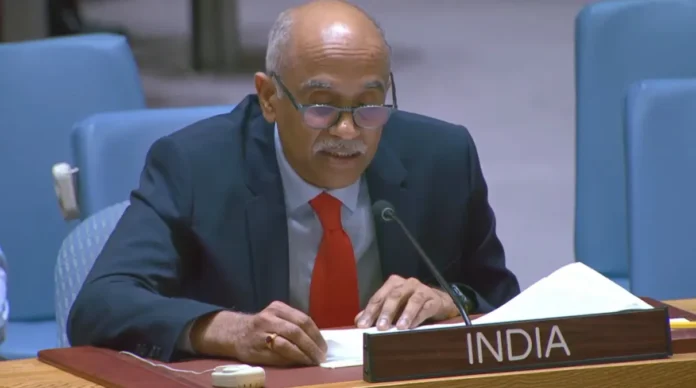
New York, October 23, 2026: India has renewed its call for comprehensive reform of the United Nations Security Council, arguing that the balance of power established after World War II cannot determine how the world is governed today. Addressing the UN General Assembly, India’s Permanent Representative, Ambassador Parvathaneni Harish, said the Council’s credibility was being undermined by a structure that no longer reflects contemporary geopolitical realities.
Harish argued that the privileges granted to the victors of World War II cannot compensate for the lack of adequate representation in the Council. He called for negotiations to move beyond repeated statements and procedural disputes, with a written negotiating text, clear timelines and a defined path toward reform.
His remarks put the spotlight on a long-running question at the United Nations: how can an institution created in 1945 respond effectively to a world that has changed dramatically over eight decades?
India Says History Cannot Determine Today’s Global Order
Harish told the General Assembly that a war fought more than 80 years ago should not determine the structure of international decision-making in the present day.
The five permanent members of the Security Council—China, France, Russia, the United Kingdom and the United States—retain permanent seats and veto power under the framework established after World War II. India argues that this arrangement does not adequately represent the contemporary distribution of population, economic influence and geopolitical responsibility.
The Council has 15 members: five permanent members and 10 elected members who serve two-year terms. The permanent members can use their veto to block substantive resolutions, even when a proposal has broad support among other members.
India says the arrangement creates a structural imbalance and limits the Council’s ability to respond effectively to international crises. New Delhi has consistently supported expanding both the permanent and non-permanent categories of membership.
India Highlights Its Contribution to World War II
Harish also invoked India’s role in World War II, challenging the idea that the existing structure should be justified solely by the status of the victorious powers.
According to the figures cited in his remarks, approximately 2.5 million Indians served during the war, while around 90,000 Indian soldiers lost their lives. He also referred to the Bengal famine, which he linked to colonial policies during the war and said had killed more than four million people.
These figures were presented as part of India’s argument about the historical costs borne by colonized populations. Estimates of wartime military casualties and famine deaths vary across historical sources, so the numbers should be understood as figures cited in the ambassador’s remarks rather than a settled consensus across all historical research.
Harish argued that an institution shaped by the victors’ priorities did not adequately incorporate the concerns of those who suffered under colonial rule. In India’s view, the historical experience of countries in Asia, Africa and other parts of the Global South strengthens the case for a more representative international system.
Why India Says the UN Security Council Needs Reform
The Security Council has primary responsibility under the UN Charter for maintaining international peace and security. It can adopt resolutions, impose sanctions and authorize certain collective measures. But disagreements among permanent members have repeatedly complicated efforts to respond to major international crises.
India has warned that the Council’s inability to reflect current global realities risks weakening confidence in the wider United Nations system.
The debate is not simply about adding more seats. It also concerns who has the authority to make decisions, whether the veto should remain unchanged, and how developing countries can gain a meaningful voice in global security decisions.
Supporters of expansion argue that the Council should better reflect the size and influence of today’s membership. They also contend that greater representation could improve the legitimacy of decisions made in the name of the international community.
However, UN member states disagree on the design of a reformed Council, including the number of additional seats, the status of new members and the future of veto powers. Those differences have contributed to years of stalled negotiations.
India Calls for Written Text and Clear Timelines
Harish said the special privileges established under the UN Charter should not become a means of delaying reform indefinitely.
He called for the Intergovernmental Negotiations (IGN) process to proceed on the basis of a written draft text, with clear timelines and a defined direction for the discussions. A draft would give member states a concrete document to debate, amend and negotiate rather than leaving the process centered on general statements of national positions.
India’s position is that text-based negotiations would help identify areas of agreement, expose points of disagreement and provide a practical route toward a comprehensive reform proposal.
The issue has become a central procedural dispute within the reform process. Some countries and negotiating groups favor moving toward text-based negotiations, while others argue that further work is needed to build broader agreement on the model of reform before negotiations are anchored in a consolidated text.
India Criticizes the Uniting for Consensus Group
In his remarks, Harish criticized a group of countries operating under the name Uniting for Consensus (UfC), which includes Italy and Pakistan among its members. He accused the group of using procedural arguments to prevent the adoption of a draft text for negotiations.
Harish questioned the idea that agreement on a draft should come only after countries have completed their discussions. He argued that a written text is needed to start substantive negotiations, not merely as a document produced at the end.
The criticism reflects a deeper disagreement over the future composition of the Council.
The UfC group opposes creating additional permanent seats and instead advocates expanding elected representation, including longer-term elected seats that could be renewed. Its members argue that creating new permanent members could reproduce the existing concentration of power and make the Council less flexible.
India, by contrast, supports expansion in both permanent and non-permanent categories. The disagreement is therefore not only about how quickly the process should move, but also about what a reformed Council should look like.
What the Dispute Means for the Global South
For many developing countries, Security Council reform is tied to a broader demand for a greater role in international decision-making. Countries across Africa, Asia, Latin America and the Caribbean argue that the current arrangement does not adequately reflect their populations, regional responsibilities or growing role in global affairs.
India has repeatedly backed a more representative Council and has called for negotiations to produce concrete outcomes rather than remain open-ended.
At the same time, member states differ over which countries should receive additional seats and whether new permanent members should have veto powers. Reaching agreement will require addressing these competing concerns while preserving the Council’s ability to make decisions.
The debate also highlights a wider challenge for multilateral institutions: legitimacy depends not only on their founding principles, but also on whether their structures remain credible to the countries expected to abide by their decisions.
What Happens Next?
The reform process continues through the General Assembly’s Intergovernmental Negotiations, where member states discuss possible models for changing the Council’s composition and working methods.
India is pressing for a more structured process based on a negotiating text, clear milestones and time-bound discussions. Progress will depend on whether countries with differing positions can agree on a framework for negotiations and eventually reconcile their competing proposals.
Any major change to the Security Council’s composition would require an amendment to the UN Charter, involving approval by the General Assembly and ratification by the required number of member states, including all five permanent members. That requirement makes reform a politically complex process even if a broader agreement emerges among the membership.
The Bottom Line
India’s latest intervention has renewed attention on the gap between the UN Security Council’s post-World War II structure and today’s international realities. Ambassador Parvathaneni Harish argues that historical privileges should not be used to delay a more representative system and that negotiations need a written text and clear timelines to make progress.
The debate remains unresolved. India and its supporters want expansion in both permanent and non-permanent categories, while the Uniting for Consensus group favors a different model centered on elected representation. Whether the UN can bridge that divide will be a major test of its ability to reform the institutions that shape global peace and security.