NEW DELHI, August 10, 2026
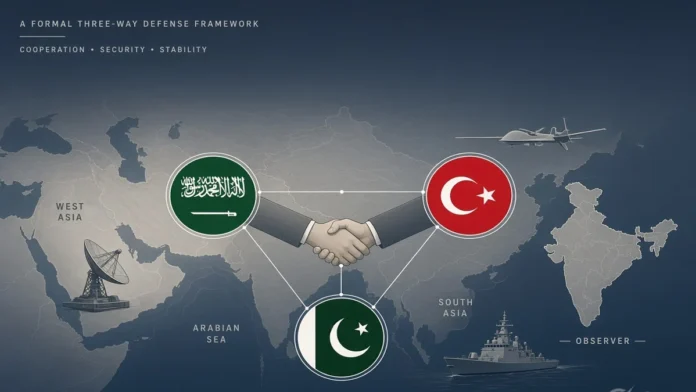
The Mecca Joint Defence Agreement signed by Saudi Arabia, Turkey and Pakistan signals the emergence of a new dimension in West Asia’s rapidly changing strategic landscape. Although the agreement does not pose an immediate or direct threat to India, Pakistan’s enthusiasm for transforming it into a broader alliance of Muslim-majority countries requires careful monitoring by New Delhi.
The agreement establishes a collective-defense commitment under which an armed attack on any one of the three signatories will be regarded as an attack on all three. It is intended to strengthen deterrence, expand military cooperation and improve coordination among the participating countries.
Its official framework does not identify Israel, Iran, India or any other country as a common enemy. It also avoids presenting the arrangement as an alliance built against a particular religious, political or regional bloc.
The political messaging emerging from Pakistan, however, has created questions about how Islamabad would like the agreement to develop. Pakistani Defense Minister Khawaja Asif has called on Muslim-majority countries to set aside their differences and establish a broader military alliance modeled on NATO.
Asif has also urged Muslim countries to unite against Israel and create a coordinated military front. His comments have raised concerns not only in Jerusalem but also in capitals such as New Delhi, where policymakers will want to understand whether Pakistan intends to draw South Asian disputes into an alliance originally presented as a West Asian security arrangement.
Why Pakistan Is Excited About a ‘Muslim NATO’
The agreement provides Pakistan with an opportunity to increase its strategic importance beyond South Asia. Islamabad has long sought a larger political and security role in the Muslim world, particularly through its close relationship with Saudi Arabia.
Pakistan brings a large military, extensive operational experience, missile capabilities and nuclear deterrence to the partnership. It also has decades of defense cooperation with Saudi Arabia, including military training, technical assistance and security coordination.
The new agreement could allow Islamabad to present itself as an essential security partner for wealthy Gulf countries. It may also create opportunities for Pakistan to receive Saudi financial support and gain greater access to Turkish defense technology.
Khawaja Asif’s call for a broader Islamic military alliance reflects this ambition. Pakistan would gain considerable diplomatic influence if the three-country pact expanded to include other nations from the Gulf, West Asia, North Africa or the wider Muslim world.
However, Asif’s proposal represents Pakistan’s political position. It should not automatically be interpreted as the agreed policy of Saudi Arabia and Turkey. Neither country has formally endorsed the creation of a military bloc directed specifically against Israel.
The Three Countries Bring Complementary Capabilities
The Mecca agreement carries strategic weight because the capabilities of Saudi Arabia, Turkey and Pakistan complement one another.
Saudi Arabia’s Financial and Energy Power
Saudi Arabia possesses major financial resources and the ability to invest heavily in defense infrastructure. It has purchased some of the world’s most advanced military equipment and maintains extensive security relationships with the United States and other Western countries.
Riyadh can finance joint weapons projects, military training, air-defense systems and defense-industrial cooperation. Its importance in global energy markets also gives it substantial economic and diplomatic influence.
For Saudi Arabia, the agreement offers an opportunity to diversify its security partnerships. It does not necessarily mean that Riyadh intends to replace the United States as its principal external security partner. Instead, Saudi Arabia appears to be creating additional strategic options in response to persistent regional instability.
Turkey’s Defense Industry and NATO Experience
Turkey possesses an advanced and rapidly expanding defense industry. It has developed sophisticated drones, missiles, warships, armored vehicles and electronic-warfare systems.
Its military has extensive operational experience, while its NATO membership provides familiarity with multinational defense planning, military standardization and alliance coordination.
Turkey could contribute defense technology, intelligence-sharing, training, joint exercises and military-industrial expertise. Its existing defense partnership with Pakistan could also be expanded through Saudi investment.
Nevertheless, Turkey’s participation in the Mecca agreement does not extend NATO’s protection or institutional resources to Pakistan or Saudi Arabia. The two alliances remain legally and operationally separate.
Pakistan’s Military and Nuclear Capabilities
Pakistan contributes a large and experienced armed force, ballistic and cruise missile systems and nuclear weapons.
Its nuclear capability inevitably generates speculation about whether the agreement places Saudi Arabia and Turkey under an extended Pakistani nuclear umbrella. No publicly available provision confirms such an arrangement.
A collective-defense pact does not automatically include nuclear protection. Unless the signatories issue a formal clarification, claims that Pakistan has extended its nuclear deterrent to the other members should be treated cautiously.
The more immediate possibilities involve conventional military cooperation, intelligence-sharing, air defense, joint exercises, logistical support and weapons development.
Is It Accurate to Call the Pact a ‘Muslim NATO’?
The term “Muslim NATO” is politically attractive but strategically imprecise.
The agreement’s core provision resembles NATO’s collective-defense principle because it treats an attack on one participant as an attack on all. That similarity alone does not make the new arrangement equivalent to NATO.
NATO has a permanent command structure, established headquarters, multinational forces, detailed operational plans, standardized military procedures and decades of combined exercises. It also has a formal political mechanism through which members consult and coordinate their responses.
The Mecca pact remains at an early stage. Its members have not publicly disclosed an integrated command structure, permanent joint force, common defense budget or precise military-response mechanism.
The seriousness of the alliance will depend on what follows the declaration. Regular joint exercises, coordinated weapons purchases, integrated air-defense networks, a permanent military headquarters and clearly defined response obligations would move it closer to a fully institutionalized alliance.
Until those structures emerge, the pact is best understood as a significant collective-security framework rather than a complete Islamic version of NATO.
The Risk of Turning a Defensive Pact Into an Ideological Bloc
A collective-defense arrangement remains credible when its primary purpose is protecting members from external aggression.
The danger arises when such an arrangement begins identifying enemies on the basis of religious or political identity. If the alliance is transformed into a platform for mobilizing Muslim-majority countries against a designated adversary, its strategic consequences would become considerably more serious.
Khawaja Asif’s call for a united military front against Israel introduces precisely this risk. His rhetoric attempts to give the agreement an ideological direction that is absent from its official text.
Such an expansion would also produce internal disagreements. Muslim-majority countries do not share identical interests, threat perceptions or diplomatic relationships. Some maintain formal ties with Israel, while others cooperate with it indirectly on trade, technology, intelligence or regional security.
Differences concerning Iran, political Islam, the Muslim Brotherhood, the Palestinian issue and relations with the United States would further complicate any attempt to create a unified military alliance.
Why an Anti-Israel Alliance Would Be Difficult
Pakistan does not recognize Israel and has consistently supported the Palestinian cause. Turkey’s position is different.
Turkey recognizes Israel and has maintained diplomatic relations with it for decades, despite repeated political confrontations and periods of severe tension. Ankara strongly criticizes Israeli military policies, but joining a permanent military alliance explicitly directed against Israel would carry substantial diplomatic and security costs.
Turkey must also consider its NATO membership, trade relations, Western security partnerships and regional ambitions.
Saudi Arabia does not maintain formal diplomatic relations with Israel. Even so, its close relationship with the United States would make direct participation in an anti-Israel military front highly complicated.
Riyadh depends heavily on American weapons, training, intelligence and security coordination. An openly hostile military position toward Israel could undermine Saudi relations with Washington and create uncertainty for its economic modernization plans.
These constraints explain why Pakistan’s rhetoric should not be confused with a unified policy adopted by all three countries.
What the Agreement Means for West Asia
The pact reflects declining confidence in existing security arrangements and a growing desire among regional governments to develop additional defense partnerships.
Conflicts involving Israel, Iran, Gaza, Lebanon and Yemen have exposed energy infrastructure, shipping routes and civilian facilities to missiles, drones and other forms of attack.
Saudi Arabia wants stronger protection for its oil facilities, ports, cities and strategic development projects. Turkey seeks greater regional influence and new markets for its defense industry. Pakistan wants economic support, energy security and a more important role in regional diplomacy.
The agreement may initially focus on military exercises, intelligence cooperation, maritime security, counterterrorism, air defense and weapons manufacturing rather than preparing for a large conventional war.
Its impact will depend on whether the signatories convert political declarations into permanent institutions and operational capabilities.
Does the Agreement Pose an Immediate Threat to India?
There is no evidence that the pact was created specifically against India.
The immediate strategic context is instability in West Asia. The agreement’s official language does not mention Kashmir, India-Pakistan relations or any South Asian territorial dispute.
There is also no public explanation of whether a future India-Pakistan conflict would activate the collective-defense clause. Such a decision would likely depend on which country was viewed as the aggressor and how the other members interpreted the circumstances.
Saudi Arabia has deep economic and political relations with India. It would have substantial interests to protect before becoming involved in an India-Pakistan confrontation.
Turkey has closer defense relations with Pakistan and has previously supported Islamabad’s political position on Kashmir. However, that does not automatically mean Ankara would join a direct military confrontation with India.
The immediate possibility of Saudi or Turkish forces entering an India-Pakistan conflict therefore appears limited.
The Long-Term Concerns for India
The more realistic concern is that the agreement could gradually strengthen Pakistan’s military capabilities.
Saudi funding may support defense procurement or joint weapons development. Turkish technology could improve Pakistan’s drones, missiles, electronic-warfare systems, warships and air-defense capabilities.
The three countries could also expand intelligence-sharing, joint training and logistical coordination. These developments would affect India’s long-term defense calculations even without triggering the collective-defense clause.
Pakistan may additionally attempt to use the alliance to secure diplomatic support on Kashmir or internationalize future disputes with India.
New Delhi must therefore monitor whether the alliance’s agenda remains restricted to West Asian security or expands to include Pakistan’s regional political objectives.
Five Developments India Should Monitor
India should closely follow five areas:
- Definition of aggression: The circumstances under which the collective-defense clause can be activated.
- Command structure: Whether the members establish permanent headquarters, joint forces or integrated military planning.
- Defense technology: The extent to which Turkish weapons and Saudi financing enhance Pakistan’s military capabilities.
- Nuclear signaling: Any suggestion that Pakistan’s nuclear deterrence covers the other members.
- Future expansion: Whether additional Gulf, Arab or Muslim-majority countries join the agreement.
India should also examine joint military exercises, weapons-production agreements, intelligence coordination and statements concerning Kashmir.
India’s Balanced West Asia Policy Is Its Greatest Strength
India has developed strong relations with nearly every major country in West Asia. Its partnerships with Saudi Arabia, the United Arab Emirates, Qatar and Oman cover energy, investment, trade, technology and security.
New Delhi also maintains important relationships with Iran and Israel. This diversified engagement provides India with diplomatic flexibility and prevents it from becoming dependent on any single regional bloc.
India should continue deepening its strategic partnership with Saudi Arabia while maintaining direct communication with Turkey. It should also strengthen intelligence capabilities and assess the military implications of growing Turkey-Pakistan defense cooperation.
A measured response is more useful than alarmist rhetoric. Treating the pact immediately as a hostile religious alliance could unnecessarily damage India’s relations with important West Asian partners.
India Needs Vigilance, Not Panic
The Mecca Joint Defence Agreement has the potential to influence the strategic balance in West Asia and beyond. Saudi financial strength, Turkish defense technology and Pakistan’s military capabilities create a combination that cannot be dismissed as merely symbolic.
At the same time, the agreement is not yet a fully developed “Muslim NATO.” Its response mechanisms, command arrangements and operational obligations remain unclear.
Pakistan’s enthusiasm and Khawaja Asif’s call for an expanded Islamic military front introduce concerns about the direction Islamabad wants the alliance to take. Saudi Arabia and Turkey, however, have separate diplomatic priorities and are unlikely to surrender their independent strategic calculations to Pakistan.
For India, the pact is not an immediate military emergency. It is a development that requires sustained diplomatic engagement, intelligence assessment and defense preparedness.
New Delhi’s response should be based on the alliance’s actions rather than political slogans. If the pact remains a defensive framework centered on West Asian security, its direct impact on India may remain limited. If it expands into an institutionalized bloc that strengthens Pakistan’s military capabilities or adopts Islamabad’s hostility toward India, the strategic consequences will become far more significant.
Note: “Muslim NATO” is an informal political description, not the official name of the alliance. Its official title is the Mecca Joint Defence Agreement.