By Team INVC | INVC NEWS
MUMBAI, India | September 14, 2026 —
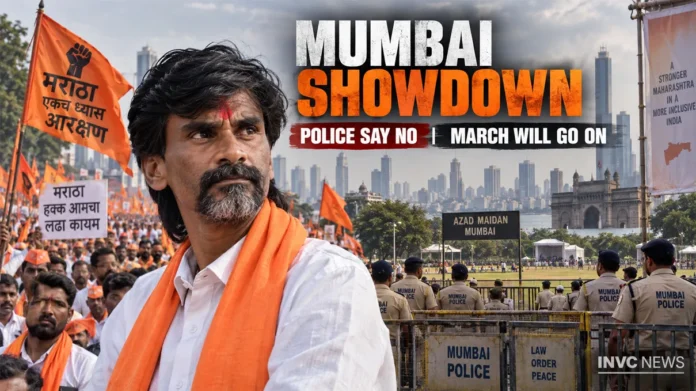
The Manoj Jarange Mumbai March has set the stage for a fresh political showdown in Maharashtra after Mumbai Police refused permission for his proposed indefinite hunger strike at Azad Maidan — only for the Maratha quota activist to declare that his march to the financial capital will go ahead.
Police have cited security and law-and-order concerns during Ganeshotsav.
Jarange has answered with an equally clear message.
He says the agitation will remain peaceful, but the march will not stop.
That has left the Devendra Fadnavis government staring at a politically explosive question:
What happens when thousands of Maratha protesters begin moving toward Mumbai while the city is already managing one of its busiest festivals?
The march is scheduled to begin on September 15, with supporters travelling toward Mumbai in stages before Jarange plans to begin an indefinite hunger strike at Azad Maidan from September 19.
The countdown has begun.
Police Say No, Jarange Says Mumbai Is Final
Mumbai Police rejected Jarange’s request to hold the hunger strike at Azad Maidan, pointing to law-and-order and security concerns.
Ganeshotsav began on September 14 and will bring huge crowds, processions and heavy police deployment across Mumbai.
Authorities therefore face an unusually sensitive combination.
On one side sits a major religious festival involving lakhs of people.
On the other sits a politically charged reservation agitation capable of mobilizing supporters from across Maharashtra.
Jarange, however, has refused to retreat.
He has said the Maratha community will proceed toward Mumbai and has challenged attempts to stop the march.
His team subsequently submitted a fresh application and assured authorities that protesters would remain peaceful and follow conditions imposed for the agitation.
Maharashtra Government Now Faces a Political Headache
For Chief Minister Devendra Fadnavis, the situation carries risks whichever way the government moves.
Allow a huge protest into central Mumbai during Ganeshotsav, and the administration faces traffic, crowd-management and security challenges.
Take an aggressive approach to stopping the march, and the government risks handing Jarange exactly the political confrontation that could energize the reservation movement.
That is the tightrope.
The Maratha quota issue has already repeatedly put Maharashtra governments under pressure.
Jarange has shown that he can mobilize supporters and keep the issue alive well beyond a single protest.
Now, by taking the agitation toward Mumbai, he is increasing the political temperature again.
Why Jarange Is Marching to Mumbai
Jarange wants the government to accelerate implementation of Maratha reservation-related demands.
A central issue involves recognizing eligible Marathas as Kunbis, which could allow qualifying individuals to access benefits available under the Other Backward Classes framework.
He has repeatedly demanded quicker issuance of Kunbi caste certificates based on historical records.
The government says it has already undertaken an extensive search for such documents.
Authorities have identified around 58 lakh historical revenue and Kunbi records, while more than 3.16 lakh Kunbi certificates have been issued.
Jarange argues that the process still falls short of what the community was promised.
That disagreement has brought the agitation back to Mumbai’s doorstep.
Kunbi Certificates Are the Heart of the Battle
The Kunbi issue sounds technical.
Politically, it is anything but.
Kunbis fall within Maharashtra’s OBC category.
Jarange wants eligible Marathas with historical evidence of Kunbi ancestry to receive certificates that recognize that status.
Supporters argue that old government documents provide the basis for expanding recognition.
Critics and sections of the existing OBC community fear that a large-scale inclusion of Marathas could affect their share of reservation benefits.
That creates another difficult equation for the state government.
Satisfying one politically powerful community could alarm another.
Fadnavis Government Cannot Afford to Ignore OBC Concerns
Maratha reservation politics does not operate in isolation.
OBC organizations have closely watched every government decision involving Kunbi certificates.
Some OBC leaders fear that bringing large numbers of Marathas into the existing reservation framework could increase competition for jobs and education seats.
The Fadnavis government therefore cannot simply treat the issue as a negotiation with Jarange.
It must balance Maratha demands with OBC concerns.
That makes every concession politically sensitive.
And every delay gives Jarange more ammunition.
Ganeshotsav Makes Timing Extremely Sensitive
Jarange’s choice of timing has dramatically increased the pressure on the administration.
Mumbai during Ganeshotsav is already a massive policing operation.
Major mandals attract enormous crowds.
Road diversions become common.
Processions require security.
Railway stations and public transport systems handle heavier passenger movement.
Now add a large reservation march heading toward South Mumbai.
The logistical challenge becomes obvious.
Maharashtra Revenue Minister Chandrashekhar Bawankule has appealed to protesters to avoid holding agitations in Mumbai during the festival, arguing that the timing could create law-and-order difficulties.
Jarange remains unmoved.
Bombay High Court Adds Another Twist
The political drama also carries a legal dimension.
The Bombay High Court recently refused to issue pre-emptive directions preventing Jarange from entering Mumbai.
The court emphasized that peaceful protest and dissent form part of democratic rights.
That does not automatically grant Jarange permission to occupy Azad Maidan indefinitely.
Police still retain powers to regulate demonstrations, venues, crowd size and security arrangements.
But the court’s position makes the situation more nuanced than a simple government ban.
Jarange can argue that he has a right to protest.
Police can argue that they have a duty to regulate how and where that protest occurs.
Mumbai now sits between those two positions.
The March Route Could Turn Into a Political Roadshow
Jarange plans to start moving from the Marathwada region toward Mumbai on September 15.
The announced route includes stops through Beed, Ahilyanagar, Pune and Raigad before supporters move toward Navi Mumbai and finally the metropolis.
That means this will not simply be a protest beginning at Azad Maidan.
It could become a multi-day political mobilization travelling across Maharashtra.
Every stop creates an opportunity for more supporters to join.
Every large gathering creates another pressure point for police.
And every confrontation—if one occurs—could instantly dominate Maharashtra politics.
Jarange Knows the Power of Mumbai
Moving an agitation to Mumbai changes its scale.
A protest in a district can pressure the local administration.
A mass protest in Mumbai pressures the entire state government.
It brings television cameras.
It disrupts the political agenda.
It forces ministers to respond.
It can turn a regional grievance into a statewide political crisis within hours.
Jarange has used that pressure strategy before.
His latest march appears designed to do it again.
Can the Government Negotiate Before Protesters Reach Mumbai?
This may be the most important question over the next few days.
The state can still try to reach an understanding with Jarange before the march reaches the city.
Officials could negotiate over venue, protest duration, delegation size or implementation timelines.
A political delegation could also meet him during the march.
That would allow the government to lower the temperature without appearing to surrender.
But any compromise would need to satisfy Jarange enough for him to change his plan.
So far, he has shown little sign of doing that.
Opposition Parties Will Watch Carefully
The agitation also creates an obvious opportunity for Maharashtra’s opposition.
Any police confrontation could trigger criticism of the Fadnavis government.
Any major concession could invite attacks from groups concerned about the OBC reservation structure.
If the march remains peaceful but draws huge crowds, Jarange himself could emerge with greater political leverage.
The government therefore has little room for error.
Opposition parties do not even need to lead the agitation.
They only need to watch for the moment when the government appears vulnerable.
One Wrong Move Could Change the Political Narrative
For both Jarange and the government, discipline will matter.
Jarange has repeatedly said the march will remain peaceful.
That promise is critical.
A large mobilization can quickly become difficult to manage if unauthorized groups join or tempers rise.
The government faces the same challenge.
Heavy-handed policing could turn a manageable protest into a larger political confrontation.
That is why the next few days could become a test not only of reservation politics, but of political crisis management.
Why Maratha Reservation Remains Such a Powerful Issue
The Maratha community carries enormous social and political weight in Maharashtra.
For decades, Maratha leaders played central roles across state politics, cooperative institutions and rural power structures.
Yet economic changes, unemployment pressures and competition for education have intensified demands for reservation.
That combination has made the issue emotionally powerful and politically difficult.
Governments have repeatedly attempted legal and administrative solutions.
Court challenges and competing reservation claims have complicated those efforts.
Jarange has transformed that long-running policy dispute into a mass political movement.
September 15 Could Be the Real Starting Gun
The crucial moment now arrives on September 15.
If Jarange begins the march as planned, political attention will follow him kilometer by kilometer toward Mumbai.
The government will have several chances to negotiate.
Police will need to manage movement along the route.
Jarange will need to keep supporters disciplined.
And Mumbai authorities will need to decide what happens if protesters reach the city without the original Azad Maidan permission they sought.
That is why this is no longer simply another reservation protest.
It is becoming a political test of nerve.
Mumbai Showdown or Last-Minute Deal?
Maharashtra politics now faces two possible scenarios.
One is confrontation.
Jarange marches toward Mumbai, police enforce restrictions and the government faces an escalating political crisis.
The other is negotiation.
Both sides reach a formula that allows a controlled protest while avoiding disruption during Ganeshotsav.
There is still time for the second option.
But the clock is running.
Police have said no to the proposed Azad Maidan hunger strike.
Jarange has effectively answered:
The march is still coming.
And that has turned the Maratha reservation battle into one of Maharashtra’s biggest political stories of the week.