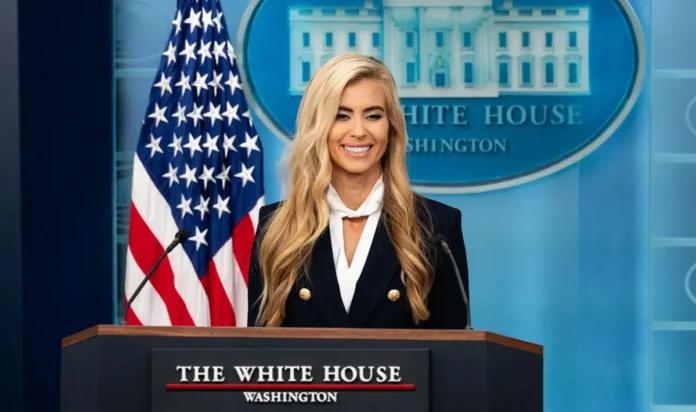
Zacharia’s first White House briefing lasted just 14 minutes and included only three media outlets, while her announcement of Kimberly Guilfoyle’s departure as U.S. ambassador to Greece became the session’s major news.
WASHINGTON, D.C. | October 15, 2026 – U.S. President Donald Trump’s new White House press secretary, Katie Zacharia, is facing criticism following an awkward debut at the White House podium after she mistakenly referred to the president as her “husband” while discussing how she plans to balance her demanding job with family life.
Zacharia made the verbal slip during her first press briefing on Tuesday, October 13, when she was responding to a question about managing her responsibilities as press secretary alongside her family commitments. While describing her husband’s support, she said, “My president,” before immediately correcting herself: “Excuse me, my husband.”
The moment drew laughter in the briefing room and quickly became a focus of media coverage and online commentary. The incident added to scrutiny of Zacharia’s performance, which was marked by a short session, limited questioning and several difficult exchanges.
The briefing lasted approximately 14 minutes, and Zacharia took questions from reporters representing just three media outlets: Fox News, Breitbart and the Daily Mail. All three are widely associated with conservative coverage and have generally been more sympathetic to Trump than many mainstream U.S. news organizations.
A Brief First Appearance Under the Spotlight
Zacharia’s debut came after a prolonged gap in White House press briefings and as the Trump administration continued to defend its policies and manage questions about major political and diplomatic developments.
During the session, she focused heavily on Trump’s agenda and the administration’s achievements. She described her role as an opportunity to amplify and communicate the president’s policies to the American public.
However, the limited duration of the briefing and the narrow range of media outlets that asked questions prompted criticism. Reporters also raised questions about U.S. intelligence sharing with Ukraine, but Zacharia did not provide an immediate answer, saying she would have to follow up.
Her response to the Ukraine question added to the impression that the new press secretary had not yet established a confident command of the issues facing the administration.
The selection of the three outlets also attracted attention. Fox News, Breitbart and the Daily Mail have all provided substantial coverage of Trump and his political movement, prompting questions about how much access journalists from other news organizations would receive during future briefings.
The choice of questioners does not, by itself, establish that other reporters were deliberately excluded. Nevertheless, the limited exchange raised broader questions about media access and the administration’s approach to press scrutiny.
“My President—Excuse Me, My Husband”
The most widely discussed moment occurred when a reporter asked Zacharia how she would manage the demands of the press secretary’s job while raising four children and maintaining family life.
Zacharia praised her husband’s support and said her family remained her priority. She explained that the idea of not spending evenings with her children was unacceptable to her.
She then stumbled over her words, saying, “My president,” before correcting herself with “my husband.” She acknowledged the mistake with a brief, lighthearted response.
The remark was an apparent verbal slip rather than a substantive statement about her relationship with Trump. However, it quickly became a talking point because it occurred during her first appearance in one of the most visible communications roles in the U.S. government.
A White House press secretary is expected to communicate the president’s position, respond to reporters’ questions and explain administration decisions under intense public scrutiny. Even a brief mistake can attract outsized attention when it occurs in a nationally watched briefing.
Zacharia’s first appearance therefore became an early test of her ability to handle the pressure of the position.
Kimberly Guilfoyle’s Departure Becomes the Main News
Despite the attention surrounding the verbal slip, Zacharia’s briefing produced a significant diplomatic announcement.
She confirmed that the White House had asked Kimberly Guilfoyle to resign as U.S. ambassador to Greece. Responding to a reporter’s question about Guilfoyle’s future, Zacharia said the administration had requested her resignation and described her as a valuable member of the team.
Guilfoyle subsequently left the post, bringing an abrupt end to her tenure as ambassador.
The development followed media reports concerning allegations of financial impropriety and questions about her conduct while serving in the diplomatic role. Guilfoyle has denied wrongdoing, and allegations reported by the media should not be treated as established findings of misconduct.
Trump later indicated that the administration had been dissatisfied with what it had read about the controversy. The departure placed Guilfoyle’s tenure and the administration’s response under renewed scrutiny.
The announcement was arguably the most consequential piece of news to emerge from Zacharia’s first briefing, even as the press secretary’s awkward wording drew widespread attention.
A New Face for Trump’s White House Communications Team
Zacharia took over the role after Karoline Leavitt stepped down. Her appointment placed her at the centre of the administration’s effort to communicate Trump’s policies and respond to questions from the White House press corps.
The position is among the most demanding communications jobs in Washington. The press secretary must regularly address questions on domestic policy, foreign affairs, national security and controversies involving senior officials, often without much time to prepare.
Zacharia’s debut attracted criticism over her brief presentation, her handling of questions and the limited number of outlets that participated. Supporters of the administration, however, may view a first appearance as an imperfect introduction rather than a definitive measure of her future performance.
The coming briefings will offer a clearer indication of whether she can provide more detailed answers, handle difficult questions and establish a consistent working relationship with journalists.
What Happens Next?
Zacharia’s first briefing has placed her under immediate scrutiny, but one awkward verbal mistake is unlikely to determine her long-term effectiveness in the role. Her performance will ultimately be judged by her ability to explain administration policy, respond accurately to questions and communicate significant developments to the public.
The episode has also renewed attention on the White House’s relationship with the press, particularly over access to briefings and the range of outlets permitted to question senior officials.
For now, her debut is being remembered for two contrasting developments: a verbal slip that quickly went viral and a major announcement concerning the departure of the U.S. ambassador to Greece. How Zacharia handles the next round of briefings will help determine whether the initial criticism fades or becomes a more persistent challenge for Trump’s communications team.