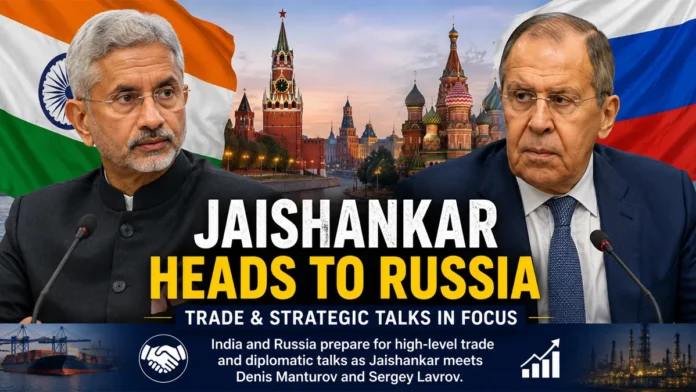
New Delhi, India | August 22, 2026 —
Jaishankar’s Russia visit is set to put trade, economic cooperation and major regional and global issues back at the center of India-Moscow diplomacy as External Affairs Minister S. Jaishankar begins a two-day official visit to Russia on August 23.
Jaishankar will travel to Russia on August 23–24, 2026, at the invitation of Russian First Deputy Prime Minister Denis Manturov, according to India’s Ministry of External Affairs.
During the visit, the Indian foreign minister will co-chair the 27th Session of the India-Russia Inter-Governmental Commission on Trade, Economic, Scientific, Technological and Cultural Cooperation, known as IRIGC-TEC.
He will also meet Russian Foreign Minister Sergey Lavrov, with the two sides expected to exchange views on regional and global developments.
The visit comes as India and Russia seek to deepen their long-standing strategic partnership while expanding economic engagement into a wider range of sectors.
Jaishankar and Manturov to Lead Key India-Russia Meeting
A major focus of the Jaishankar Russia visit will be the 27th IRIGC-TEC session.
The commission is one of the principal institutional mechanisms for overseeing economic cooperation between India and Russia.
Jaishankar and Manturov are expected to review progress across trade, economic relations, science, technology and cultural cooperation while identifying areas where bilateral engagement can be expanded further.
The mechanism has assumed greater importance as New Delhi and Moscow work to broaden their economic relationship beyond traditional areas of cooperation.
India and Russia have maintained a long-standing strategic partnership covering areas including defense, energy, trade, investment, science and technology.
Jaishankar to Meet Sergey Lavrov
Diplomatic issues will form another important part of the visit.
Jaishankar is scheduled to meet Russian Foreign Minister Sergey Lavrov and exchange perspectives on regional and global issues.
The meeting gives the two foreign ministers an opportunity to assess rapidly changing international developments while reviewing bilateral priorities.
Both ministers have maintained regular engagement as India and Russia navigate a geopolitical environment shaped by conflicts, sanctions, energy-security concerns and changing global alliances.
New Delhi has consistently emphasized dialogue and diplomacy in dealing with international conflicts while maintaining its strategic autonomy.
Trade Takes Center Stage in India-Russia Relations
Economic cooperation has emerged as one of the most important pillars of contemporary India-Russia relations.
The two countries have set an ambitious target of taking bilateral trade to $100 billion by 2030.
Russia has become an important energy supplier to India, while New Delhi has been seeking greater market access for Indian goods and a more diversified bilateral trade structure.
Indian exports to Russia include pharmaceuticals, machinery, chemicals, agricultural products, and other manufactured goods.
However, the rapid expansion of energy imports has created a substantial trade imbalance.
Addressing that imbalance by expanding Indian exports has therefore become an important part of the bilateral economic agenda.
India and Russia Seek Broader Economic Partnership
The IRIGC-TEC framework goes well beyond merchandise trade.
Science, technology, industrial cooperation, connectivity, investment and cultural exchanges also fall within its mandate.
For New Delhi, greater participation by Indian companies in the Russian market could create opportunities across pharmaceuticals, engineering goods, technology, agriculture, and consumer products.
For Moscow, India remains a major Asian economy and an important long-term economic partner.
The challenge for both sides is to translate strong political ties into a more diversified and sustainable commercial relationship.
Energy Remains a Major Pillar
Energy continues to be one of the most closely watched elements of India-Russia economic ties.
India’s purchases of Russian crude expanded dramatically after 2022 as changing global trade flows created opportunities for Indian refiners.
New Delhi has repeatedly maintained that its energy purchasing decisions are guided by national requirements, affordability, and energy security.
Russia, meanwhile, has become an important source of crude oil for the world’s third-largest oil-consuming and importing country.
Energy cooperation consequently remains a major factor in the broader economic relationship, even as both governments seek to expand cooperation into other sectors.
Long-Standing Strategic Partnership
India and Russia describe their relationship as a Special and Privileged Strategic Partnership.
The relationship extends across defense, nuclear energy, space, trade, science and technology, education, and cultural cooperation.
Russia has historically been one of India’s most important defense partners, although India has increasingly diversified its military procurement and expanded domestic defense manufacturing.
Civil nuclear cooperation is another important pillar, particularly through the Kudankulam Nuclear Power Plant project in Tamil Nadu.
At the same time, both countries have sought new areas of cooperation that reflect changing economic and technological priorities.
Why Jaishankar’s Russia Visit Matters
The timing of the visit makes it particularly significant.
India is balancing relationships with major global powers while pursuing an independent foreign policy centered on its national interests.
Russia remains a key strategic partner, even as India continues to deepen cooperation with the United States, Europe, Japan, and other countries.
For Moscow, maintaining strong relations with India carries substantial strategic and economic importance.
The August 23–24 meetings will therefore be watched not only for immediate agreements but also for indications of how New Delhi and Moscow intend to shape their economic partnership in the years ahead.
Focus Now Turns to Moscow Talks
Attention will now turn to the outcome of Jaishankar’s discussions with Manturov and Lavrov.
Progress on trade diversification, investment, scientific cooperation, and other economic issues could provide new momentum to bilateral ties.
The discussions with Lavrov will also provide a window into how India and Russia view major international developments and areas where their positions converge or differ.
With both countries targeting significantly higher bilateral trade by the end of the decade, the Jaishankar-Russia visit could help set priorities for the next phase of one of India’s longest-standing strategic partnerships.