TEHRAN | August 8, 2026
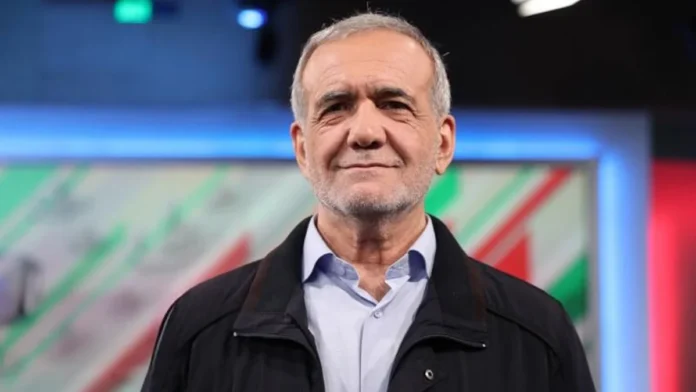
Iran US Talks remain central to Tehran’s strategy for ending the conflict, but Iran will not surrender its rights under military or economic pressure, President Masoud Pezeshkian has said, defending his government’s decision to negotiate with Washington despite criticism from hard-line factions at home.
In an interview broadcast Friday, Pezeshkian argued that diplomacy remained a legitimate way to secure Iran’s interests and end the fighting. He said Tehran would continue honoring its obligations as long as Washington fulfilled its own commitments, but Iran would not consider itself bound where the United States failed to comply.
His comments came as negotiations over the Strait of Hormuz entered a critical phase and fresh explosions were reported near Iran’s Qeshm Island, underscoring how fragile the current de-escalation remains. Reuters reported that a U.S. official saw progress toward an Iran-Oman arrangement that could reopen normal commercial traffic through the strategic waterway.
Pezeshkian Defends Talks With the United States
Pezeshkian rejected the argument that negotiations amount to weakness or surrender.
His position is that Iran can defend its national rights through diplomacy while remaining prepared to resist military coercion. In Friday’s interview, he also said most senior Iranian military commanders supported efforts to negotiate an agreement that could stop the fighting.
Pezeshkian questioned why Tehran should rule out dialogue when negotiations could achieve national objectives without prolonging conflict.
The remarks are particularly significant because Iran’s civilian government has faced resistance from influential hard-line political and security factions over engagement with Washington.
Iran Says Compliance Must Work Both Ways
Pezeshkian also made clear that Tehran views the U.S.-Iran arrangement as reciprocal.
According to the president’s position, Iran will continue fulfilling its obligations as long as Washington complies with the terms it has accepted. If the United States fails to meet those commitments, Tehran would not regard itself as obligated to continue carrying out its side unilaterally.
That stance comes as Washington is also publicly emphasizing conditional compliance. A U.S. official told Reuters that American actions would be tied to Iran’s implementation of its commitments, particularly in negotiations over shipping through Hormuz.
What Was Agreed in the June US-Iran Deal?
Washington and Tehran signed an interim memorandum in June after months of fighting.
The agreement called for an end to military operations and committed the two countries to negotiate a more comprehensive final settlement within 60 days, with an extension possible by mutual consent. It also contained provisions involving the U.S. naval blockade and commercial navigation through the Strait of Hormuz.
However, the ceasefire proved fragile.
Reuters reported that the June agreement initially halted hostilities, but fighting resumed on July 7 before being paused again. U.S. Central Command had not reported further strikes on Iran since July 29 as of Friday.
The repeated breakdowns have left uncertainty over whether the two governments can convert the interim arrangement into a durable peace agreement.
Pezeshkian Rejects Resignation Speculation
Pezeshkian has also pushed back against reports that he was considering resigning amid disputes inside Iran’s leadership over negotiations with the United States.
Earlier this week, he publicly rejected suggestions that he intended to step down and indicated that he planned to continue carrying out his duties.
The speculation emerged amid signs of disagreement between Pezeshkian’s government and more hard-line centers of power over how far Iran should go in negotiating with Washington.
Those tensions could remain an important factor as Tehran decides how to approach the next stage of diplomacy.
Two Explosions Reported on Qeshm Island Near Strait of Hormuz
The diplomatic uncertainty coincided with another security incident in southern Iran.
Two explosions were heard on Qeshm Island in Hormozgan province at about 9:40 p.m. local time Thursday, near the entrance to the Strait of Hormuz.
Iran’s semi-official Tasnim news agency, citing informed sources, attributed the sounds to an Iranian military operation against what it described as hostile targets near the strategic waterway. Tasnim said further details of the naval operation would be released later.
However, a provincial official said no impact or damage had been reported on Qeshm or in nearby Bandar Abbas and that authorities were investigating the source of the explosions. That means the precise circumstances surrounding the incident had not been independently established.
Why the Strait of Hormuz Is Critical
The Strait of Hormuz is one of the world’s most strategically important energy corridors.
Before the current conflict began, roughly one in every five barrels of oil consumed globally passed through the waterway, according to Reuters. Disruptions during the conflict have restricted shipping and contributed to higher global energy prices.
Iran and Oman have been discussing a framework aimed at restoring commercial navigation, while Washington has indicated that it could lift its blockade of Iranian ports if an acceptable arrangement is implemented.
A lasting agreement over Hormuz is widely viewed as an essential component of any broader U.S.-Iran settlement.
Iran-Backed Iraqi Militias Delay Planned Response
In another sign of the complex regional situation, the Islamic Resistance in Iraq, an umbrella term used for Iran-aligned armed groups, said Friday it had postponed a response that had been planned for that day.
The announcement came after an appeal from Hadi al-Amiri, an influential Iran-aligned Iraqi political figure, as well as positions taken by other political leaders.
The group did not disclose what form its planned response would have taken or identify a specific intended target, Reuters reported.
The militias had previously threatened retaliation after Saudi Arabia, in coordination with U.S. Central Command, carried out strikes against Iran-aligned groups in Iraq in late July.
Why Did the US and Saudi Arabia Strike Iraq?
Saudi Arabia said its late-July action followed drone attacks targeting oil facilities in the kingdom’s Eastern Province and Riyadh region.
Riyadh said the drones originated from Iraqi territory and accused Iran-aligned armed groups of responsibility. Those factions denied involvement, while the Iraqi government said it was investigating the allegations.
The United States and Saudi Arabia subsequently targeted logistics and weapons sites used by Iran-linked forces inside Iraq.
Casualty figures varied as reports emerged. The Popular Mobilization Forces later said at least 20 people were killed and 32 wounded in the strikes, according to reports citing the organization.
The U.S. and Saudi governments described the operation as a response to attacks on American personnel and Saudi energy infrastructure.
Iraq Tries to Prevent Wider Escalation
Iraq is now attempting to prevent its territory from becoming another major front in the regional conflict.
Iraqi Prime Minister Ali al-Zaidi met Saudi intelligence chief Khalid al-Humaidan on Friday to discuss regional security. Zaidi said Baghdad would not allow Iraqi territory to be used to launch attacks against other countries and emphasized Iraq’s commitment to sovereignty and regional de-escalation.
The Iraqi militia decision to delay retaliation could therefore provide temporary breathing room for diplomatic efforts.
Can Iran and the US Still Reach a Deal?
For now, neither diplomacy nor military deterrence has produced a lasting settlement.
Washington and Tehran have repeatedly moved between negotiations, ceasefires and renewed confrontation. The situation around Hormuz remains especially important because any prolonged disruption to the waterway could affect international oil supplies, shipping costs and inflation far beyond the Middle East.
Pezeshkian’s latest comments signal that his government wants to keep the negotiating channel open. At the same time, his insistence that Iran cannot be compelled to surrender reflects the political limits within which any Iranian negotiating team must operate.
The next major test for Iran US Talks will be whether negotiations over the Strait of Hormuz produce an enforceable agreement and whether both Washington and Tehran can prevent another cycle of military retaliation from derailing diplomacy.