TEHRAN — August 17, 2026
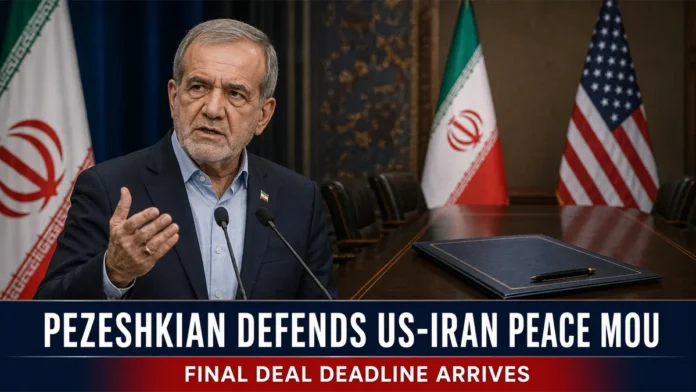
The Iran-US peace MoU was negotiated with “dignity” and “strength,” Iranian President Masoud Pezeshkian said as he defended the interim agreement while its 60-day deadline for reaching a final settlement arrived amid renewed tensions between Tehran and Washington.
Pezeshkian said Iran had followed the principles outlined by former Supreme Leader Ali Khamenei while negotiating the memorandum of understanding. He rejected suggestions that Tehran had surrendered to pressure from the United States.
“We pursued the recent agreement with strength and did not surrender to our enemies,” Pezeshkian said during a Sunday meeting attended by Education Minister Alireza Kazemi.
The president added that the memorandum was prepared only after careful deliberation and detailed discussions with specialists.
Pezeshkian Defends June 18 Peace Memorandum
Iran and the United States signed the peace memorandum on June 18 as part of an effort to end the regional conflict and create a pathway toward a comprehensive settlement.
Under the arrangement, the two countries were expected to negotiate a final agreement during a 60-day period ending Monday. The talks were intended to address unresolved issues between Tehran and Washington while preventing a renewed escalation.
However, the negotiating process has been overshadowed by rising tensions in recent weeks. No final agreement had been publicly confirmed as the deadline approached, leaving the future of the diplomatic initiative uncertain.
Pezeshkian maintained that Iranian officials did not compromise the country’s interests while negotiating the memorandum.
His latest comments appeared intended to answer domestic criticism and reassure supporters that the agreement was reached from a position of strength rather than under foreign pressure.
Iran’s Parliament Speaker Calls MoU a Diplomatic Victory
Iranian Parliament Speaker Mohammad Baqer Qalibaf also defended the memorandum, describing it as evidence of Iran’s “glory and victory.”
Qalibaf said Saturday that the agreement represented another step toward consolidating what he characterized as Iran’s success in diplomacy.
Iranian officials have repeatedly presented the memorandum as an outcome that protects the country’s sovereignty and strategic interests. Before its signing, Foreign Minister Abbas Araghchi said the proposed framework had been examined by the Supreme National Security Council and other decision-making institutions.
Araghchi previously explained that talks on a final agreement would cover Iran’s nuclear program and the lifting of sanctions. He also said the negotiating period could either end or be extended depending on the progress achieved.
Details of the earlier negotiating process and Tehran’s official position were outlined in an Iranian government report.
What Happens After the 60-Day Deadline?
The expiration of the negotiating period does not automatically mean that the memorandum has collapsed. Tehran and Washington could agree to extend the talks, introduce a revised timetable or continue negotiations under a different diplomatic framework.
Nevertheless, several key questions remain unanswered:
- Whether both sides will formally extend the negotiating deadline
- Whether military and maritime tensions can be reduced
- How Iran’s nuclear program will be addressed
- Whether Washington will offer sanctions relief
- What guarantees each government will require before signing a final agreement
The absence of a confirmed final deal could expose the memorandum to growing political pressure in both countries. Iranian officials are presenting it as a diplomatic success, while critics in the United States continue to question the Trump administration’s broader strategy toward Tehran.
Senator Ruben Gallego Attacks Trump’s Iran War Planning
The debate over the memorandum unfolded as Democratic Senator Ruben Gallego criticized President Donald Trump’s handling of the Iran conflict.
Gallego, an Arizona senator who served in the Marine Corps and fought in the Iraq War, said the administration entered the conflict without a clearly defined mission, exit strategy or understanding of how the war could escalate.
“This administration did not plan for this war, did not plan how to get out of this war and did not really understand how this war was going to escalate,” Gallego said during a Sunday television interview.
His criticism centered partly on reports of fatigue, declining morale and mental-health concerns aboard the USS Abraham Lincoln, which has remained deployed because of continuing US military operations connected to Iran.
Gallego said the reported problems aboard the aircraft carrier reflected wider weaknesses in Pentagon planning and administration leadership. The Navy has disputed some claims about deteriorating conditions and mental-health incidents aboard the ship.
USS Abraham Lincoln Concerns Add Pressure on Washington
The prolonged deployment of the USS Abraham Lincoln has become a politically sensitive issue in Washington. Families of service members and Democratic lawmakers have sought more information about working conditions, food supplies, rest periods and access to mental-health care.
Gallego argued that American military personnel were bearing the consequences of an operation launched without sufficient preparation for a long-term conflict.
The administration has defended its handling of the military campaign, while Pentagon officials have maintained that American forces can continue carrying out their assigned missions.
Still, concerns surrounding the carrier have intensified calls for Washington to define its strategic objectives and explain how it intends to conclude the conflict.
Iran-US Diplomacy Faces a Critical Test
Pezeshkian’s defense of the memorandum highlights the political pressure facing both governments. Tehran wants to demonstrate that it protected Iran’s sovereignty, while Washington must decide whether negotiations can produce an enforceable final settlement.
The Iranian president’s remarks do not confirm that a final deal has been reached. Instead, they reinforce Tehran’s position that the June memorandum was carefully negotiated and did not amount to capitulation.
Whether the two governments extend negotiations or allow the diplomatic process to stall will determine if the memorandum remains a foundation for peace—or becomes another short-lived pause in the Iran-US confrontation.