
MUMBAI, India | August 22, 2026
India obesity guidelines are calling for a major shift in how excess weight is diagnosed and treated, with leading medical specialists emphasizing that obesity should be recognized as a chronic disease requiring individualized, long-term care rather than simply being blamed on overeating or lack of exercise.
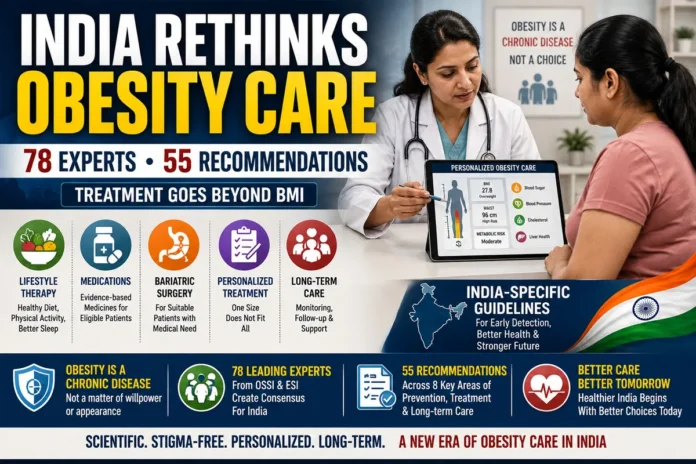
A joint expert consensus developed by the Obesity and Metabolic Surgery Society of India (OSSI) and the Endocrine Society of India (ESI) brings together 78 specialists and sets out 55 recommendations covering almost every stage of obesity care.
The recommendations span prevention and diagnosis to lifestyle treatment, obesity-management medications, metabolic and bariatric surgery, monitoring and long-term follow-up.
The central message is clear: obesity treatment should be personalized according to an individual’s health status, disease severity, metabolic risk and Indian-specific body-composition patterns.
78 Experts Develop India-Specific Obesity Framework
The consensus was developed using a modified Delphi process, a structured method used to obtain agreement among specialists.
A total of 78 experts participated, including 38 specialists from OSSI and 40 from ESI.
Researchers initially developed 73 statements after reviewing available scientific evidence and clinical experience.
Statements receiving more than 80% agreement were considered to have achieved consensus.
After revisions and the removal of overlapping recommendations, experts finalized 55 statements across eight major areas of obesity management.
Agreement exceeded 80% for all 55 final statements.
The framework represents one of the most comprehensive India-specific efforts to standardize obesity care.
Obesity Should Be Treated as a Chronic Disease
One of the strongest recommendations is that obesity should be formally recognized as a chronic non-communicable disease.
This is important because people living with obesity are frequently told simply to eat less or exercise more.
Experts argue that this oversimplifies a complex health condition.
Obesity can be influenced by several interacting factors, including:
- Genetics
- Metabolism
- Hormonal conditions
- Diet
- Physical activity
- Sleep
- Mental health
- Environment
- Socioeconomic conditions
- Medications
- Lifestyle patterns
Because these factors vary substantially between individuals, the same weight-loss strategy will not necessarily work for everyone.
The experts therefore favor a patient-centered and stigma-free approach.
Why BMI Alone May Not Tell the Whole Story
Body mass index, or BMI, remains an important screening measurement, but Indian obesity experts have increasingly emphasized the need for broader clinical assessment.
Indian populations can develop higher body-fat levels and metabolic risks at comparatively lower BMI levels than some Western populations.
That means doctors may also need to assess factors such as waist measurements, fat distribution, metabolic complications and obesity-related diseases rather than relying on body weight alone.
A person with a relatively modest BMI could still have harmful abdominal or visceral fat and significant metabolic risk.
Conversely, weight alone may not accurately reflect an individual’s overall health condition.
The new framework therefore emphasizes Indian-specific BMI and anthropometric thresholds as part of a wider clinical assessment.
Indians May Develop Metabolic Disease Earlier
The consensus highlights a particularly important problem for India.
Indian patients can experience higher levels of body fat at lower BMI values and at younger ages compared with Western populations.
This may contribute to an earlier onset of conditions such as:
- Type 2 diabetes
- High blood pressure
- Cardiovascular disease
- Abnormal cholesterol
- Fatty liver disease
- Sleep apnea
- Joint problems
This metabolic vulnerability makes early recognition and treatment particularly important.
Experts argue that waiting until obesity becomes severe can allow preventable health complications to develop.
Eight Areas Covered by the New Recommendations
The 55 consensus statements cover eight major areas.
1. Recognition of Obesity
Healthcare professionals are encouraged to recognize obesity as a chronic disease rather than simply a lifestyle failure.
2. Prevention
Greater attention should be given to preventing unhealthy weight gain and identifying people at increased metabolic risk early.
3. Treatment Selection
Treatment should be selected according to individual health conditions, obesity severity and treatment goals.
4. Monitoring and Follow-Up
Obesity often requires long-term monitoring because weight regain and metabolic complications can occur after initial treatment.
5. Lifestyle Therapy
Nutrition, physical activity, behavioral changes, sleep and other lifestyle factors remain foundational elements of obesity management.
6. Obesity-Management Medications
Medicines may be considered when clinically appropriate and should form part of supervised medical care rather than being used casually for cosmetic weight loss.
7. Metabolic and Bariatric Surgery
Surgery may be appropriate for selected patients with significant obesity or associated medical complications when recommended through proper clinical assessment.
8. Palliative Care
The framework also addresses the needs of patients with severe disease and complex health conditions where the goals of treatment may need to be individualized.
Diet and Exercise Remain Important — But May Not Be Enough for Everyone
Lifestyle changes remain central to obesity treatment.
Healthy nutrition, regular physical activity, adequate sleep and behavioral support can improve both weight and metabolic health.
However, experts increasingly recognize that lifestyle treatment alone may not produce adequate or sustained results for every patient.
People with more severe obesity or associated diseases may require additional treatment.
That can include physician-supervised medication or, in suitable cases, metabolic and bariatric surgery.
The approach represents a move away from the idea that all patients should first repeatedly attempt weight loss through diet alone before other treatments are considered.
Weight-Loss Medicines Have Changed Obesity Treatment
The expansion of obesity-management medications has dramatically changed treatment options in recent years.
Newer therapies can produce substantially greater weight loss than many older medicines when used appropriately.
However, obesity drugs are prescription medical treatments rather than general-purpose slimming products.
Doctors must consider factors including existing diseases, current medications, treatment targets, side effects and contraindications before deciding whether a drug is appropriate.
The Indian consensus therefore places medication within a broader treatment strategy rather than presenting it as a standalone solution.
Bariatric and Metabolic Surgery Remains Important
Metabolic and bariatric surgery also remains an established treatment option for selected patients.
Modern bariatric procedures can deliver substantial and sustained weight loss and may improve obesity-related conditions, including type 2 diabetes, in appropriate candidates.
However, surgery is not suitable for everyone.
Patients require medical assessment, nutritional evaluation and long-term follow-up.
The new framework aims to help clinicians decide when lifestyle intervention, medication, surgery or a combination of approaches may be most appropriate.
Experts Call for Stigma-Free Obesity Care
Another important part of the recommendations concerns stigma.
People living with obesity frequently face discrimination and negative assumptions, including the belief that their condition simply reflects lack of discipline.
Such stigma can discourage patients from seeking medical help.
It may also negatively affect mental health and the relationship between patients and healthcare professionals.
The consensus supports language and treatment approaches that focus on health rather than blame.
This shift could be particularly important in India, where obesity may simultaneously carry social stigma and remain under-recognized as a serious medical condition.
Obesity Care Could Become Part of National Health Programs
The expert panel has also backed greater integration of obesity prevention and treatment into broader national health programs.
This reflects the connection between obesity and several major chronic diseases already placing pressure on India’s healthcare system.
Better obesity management could potentially help reduce the future burden of diabetes, heart disease and other metabolic conditions.
Experts also emphasize equitable access to treatment, an important challenge because newer obesity drugs, specialist consultations and bariatric procedures may not be affordable or accessible to all patients.
Long-Term Follow-Up Is Critical
Another significant change is the emphasis on long-term care.
Obesity is increasingly understood as a condition that can relapse.
A person may initially lose weight through diet, medication or surgery but later experience weight regain.
That does not necessarily mean treatment has “failed.”
Instead, patients may need adjustments to nutrition, exercise, medication or other components of care over time.
Regular follow-up can also help doctors monitor diabetes risk, cardiovascular health, nutritional status and other obesity-related complications.
India Needs Its Own Obesity Strategy
The importance of an India-specific framework is linked to the country’s unique population and healthcare environment.
Indian patients may develop metabolic complications at lower body weights than populations used to develop many international obesity standards.
Dietary habits, healthcare access, financial constraints and cultural factors also differ significantly across India.
A treatment strategy developed entirely around Western populations may therefore not always translate directly to Indian clinical practice.
The OSSI-ESI consensus attempts to address that gap through recommendations tailored to Indian realities.
What the New Guidelines Mean for Patients
For patients, the biggest change is conceptual.
Obesity should not automatically be viewed simply as a failure to control food intake.
Instead, doctors are being encouraged to evaluate the full clinical picture and choose treatment accordingly.
For one person, lifestyle changes may be enough.
Another may benefit from lifestyle treatment plus medication.
Someone with severe obesity and serious metabolic complications may be evaluated for bariatric surgery.
The goal is not to push every patient toward the same treatment but to match treatment intensity to medical need.
India’s Obesity Treatment Is Entering a New Phase
The India obesity guidelines represent a broader transformation in medical thinking about weight management.
With 78 specialists agreeing on 55 recommendations, the joint OSSI-ESI framework moves obesity care toward earlier recognition, individualized treatment, multidisciplinary management and long-term follow-up.
Perhaps most importantly, the recommendations challenge the idea that obesity can always be solved through willpower alone.
For India, where diabetes and cardiovascular disease already represent major public-health challenges, better recognition and treatment of obesity could become increasingly important in preventing serious disease before it develops.
Medical Disclaimer: This article provides general information about expert obesity-management recommendations and is not a substitute for diagnosis or treatment by a qualified healthcare professional. Prescription medicines and surgical treatments should only be considered after appropriate medical evaluation.