VIENNA, Austria | September 10, 2026 —
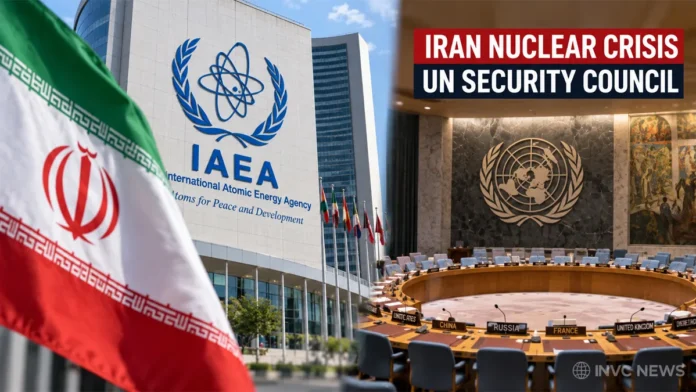
IAEA Iran UN Security Council referral has pushed Tehran’s nuclear dispute into a new and potentially more dangerous diplomatic phase after the International Atomic Energy Agency’s Board of Governors voted to report Iran to the United Nations Security Council for the first time in about 20 years.
The decision significantly raises international pressure on Tehran at a moment when tensions surrounding Iran are already running exceptionally high. However, the referral does not automatically impose new sanctions. Any punitive measures would require further action at the Security Council.
IAEA board backs Iran referral by 23 votes
The IAEA’s 35-member Board of Governors approved the resolution with 23 countries voting in favor.
Russia, China and Niger voted against the measure, while eight countries abstained. One board member did not vote.
The United States, United Kingdom, France and Germany sponsored the resolution.
The dispute centers on Iran’s failure to provide answers that the nuclear watchdog considers sufficient regarding uranium particles detected at undeclared locations.
Iran rejects accusations that it has pursued a secret nuclear weapons program and continues to insist that its nuclear activities serve peaceful purposes.
Why the decision is so significant
The latest vote represents a major escalation because the IAEA board has not referred Iran to the UN Security Council in this manner for approximately two decades.
The Security Council became deeply involved in Iran’s nuclear dispute during the 2000s, eventually imposing multiple rounds of sanctions.
Diplomatic negotiations later produced the 2015 nuclear agreement, formally known as the Joint Comprehensive Plan of Action, or JCPOA.
That framework substantially restricted Iran’s nuclear activities in exchange for sanctions relief. The agreement, however, gradually unraveled after the United States withdrew from it in 2018.
Iran subsequently expanded several aspects of its nuclear program.
The latest IAEA decision therefore revives memories of an earlier period when Iran’s nuclear activities became one of the world’s most serious diplomatic crises.
Uranium traces remain at heart of dispute
IAEA inspectors have spent years seeking explanations about uranium particles found at locations Iran had not declared as nuclear sites.
The watchdog says unresolved safeguards questions prevent it from providing full assurance about the exclusively peaceful nature of Iran’s nuclear program.
Tehran has repeatedly disputed Western interpretations of the evidence.
Iranian officials have also accused the United States and European governments of politicizing the IAEA and using the agency to increase pressure on the country.
The dispute has become even more complicated because military conflict and security concerns have disrupted normal inspection activities.
Referral does not mean automatic UN sanctions
The Security Council referral is politically important, but it should not be confused with the immediate restoration of international sanctions.
The Council can debate the issue and consider possible responses. Those could range from political demands and additional diplomatic pressure to more consequential measures if members agree.
Any significant new Security Council action, however, would require sufficient support among its members.
Russia and China both opposed the IAEA resolution and hold permanent seats with veto power on the Security Council.
Their opposition could make agreement on punitive measures extremely difficult.
As a result, the immediate impact may be diplomatic rather than economic.
Nevertheless, the referral increases pressure on Iran and gives the nuclear dispute a considerably higher international profile.
Iran nuclear crisis collides with wider Middle East tensions
Timing makes the development particularly important.
The nuclear confrontation is unfolding alongside severe military and geopolitical tensions involving Iran, the United States and regional actors.
That overlap creates a dangerous combination.
A nuclear dispute that might ordinarily remain within diplomatic institutions is now developing during a broader security crisis, leaving governments with less room for miscalculation.
Any further breakdown in cooperation between Tehran and the IAEA could intensify pressure for stronger international action.
Conversely, renewed access for inspectors or credible answers to outstanding safeguards questions could provide an opening for diplomacy.
Russia and China emerge as critical players
Moscow and Beijing’s opposition to the IAEA resolution highlights the geopolitical divide surrounding Iran.
Both countries maintain significant political and economic relationships with Tehran.
Western governments, meanwhile, continue to demand greater transparency and cooperation from Iran over its nuclear activities.
That division is likely to follow the issue into the Security Council.
Therefore, attention will now turn toward whether the five permanent Security Council members can find any common ground.
Without such agreement, the Council may struggle to produce a meaningful unified response.
What happens next?
The next phase will depend heavily on Iran’s response.
Tehran could cooperate more extensively with the IAEA, provide additional information about undeclared sites and allow inspectors greater access where security conditions permit.
Alternatively, Iran could further restrict cooperation in response to what it views as political pressure.
The second scenario could deepen the confrontation quickly.
Diplomats will also watch whether Washington and European governments use the referral to push for negotiations or seek tougher international measures.
For the moment, the most important development is unmistakable: Iran’s nuclear dispute has returned to the UN Security Council after approximately two decades, placing one of the world’s most consequential nuclear questions back at the center of global diplomacy.