BEIJING, China | September 26, 2026 —
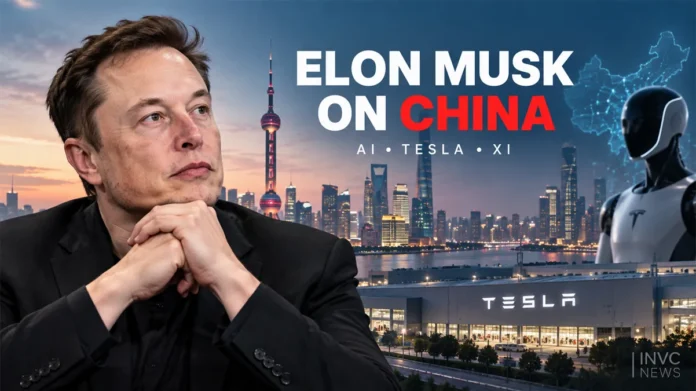
Tesla CEO Elon Musk has offered unusually expansive praise for China’s leadership, manufacturing strength and artificial intelligence capabilities, while outlining a future in which the United States and China could play major roles in developing humanoid robots and advanced AI systems.
In an interview aired by Chinese state broadcaster CCTV and China Media Group earlier this week, Musk described Chinese President Xi Jinping as a “great leader” and said he had personally witnessed major changes in China’s infrastructure and living standards.
The remarks were Musk’s assessment. They came against the backdrop of his extensive business interests in China, where Tesla operates its largest manufacturing base outside the United States.
THE 60-SECOND BRIEF
What happened: Elon Musk gave a wide-ranging interview to Chinese state media.
On Xi Jinping: Musk described the Chinese president as a “great leader” and praised China’s development during his tenure.
On Tesla China: Musk called the Shanghai Gigafactory a “gem” and credited its performance to the Chinese team.
On AI: Musk praised Chinese large-language models and argued that China could overcome computing constraints faster than many expect.
On robots: Musk said China and the United States could help drive the global humanoid robotics industry.
On China travel: Musk again encouraged people to visit China and experience its infrastructure and cities firsthand.
Musk Calls Xi Jinping a ‘Great Leader’
One of the most politically notable parts of the interview came when Musk discussed Chinese President Xi Jinping.
Musk said China had changed dramatically during Xi’s time in office, pointing to new infrastructure, construction and what he described as increased prosperity visible in everyday life.
He characterized Xi as highly capable and credited his leadership with much of the progress Musk said he had observed.
Those comments represent Musk’s personal assessment of China’s development and leadership.
China’s economic performance under Xi has also included significant challenges, including weak domestic demand and a prolonged property-sector downturn, even as exports and advanced manufacturing have remained major strengths.
Shanghai Gigafactory Gets Some of Musk’s Strongest Praise
Musk was equally enthusiastic when discussing Tesla’s operations in Shanghai.
He credited the success of the factory to Tesla’s Chinese workforce, describing the team as talented, hardworking and reliable.
He also praised the plant’s manufacturing quality and efficiency.
Musk called the Shanghai facility a “gem.”
The factory has become one of Tesla’s most important global production centers and a major export hub for Model 3 and Model Y vehicles.
For Tesla, China represents far more than a production location.
It is also one of the world’s largest and most competitive electric-vehicle markets.
Why China Matters So Much to Tesla
Tesla’s relationship with China has become central to the company’s global strategy.
The Shanghai Gigafactory gave Tesla access to China’s deep manufacturing supply chain, large engineering workforce and enormous EV market.
At the same time, Tesla faces increasingly intense competition from Chinese electric-vehicle manufacturers.
That creates a complicated relationship.
China is simultaneously one of Tesla’s most important production bases, one of its most important markets and home to some of its strongest competitors.
Musk Praises Chinese AI Models
Musk also spoke positively about China’s artificial intelligence industry.
He said Chinese large-language models had achieved impressive performance relative to the amount of computing power used.
Chinese AI developers have increasingly emphasized efficiency as access to the most advanced semiconductor hardware remains constrained by export controls and global competition.
Musk suggested China could overcome its computing limitations faster than many observers expect.
He predicted that advances in domestic chip manufacturing and lithography could substantially improve China’s computing capacity within several years.
That timeline remains Musk’s forecast rather than an established outcome.
AI Has Become a Major US-China Competition
Artificial intelligence has emerged as one of the most important areas of strategic competition between Washington and Beijing.
The two countries are competing across advanced chips, data centers, AI models, robotics and semiconductor manufacturing.
At the same time, officials from both countries have discussed establishing mechanisms for dialogue around AI safety.
That creates an unusual dynamic.
The United States and China are technological competitors, but both governments and companies also face pressure to manage the risks created by increasingly powerful AI systems.
Musk Sees Humanoid Robots Becoming Part of Everyday Life
Musk also offered a sweeping vision of the future of humanoid robotics.
He suggested that personal robots could eventually become commonplace.
Such machines, in his view, could help care for older parents, supervise children, provide personalized education and perform household or professional tasks.
Musk has repeatedly argued that humanoid robots could eventually become one of the world’s largest industries.
Tesla is developing its own humanoid robot, Optimus.
However, mass adoption at the scale Musk describes would require major advances in hardware, software, safety, cost and manufacturing.
China and US Could Drive Robotics Together
One of the most significant elements of Musk’s comments was his suggestion that China and the United States could both help push humanoid robotics forward.
The two countries already possess many of the ingredients required for large-scale robotics development.
The United States has leading AI companies and advanced software expertise.
China has enormous manufacturing capacity, extensive electronics supply chains and a rapidly growing robotics industry.
Whether those strengths lead to cooperation or deeper competition will depend heavily on technology policy and US-China relations.
Musk Imagines One Person Controlling Thousands of AI Agents
Musk went beyond physical robots.
He also described a future in which individuals could direct large numbers of digital AI agents and robotic systems.
Under that model, one person could potentially coordinate hundreds or thousands of intelligent machines.
It is an ambitious vision of automation.
It would also raise major questions about employment, security, accountability and the concentration of technological power.
‘China Is Amazing’
Musk has repeatedly encouraged people to visit China rather than form their views entirely from afar.
In August, he publicly described China in highly positive terms and urged people to see the country themselves.
During the interview, he again discussed his experiences traveling in China.
Musk recalled taking high-speed rail from Beijing to Xi’an and praised the journey.
He also highlighted Xi’an’s Terracotta Army as a major attraction.
His advice to travelers was simple: look out the window rather than spending the entire journey looking at a phone.
Musk’s China Ties Draw Attention in Washington
Musk’s comments also carry a wider geopolitical dimension.
Tesla has extensive commercial interests in China.
At the same time, Musk controls SpaceX, which has major contracts and relationships with the US government, including national-security agencies.
That combination has attracted scrutiny in Washington.
His praise for Chinese leadership therefore lands in a politically sensitive environment shaped by trade disputes, semiconductor restrictions, Taiwan, AI competition and national-security concerns.
THE BIGGER PICTURE
Musk’s interview reveals the complicated nature of the US-China technology relationship.
The two countries are fierce competitors.
Yet their economies, manufacturing systems and technology industries remain deeply connected.
Tesla is one of the clearest examples.
It is an American company whose global manufacturing strategy depends heavily on China.
Meanwhile, China wants greater independence in advanced chips and AI while continuing to attract international investment.
Musk appears to see opportunities for both competition and cooperation.
Whether governments on either side allow that balance to continue is a much larger question.
WHAT HAPPENS NEXT
Attention will increasingly turn toward three areas.
First, Tesla’s performance in China as domestic EV competition intensifies.
Second, China’s progress in advanced semiconductor manufacturing and AI.
Third, whether humanoid robots such as Tesla Optimus can move from prototypes toward commercially viable mass production.
Musk has offered an ambitious prediction.
The technology will now have to catch up with the vision.
INVC NEWS Bottom Line
Elon Musk used his Chinese state-media interview to deliver a clear message: he remains strongly impressed by China’s manufacturing capability, AI development and infrastructure.
He praised President Xi Jinping, called Tesla’s Shanghai factory a “gem” and predicted rapid progress in Chinese computing technology.
But the larger story goes beyond praise.
Tesla’s future, China’s technological ambitions and the rapidly evolving US-China relationship are increasingly intersecting around the same industries:
AI, chips, electric vehicles and humanoid robots.
What happened. Why it matters. What comes next.