BRUSSELS, Aug. 16, 2026
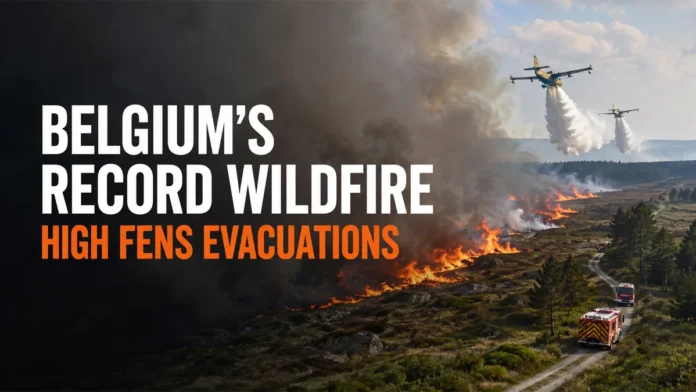
A fast-moving Belgium wildfire has burned an estimated 2,700 hectares of vegetation in the High Fens nature reserve, making it the largest recorded forest and heathland fire in the country’s history.
The blaze in eastern Belgium forced authorities to evacuate approximately 600 people from nearby communities as strong winds, heavy smoke and difficult terrain complicated the firefighting operation.
The latest perimeter estimate, released by the office of the governor of Liège at approximately 4 p.m. GMT Saturday, marked a sharp increase from the 1,600 hectares reported earlier in the day. The burned-area estimate may change as emergency teams and satellite analysts refine their assessment.
Firefighters from across Belgium were joined by crews and equipment from neighboring countries. The European Union also mobilized helicopters and water-bombing aircraft after Belgium activated the EU Civil Protection Mechanism.
No deaths or destruction of homes had been confirmed in the latest available official updates.
Belgium Wildfire: Key Developments
| Detail | Latest Confirmed Information |
|---|---|
| Location | High Fens nature reserve, Liège province |
| Estimated area burned | Approximately 2,700 hectares |
| Fire began | Friday afternoon |
| Residents evacuated | About 600 |
| Main communities affected | Sourbrodt and Bütgenbach |
| International aircraft | Three helicopters and two firefighting planes |
| Additional responders | Belgian, German and Luxembourg crews |
| Cause | Not yet confirmed |
| Record status | Largest wildfire recorded in Belgium |
Burned Area Rises From 1,600 to 2,700 Hectares
The fire’s estimated footprint expanded rapidly throughout Saturday.
Regional authorities initially reported that approximately 1,600 hectares had burned. By Saturday evening, the governor’s office raised the estimate to around 2,700 hectares, indicating that the blaze had continued spreading despite extensive ground and aerial operations.
The new figure surpasses the previous Belgian wildfire record by a wide margin. European wildfire data indicates that a 2011 blaze burned close to 1,400 hectares.
The current fire has therefore affected nearly twice the area of the earlier record-setting event.
The High Fens is Belgium’s largest nature reserve and includes extensive heathland, peat bogs, wetlands and protected habitats. Fire in peat-rich terrain can be especially difficult to extinguish because heat and embers may remain below the surface.
Around 600 Residents Evacuated
Authorities ordered precautionary evacuations as shifting winds and dense smoke threatened surrounding communities.
Approximately 500 residents of Sourbrodt, in the municipality of Waimes, were moved to safer locations. Evacuation instructions reportedly covered 15 streets.
Another 100 people in Bütgenbach were also evacuated, with orders covering seven streets.
Tourists staying in the surrounding area were advised to leave, while a children’s summer camp was evacuated as a safety measure.
The evacuation figures are separate from the more than 2,000 people displaced by another major wildfire in neighboring Germany. The two emergencies should not be confused.
Why Firefighters Are Struggling to Contain the Blaze
The High Fens presents several operational challenges.
Much of the reserve is difficult for conventional fire engines to access. Emergency crews must work across uneven heathland, wetland and forest tracks while protecting themselves from smoke and rapidly changing fire behavior.
Strong winds have repeatedly altered the direction of the flames. Wind can carry burning material ahead of the main fire line, creating new outbreaks and threatening areas previously considered safe.
Hot and dry weather also left vegetation vulnerable to ignition. Temperatures reached approximately 37 degrees Celsius in parts of Belgium on Friday during the country’s latest period of intense summer heat.
The cause of the fire had not been established in the latest updates.
EU Sends Helicopters and Firefighting Aircraft
Belgium requested assistance through the EU Civil Protection Mechanism, which coordinates emergency support from European countries during large disasters.
The international deployment included:
- Two Dutch military helicopters
- One Czech firefighting helicopter
- Two Swedish firefighting aircraft
The aircraft were assigned to help slow the fire’s spread and support crews working in areas inaccessible to vehicles.
Under the mechanism, the EU Emergency Response Coordination Centre circulates a country’s assistance request to participating states and coordinates the deployment of aircraft, equipment and specialized personnel. (How the EU mechanism works)
Belgian Military Supports Ground Operations
Belgium deployed helicopters and military equipment to reinforce the emergency response.
The armed forces sent three Panther firefighting vehicles, which can operate in demanding terrain and supply water to areas where ordinary vehicles may struggle to reach.
Local farmers also assisted by helping refill water points used by firefighting helicopters.
Emergency teams from Germany and Luxembourg joined firefighters from multiple Belgian provinces. Their involvement expanded the number of crews available for protecting communities, managing fire lines and monitoring possible flare-ups.
Roads and Public Areas Closed
Authorities restricted access to sections of the High Fens and nearby infrastructure.
The N68 national road and several local routes were closed during the emergency. Access to the Gileppe reservoir and Eupen dam area was also restricted.
Residents and visitors were urged not to enter closed zones. Unauthorized traffic can obstruct emergency vehicles and expose drivers to smoke, falling trees and fast-moving flames.
Tourists were advised to avoid the wider High Fens region until local authorities declare the area safe.
High Fens Faces Significant Ecological Damage
The High Fens contains habitats of European conservation importance, including peat bogs, heathlands and wetlands that support specialized plant and animal species.
While the reported 2,700-hectare perimeter does not mean every part of that area was completely destroyed, the ecological consequences could be extensive.
Peat and dry vegetation can continue smoldering after visible flames subside. This creates a risk of reignition and may require emergency crews to monitor the area for days.
A complete environmental assessment will only be possible after firefighters secure the perimeter and authorities can safely inspect the affected landscape.
Fire Emerges During Wider European Heatwave
The Belgian blaze is part of a broader period of dangerous wildfire conditions across Europe.
Fires have affected multiple countries during prolonged heat and drought. Neighboring western Germany has also battled a major blaze near the Belgian border, although German authorities reported that its spread had stabilized by Saturday.
The High Fens operation remains a distinct Belgian emergency involving separate evacuation figures and resources.
European authorities have repeatedly warned that prolonged heat, dry vegetation and strong winds can allow relatively small fires to grow rapidly.
Is the Belgium Wildfire Under Control?
Officials had not declared the High Fens wildfire fully contained in the latest available update.
The rising burned-area estimate and precautionary evacuations indicated that the emergency remained active Saturday evening. Aircraft, military vehicles and international teams were continuing containment work.
Conditions can change quickly depending on wind speed and direction. Residents should rely on instructions from municipal and provincial authorities before returning to evacuated areas.
What Residents Should Do
People in or near affected communities should:
- Follow evacuation orders immediately.
- Keep identification, medication and essential supplies ready.
- Close windows and ventilation systems when smoke is present.
- Avoid roads reserved for emergency vehicles.
- Do not enter the High Fens to photograph the fire.
- Monitor municipal and provincial emergency messages.
- Seek medical help for breathing difficulty or smoke exposure.
The latest verified estimate places the burned area at approximately 2,700 hectares, not the earlier 2,000-hectare figure. Because the fire perimeter remains subject to revision, all area and evacuation totals should be treated as provisional.