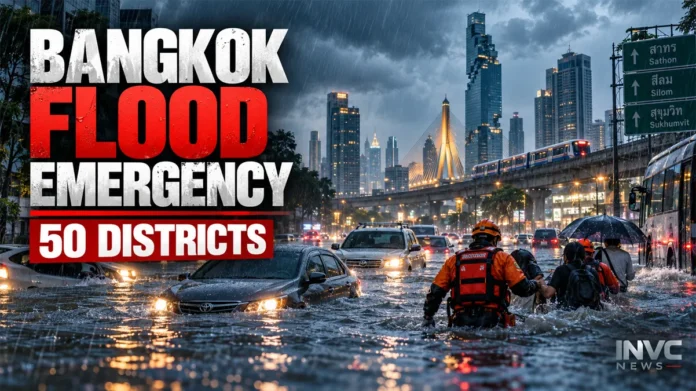
BANGKOK, Thailand | September 26, 2026 —
Bangkok has declared all 50 districts disaster-affected areas after relentless rain flooded roads, overwhelmed canals and disrupted daily life across the Thai capital.
The citywide declaration took effect from September 25 and expands an earlier disaster designation that covered only Nong Chok, Suan Luang and Khan Na Yao districts.
The move allows government agencies and local authorities to accelerate emergency response, relief operations and assistance to affected communities.
The flooding follows nearly two days of intense rainfall across Bangkok, with some areas experiencing severe water accumulation, difficult road access and significant transport disruption.
THE 60-SECOND BRIEF
What happened: All 50 districts of Bangkok have been declared disaster-affected areas.
Why: Persistent heavy rain caused widespread flooding, waterlogging and canal overflow.
Effective date: The citywide declaration took effect on September 25.
Earlier declaration: Nong Chok, Suan Luang and Khan Na Yao were initially listed as disaster zones.
Weather outlook: Heavy to very heavy rain remains possible through September 27.
Main risks: Flash floods, overflowing waterways, traffic disruption and landslides in vulnerable areas.
Bangkok Expands Disaster Declaration to Entire City
Bangkok authorities initially identified three districts as disaster-affected areas.
As conditions worsened, the declaration was expanded to cover all 50 districts of the capital.
The broader order gives the Bangkok Metropolitan Administration and other agencies greater flexibility to mobilize emergency resources, provide assistance and respond more quickly in flooded areas.
Authorities said the move was necessary because heavy rain continued to affect transport, access and public safety across multiple parts of the city.
Nearly 48 Hours of Heavy Rain Overwhelm Roads and Canals
Continuous rainfall has pushed Bangkok’s drainage system under significant pressure.
Roads in several areas have been submerged, while canals have risen to critical levels.
Residents in affected neighborhoods have been forced to navigate standing water, and traffic conditions have deteriorated sharply in some locations.
Reports from the city showed water entering homes, shops and low-lying areas as rainfall continued.
Bangkok Governor Chadchart Sittipunt has urged residents to remain cautious and avoid unnecessary travel in heavily affected zones.
Thai Weather Agency Warns of More Heavy Rain
The Thai Meteorological Department has warned that heavy to very heavy rain remains possible across Thailand on September 26 and September 27.
Bangkok and surrounding areas are among the regions specifically included in the warning.
An active low-pressure system over the lower Central region, combined with a strengthening southwest monsoon, is expected to continue producing intense rainfall.
The weather agency has warned that accumulated rain could trigger flash floods, overflowing waterways and landslides, particularly in low-lying areas and locations close to rivers or foothills.
Flooding Disrupts Traffic Across Bangkok
Road transport has been among the most visible casualties of the flooding.
Heavy water accumulation has slowed vehicles, forced motorists to seek alternate routes and made some roads difficult to use.
Bangkok’s high population density means even relatively localized flooding can rapidly create major traffic problems.
When multiple districts are affected at the same time, congestion can spread across large parts of the city.
Authorities have deployed teams to manage drainage, traffic flow and emergency assistance.
Shelters and Emergency Support Prepared
Bangkok officials have also prepared emergency shelters and support measures for residents who may need to leave their homes.
Special attention is being given to vulnerable people, including bedridden patients and residents who may require medical assistance.
Authorities are distributing sandbags and increasing drainage operations in critical areas.
Residents have also been advised to document flood-related damage, including photographs, which may be required for future compensation or assistance applications.
Prime Minister Cuts Short Overseas Trip
Thailand’s Prime Minister Anutin Charnvirakul has cut short an overseas trip and is returning as the flood situation intensifies.
The move reflects the seriousness of conditions in the capital and the wider concern over continued rainfall.
Government agencies are coordinating with Bangkok authorities as emergency measures expand.
What Indian Travelers Should Know
Bangkok remains one of the most popular international destinations for Indian travelers.
Anyone currently in Bangkok or planning to travel there should expect possible disruptions.
Road journeys may take longer than usual, particularly in areas affected by standing water or drainage problems.
Travelers should allow extra time for airport transfers and avoid routes known to be heavily flooded.
Hotel guests should check local conditions before leaving their accommodation.
Those using taxis or ride-hailing services should also confirm whether normal routes remain accessible.
Are Bangkok Airports Closed?
There is currently no confirmed citywide shutdown of Bangkok’s main airports.
However, severe weather can affect ground transport to and from airports even when flight operations continue.
Passengers should therefore check airline updates before departure and allow additional travel time.
Flooding on access roads can create delays that are unrelated to airport operations themselves.
Why Bangkok Is Vulnerable to Flooding
Bangkok is naturally vulnerable to flooding because much of the city sits on low-lying land.
Rapid urban development, dense construction and intense rainfall can place enormous pressure on drainage systems.
The city also depends heavily on canals, pumps and water-management infrastructure to remove excess rainwater.
When rainfall arrives faster than the system can drain it, streets and low-lying neighborhoods can flood quickly.
Climate change is also increasing concern over more intense rainfall events and rising sea levels across coastal cities in Southeast Asia.
THE BIGGER PICTURE
Bangkok’s latest flood emergency shows how quickly extreme rainfall can overwhelm a major urban center.
The declaration covering all 50 districts does not necessarily mean every neighborhood is equally flooded.
Instead, it gives authorities a legal and administrative framework to respond across the entire city if conditions worsen.
That distinction is important.
The emergency declaration is primarily about enabling faster assistance and coordinated response.
However, continued heavy rain means conditions can change rapidly from one district to another.
WHAT HAPPENS NEXT
Weather conditions over the next 24 to 48 hours will be critical.
If heavy rain continues, water levels in canals and low-lying areas could remain elevated.
Authorities will focus on pumping operations, drainage, traffic management and relief assistance.
Residents and visitors should monitor official weather warnings and avoid unnecessary travel through flooded roads.
INVC NEWS Bottom Line
Bangkok has escalated its flood response to the highest citywide level by declaring all 50 districts disaster-affected areas.
The capital is dealing with flooded roads, rising canals and major transport disruption after prolonged heavy rain.
With additional heavy rainfall still possible through September 27, the emergency is not over.
For residents and travelers alike, the safest approach is simple:
Check conditions before traveling, avoid flooded roads and follow official local advisories.
What happened. Why it matters. What comes next.