By Team INVC | INVC NEWS
CANBERRA, Australia | September 9, 2026 —
Australia Social Media Algorithm Plan has opened a new technology-policy dispute with the United States after the Trump administration warned against regulations, fines and other measures it believes could unfairly target America’s powerful technology sector.
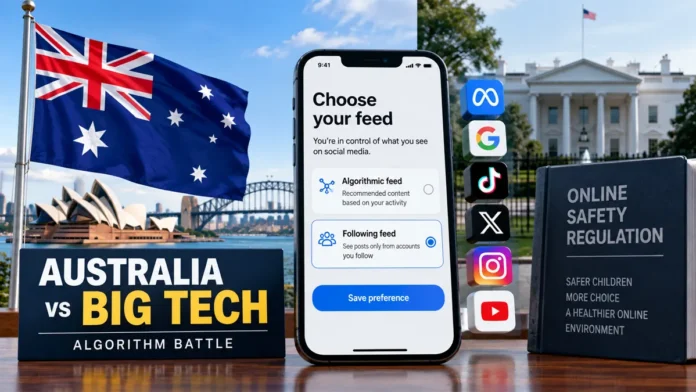
Australia’s Labor government has released draft legislation that would give users aged 16 and older the ability to choose whether social-media platforms use algorithms to determine their main content feeds.
Under the proposed “My Feed, My Way” approach, users could switch away from algorithmically recommended content and instead see posts from accounts, friends and creators they have chosen to follow.
The proposal forms part of a broader Digital Duty of Care framework aimed at making online platforms responsible for reducing foreseeable harm.
Companies that fail to comply with the proposed requirements could face penalties of up to A$109.2 million, or roughly US$79 million.
White House Raises Concern Over Australian Tech Rules
The proposal quickly attracted attention in Washington.
White House spokesperson Kush Desai said President Donald Trump had already warned US trading partners against measures including digital-services taxes, large fines and other regulatory actions that Washington believes unfairly burden American technology companies.
Desai indicated that the administration would raise such concerns with its trading partners.
The intervention adds a trade and diplomatic dimension to what Australia describes primarily as an online-safety and consumer-choice reform.
Many of the world’s largest social-media and technology companies — including Meta, Google and other major platform operators — are headquartered in the United States.
As a result, tougher foreign regulation of digital platforms has increasingly become an issue in US trade policy.
Australia Says It Will Decide Its Own Digital Rules
Australian Prime Minister Anthony Albanese has rejected suggestions that concerns from Washington should determine Canberra’s domestic technology policy.
Albanese said Australia is a sovereign country and will make policy decisions according to its national interest.
He also emphasized that his relationship with President Trump remains strong.
Communications Minister Anika Wells similarly played down the White House response.
She said she had not received a direct warning from a US representative over the latest proposal and characterized the public response as broader commentary on technology regulation.
Wells insisted Australia has the right to establish rules designed to protect its citizens, particularly children.
What Is Australia’s ‘My Feed, My Way’ Plan?
The most consumer-facing part of the proposed legislation concerns algorithmic feeds.
Many social-media platforms currently use recommendation systems to decide what users see.
These systems analyze behavior including viewing history, likes, interactions and other signals to recommend content designed to keep people engaged.
Under Australia’s proposal, eligible users would have to be offered a clear choice.
They could continue using an algorithmically recommended feed or select a feed based primarily on accounts and creators they deliberately follow.
Users would also be able to change their preference later.
The government argues that this approach gives individuals more control over what appears on their screens rather than allowing platforms to make that decision automatically.
Children’s Online Safety Is Central to the Proposal
The algorithm option is only one part of the broader Digital Duty of Care plan.
The draft would require online platforms to take proactive steps to reduce foreseeable harms.
For children, regulators are particularly concerned about recommendation systems that may amplify material involving eating disorders, misogyny, dangerous behavior, abuse, cyberbullying and other harmful content.
Platforms would also face obligations involving illegal material.
Australia’s eSafety Commissioner has previously warned that recommendation systems can amplify harmful content because platforms often optimize feeds for engagement without adequately distinguishing between positive and harmful interactions.
The government wants responsibility to shift increasingly toward technology companies rather than leaving parents and users to manage every online risk themselves.
Australia Already Restricts Social Media for Under-16s
The proposal comes after Australia introduced one of the world’s most closely watched social-media age restrictions.
Since December 10, 2025, designated social-media platforms have been required to take reasonable steps to prevent Australians younger than 16 from holding accounts.
Platforms covered by the rules include major services such as Facebook, Instagram, TikTok, Snapchat, X and YouTube.
The latest Digital Duty of Care proposal therefore focuses partly on what happens once users are old enough to access those services.
For Australians aged 16 and older, the government now wants greater control over how platforms construct their feeds.
Maximum Fine Could Reach A$109.2 Million
The financial penalties proposed under the framework are substantial.
Companies could face a maximum penalty of A$109.2 million for serious failures to meet the new obligations.
That figure makes enforcement one of the most politically sensitive parts of the proposal.
The Trump administration has repeatedly criticized foreign governments when it believes taxes, penalties or digital regulations disproportionately affect American companies.
Australia, however, argues that the legislation is based on user safety rather than the nationality of technology companies.
That disagreement could become the central issue if the draft eventually becomes law.
Could the Dispute Affect US-Australia Relations?
For now, Australian officials are publicly rejecting suggestions of a wider diplomatic rupture.
Albanese has said his relationship with President Trump remains positive and that he expects to meet the US president in New York around the upcoming United Nations General Assembly.
Nevertheless, digital regulation is emerging as another potential point of friction between Washington and Canberra.
The two countries have deep defense, intelligence and trade relationships, but the technology sector is increasingly becoming part of international trade disputes.
If Australia adopts tougher penalties and mandatory algorithm-choice requirements, US technology companies could push Washington for stronger intervention.
Big Tech Faces a Bigger Global Regulatory Challenge
Australia is not acting in isolation.
Governments around the world are increasingly examining how algorithms shape what people see online.
Concerns include addictive product design, harmful recommendations, children’s exposure to inappropriate material, privacy and the enormous influence of automated recommendation systems over public information.
Australia’s proposal takes a particularly direct approach by asking platforms to give users a visible choice between an algorithmic feed and a following-based feed.
That could have implications beyond Australia if similar policies gain political support elsewhere.
For technology companies, such rules could also affect engagement and advertising models that rely heavily on personalized recommendations.
What Happens Next?
The proposal is currently at the draft stage.
That means the details can still change before legislation passes Parliament.
The government will face scrutiny from technology companies, opposition parties, online-safety advocates and civil-liberties groups as lawmakers debate how much power regulators should have.
The United States may also continue raising concerns if Washington believes the final rules discriminate against US companies.
For Albanese’s government, however, the message is clear: Australians should have more control over the algorithms shaping their online lives.
The result could turn the Australia Social Media Algorithm Plan into not only a major domestic technology reform but also the next test of how far US allies are willing to go in regulating American Big Tech.